
There is a strange comfort in the idea that China “suddenly” appeared. One day, the story goes, it was a poor peasant nation of bicycles and grey Mao suits; the next, it was the factory floor of the planet and a serious claimant to superpower status. It makes for a dramatic before-and-after. It is also, like most convenient stories, almost entirely wrong.
What we call China did not burst into the world in the late twentieth century. It is one of the oldest continuous civilizations on Earth, and the instincts that drive it today — the obsession with order, the hunger for unity, the conviction that the state is the engine of progress, the deep mistrust of chaos — were forged not in our lifetime but in the mud of a particular river several thousand years ago. If you want to understand why China moves the way it does now, you have to start a very long way back.
This series will trace that long arc: from farming villages on a floodplain to the present-day contest for global leadership, through dynasties and revolutions, famine and boom, silk and semiconductors. We begin at the beginning — with the land itself.
The Yellow River Problem
Geography is destiny before it is anything else. China’s heartland formed along the middle and lower reaches of the Yellow River, in the broad central plains of what is now Henan province. The river carries a fine, wind-blown silt called loess, so fertile and so abundant that early farmers could coax enormous grain surpluses from it. That surplus is the real origin story. Extra food means extra hands; extra hands mean cities, armies, artisans, priests, and, eventually, kings.
But the Yellow River is a generous and murderous parent. It floods often and unpredictably, reshaping its course across the plain and drowning the very people it feeds. No single village could tame it. Controlling the river demanded coordinated labour across wide distances — dikes, canals, granaries, warnings passed downstream. In other words, it demanded organization on a scale that only a central authority could provide.
Historians have long noted this feedback loop: in China, the need to manage water helped birth the state, and the state, once born, justified itself partly through water management. You can already feel, even at this prehistoric remove, the outline of a civilization that treats a strong central government not as a necessary evil but as the precondition of survival itself.
By around 5000 BCE, farming villages dotted the Yellow River basin. We know them by their pottery: the Yangshao culture (around 5000–3000 BCE) with its painted vessels, and the Longshan culture (around 2600–2000 BCE) with its sleek black pottery. These were not yet “China,” but they were the soil out of which China would grow.
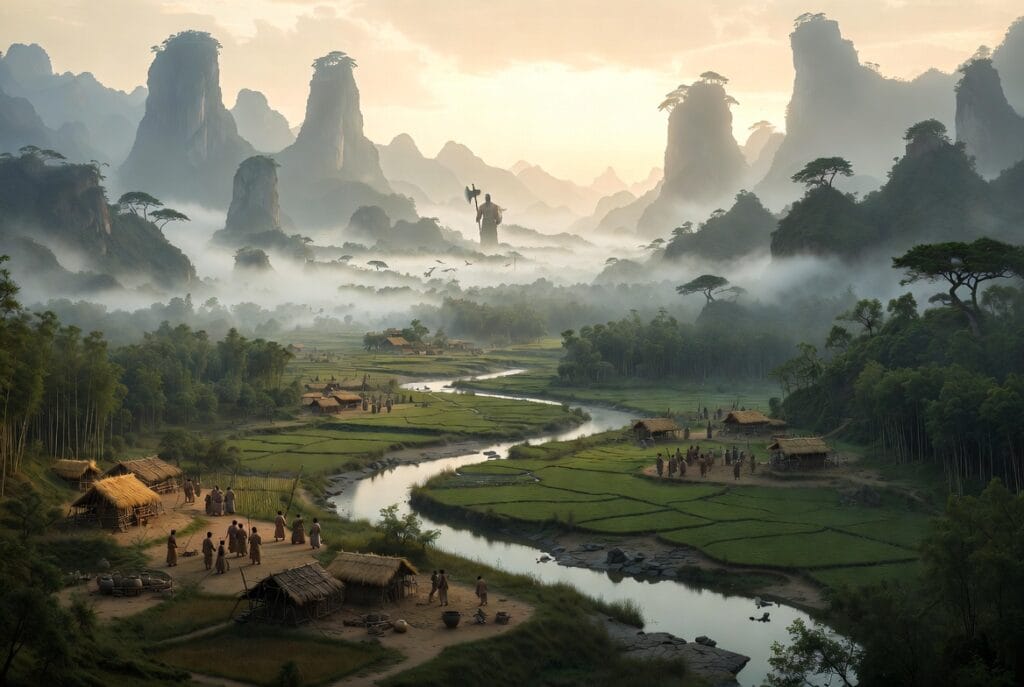
Yu the Great, and the Myth That Made a Dynasty
Every civilization needs a founding myth, and China’s is unusually practical. The story goes that a man named Yu laboured for thirteen years to control the floods of the Yellow River, dredging channels and guiding the waters to the sea. He was said to be so devoted that he passed his own home three times without stopping to enter. For his efforts, he was chosen to rule, and he passed power to his son — inventing, in one stroke, both the hereditary dynasty and the idea that a leader earns authority through service to the people’s survival.
Yu is credited with founding the Xia Dynasty, traditionally dated to around 2070–1600 BCE. For a long time, the Xia was treated as half-myth, a convenient legend cooked up by later historians to give the past a tidy origin. That changed with excavations at Erlitou in Henan, which uncovered palace foundations, elite burials, and early bronze ritual vessels matching the timeline and sophistication the old texts described. Many scholars now associate Erlitou with the late Xia or a pre-Shang horizon — though, with no inscription naming the dynasty, the debate continues.
Whether or not we call the first dynasty “Xia,” the underlying point holds: by the second millennium BCE, along the Yellow River, scattered Stone Age villages had consolidated into something recognisably state-like, with hierarchy, specialised craft, and inherited rule.
Shang: Where China Becomes Itself
The first dynasty to leave behind indisputable written records is the Shang, which ruled from roughly 1600 to 1046 BCE. And here, quite suddenly, China snaps into focus.
The Shang gave us writing — not yet the fluid calligraphy of later ages, but incisions carved into turtle shells and ox shoulder blades, used for divination. A king or priest would pose a question to the ancestors — Will it rain? Will the harvest be good? Will we win the battle? — apply heat until the bone cracked, and read the answer in the fractures. These “oracle bones,” uncovered in great numbers near modern Anyang, contain the earliest known body of Chinese script. They are also a window into a worldview in which the dead were not gone but active, and the living ruled in ongoing conversation with them.
The Shang were master metallurgists. Their bronze casting was among the most advanced in the ancient world — not crude tools but enormous, gorgeously decorated ritual vessels used in ceremonies of ancestor worship. They produced high-quality silk, developed a calendar, and worshipped a supreme deity called Shangdi, “the Lord on High,” who presided over war, weather, and good government.
They also bequeathed something subtler: a model of kingship in which authority flowed from the divine, but only so long as the king upheld order and prosperity. That idea — that power is conditional on performance, that heaven watches and judges — would, within a few centuries, become the most important political concept in Chinese history.
The Mandate of Heaven
Around 1046 BCE, a people called the Zhou, dwelling upstream in the Wei River valley near modern Xi’an, overthrew the last Shang king. Their justification was revolutionary, and it changed everything.
The Zhou claimed the Shang had grown corrupt and tyrannical, and that the supreme deity — which they increasingly called Tian, “Heaven” — had therefore withdrawn its favour and transferred it to the Zhou. This was the Mandate of Heaven (tianming): the doctrine that the right to rule is not fixed by bloodline but granted by Heaven to the virtuous, and withdrawn from the unworthy. A successful rebellion was, by definition, proof that the old dynasty had lost the mandate.
It is hard to overstate how much this idea shaped China. It did two remarkable things at once. First, it gave rulers a powerful legitimacy — they governed with the backing of Heaven itself. Second, it gave the governed a built-in right to revolt — if a ruler was cruel or failed to keep the people fed, he had forfeited the mandate, and overthrowing him was not treason but the restoration of cosmic order. Rebellions ever afterward would be justified in these terms.
The Zhou Dynasty would prove the longest-ruling in Chinese history, enduring some eight centuries, from 1046 to 256 BCE. In its early “Western Zhou” phase, the court held together a loose feudal network of loyal states. But the later centuries were anything but stable. The Eastern Zhou period split into the Spring and Autumn era (roughly 770–476 BCE) — many small states squabbling for primacy — and the Warring States period (roughly 475–221 BCE), when those small states consolidated into a few large, ruthless kingdoms locked in existential struggle.
It sounds like collapse. It was also, paradoxically, the most fertile intellectual moment China has ever known — the era later called the Hundred Schools of Thought.
The Hundred Schools of Thought
Crisis breeds thought. As the Zhou order disintegrated, thinkers across the warring states asked the most urgent possible question: How do we restore order to a broken world? Out of this ferment came what later generations called the Hundred Schools of Thought, a flowering of philosophy that rivaled ancient Greece and India for sheer range and lasting influence.
The most famous voice to emerge was Confucius (around 551–479 BCE), a frustrated minor official who travelled from state to state offering advice no ruler wanted. His answer to chaos was moral: order begins with the cultivation of virtue in individuals — especially rulers — and spreads outward through correct relationships, between parent and child, elder and younger, ruler and subject. He prized ritual, learning, and benevolence (ren), and held that a leader who governs by moral example beats one who governs by force. His teachings, recorded by disciples, would shape Chinese government, education, and family life for the next two and a half millennia.
Alongside him stood the more pragmatic Legalists, who had no patience for moral example. People, they argued, are self-interested; the only reliable tools of order are clear laws, harsh punishments, and a strong state that rewards service and punishes failure. It was Legalism, not Confucianism, that the state of Qin would eventually use to forge an empire — and the tension between Confucian idealism and Legalist hard realism has run through Chinese governance ever since.
And there was Daoism, traditionally traced to the shadowy figure of Laozi (around the sixth century BCE) and the cryptic text known as the Dao De Jing. Where Confucius sought order through effort and structure, Daoism counselled harmony with the natural flow of things, the dao — restraint, simplicity, and the wisdom of not forcing. Its core ideas reach back even further, to peasant beliefs of the Shang age, and it offered a counterweight to the relentless ambition of statecraft.
By the end of the Warring States period, China had not one philosophy but a toolkit: Confucianism for ethics and legitimacy, Legalism for raw state power, Daoism for the human spirit. Later dynasties would draw from all three, sometimes openly, sometimes by stealth. The Chinese state you see today — at once moralistic and ruthlessly practical — was born in these centuries of fragmentation.
Qin: The First Empire
In 221 BCE, the western state of Qin, long the most ruthless and best organised of the contenders, swallowed its last rival and unified the Chinese world for the first time. Its king declared himself Qin Shi Huangdi — “First Emperor of Qin” — and it is from “Qin” (pronounced roughly “chin”) that the word China itself derives.
The First Emperor was a Legalist in full. He standardized weights, measures, currency, and even the width of cart axles so that roads could be shared. He unified the script, so that a single written language could carry orders — and literature — across his vast realm. He began linking older defensive walls into what would become the Great Wall. He burned books he found subversive and buried scholars he found troublesome.
His dynasty collapsed almost immediately after his death in 210 BCE — it lasted only fifteen years — but it had set the template. China, the Qin proved, could be one. The imperial ideal — a unified realm under a single sovereign, run by a centralized bureaucracy — would survive in the Chinese political imagination for the next two thousand years, outlasting dynasties, invasions, and even the monarchy itself.
Han: The Prototype of China
If Qin created the idea of empire, the Han made it work. Founded by a commoner-turned-rebel named Liu Bang in 202 BCE, the Han Dynasty ruled, with one brief interruption, for about four hundred years, until 220 CE. It lasted long enough that the majority ethnic group in China today still calls itself “Han.”
The Han took the harsh Qin machinery of state and softened it, grafting Confucian ethics onto Legalist structure — a fusion later historians would simply call “the imperial system.” They professionalised government through Confucian education, recommendation, and administrative routines, laying the groundwork for the examination bureaucracy later dynasties would perfect. They helped define the core imperial geography later dynasties would inherit and rework, and they opened the trade routes later generations would name the Silk Road, linking China through Central Asia toward the markets and cultures of the West.
The Han gave the world two things that would reshape it. The first was paper. Archaeological evidence places early hemp-based paper in China by the second century BCE, an innovation that would eventually make the spread of knowledge cheaper and faster than humanity had ever known. The second was silk as a long-distance prestige good. The Han did not invent silk — it had been woven for over a thousand years already — but they helped turn it into an international commodity, carried through networks of intermediaries across deserts and mountains toward Roman markets, where it became a luxury so prized that Rome’s senators fretted about the gold draining east to pay for it.
The Han collapsed in 220 CE, ushering in centuries of disunion. But the prototype held. Every dynasty that came after would measure itself against the Han, claim its mandate, and rebuild its structures. The map of China, the idea of a single written culture spanning many spoken tongues, the dream of unity after division — all were Han legacies.
The Roots Beneath the Rise
Stand back, and a pattern emerges. Long before there was a “China” in the modern sense, the civilization had developed a set of habits and convictions that would prove astonishingly durable. The land demanded coordination, and so the state grew strong. Floods demanded control, and rulers earned their place by providing it. Heaven granted a mandate, but only to the competent. Philosophy offered both ethics and raw power. Empire, once imagined, could never quite be uninvented. And invention itself — paper, silk, bronze, script — was woven into the culture from the start.
These are the roots. They explain, even now, why a unified, centralized, technologically ambitious, order-obsessed China feels less like a modern choice than like a historical pattern later Chinese governments have repeatedly returned to. But patterns alone do not build superpowers. For that, China would need its most dazzling era of all — an age when, centuries before Europe’s Industrial Revolution, it ran the most advanced economy on Earth. Continue…..








[…] dynasties, it’s worth pausing at the edge of that first great fracture. When we look back at the origins of ancient China—from the ritual bronzes of the Shang to the hard-forged central authority of the Qin and the […]