This article is based on NASA mission updates and published geological observations from the Curiosity science team.
According to NASA’s Curiosity mission team, the newly exposed bedrock near Cerro Castillo represents an important geological transition zone that may preserve clues about Mars’ environmental evolution.
More Than Just a Pretty Picture
When most people think of Mars, they picture endless red deserts, giant volcanoes, or NASA’s famous rovers exploring an alien world. But Curiosity’s latest images tell a much more intriguing story.
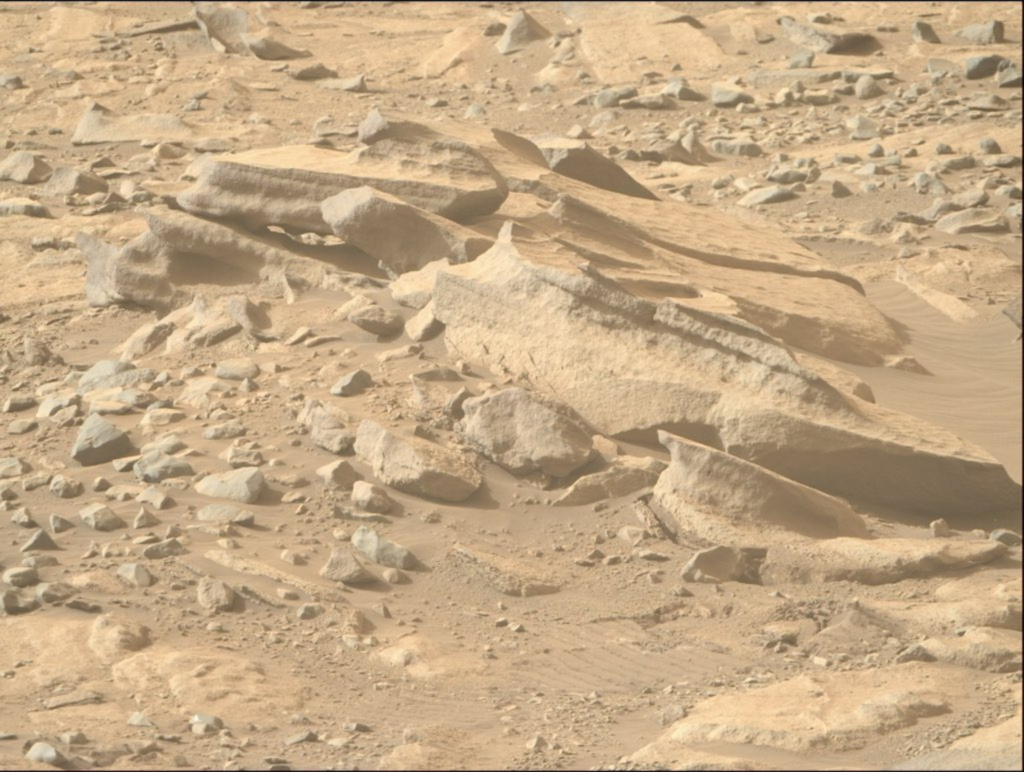
The rover has photographed a remarkable outcrop of Mars Curiosity pinstriped rocks near Cerro Castillo, on the lower slopes of Mount Sharp inside Gale Crater.
At first glance, they appear to be ordinary layered rocks. To planetary geologists, however, they represent something far more important—a preserved record of ancient environmental change. Curiosity has reached a geological transition zone that could help scientists understand how Mars transformed from a planet that once supported lakes into the cold, dry world we see today.
Let’s explore why these unusual layered rocks are generating excitement and what they may reveal about the Red Planet’s hidden past.
Quick Facts
| Fact | Details |
|---|---|
| Rover | Curiosity |
| Location | Cerro Castillo, Gale Crater, Mars |
| Mission Sol | 4942 (July 2026) |
| Camera | Left Navigation Camera (Navcam) |
| Feature | Pinstriped layered bedrock |
| Mission Stage | Ascending Mount Sharp toward the Yardang Unit |
| Image Credit | NASA/JPL-Caltech/MSSS |
Did You Know?
Curiosity landed inside Gale Crater in August 2012. More than thirteen years later, it is still climbing Mount Sharp, exposing progressively younger rock layers and helping scientists reconstruct billions of years of Martian history.
Why Are Scientists Excited About These Pinstriped Rocks?
To most people, the rocks simply look weathered by the Martian wind. Scientists, however, see evidence of a much longer geological story.
The distinctive “pinstriped” appearance is believed to be the result of differential weathering—a process in which rock layers with different mineral compositions erode at different rates.
Some layers are harder and resist erosion, while softer layers gradually wear away under billions of years of wind exposure. As erosion continues, alternating light and dark bands become increasingly visible, producing the striking striped pattern captured by Curiosity.
Visualizing the Layers
Imagine cutting through the trunk of an ancient tree. Every ring records a different chapter in the tree’s life.
Mars’ layered rocks work in a similar way.
Instead of yearly growth rings, each geological layer may represent thousands—or even millions—of years of environmental change. Together, they preserve a timeline of ancient Mars that scientists are only beginning to decode.
Where Did Curiosity Find Them?
The discovery was made near Cerro Castillo, a rocky outcrop along Curiosity’s long ascent of Mount Sharp, the massive mountain rising from the center of Gale Crater.
This location is especially important because it sits within a geological transition zone.
Below Cerro Castillo, Curiosity explored sulfate-rich rocks that likely formed as ancient lakes gradually evaporated. Ahead lies the Yardang Unit, a region heavily sculpted by wind erosion.
Studying rocks between these two environments allows scientists to investigate how Mars evolved from a wetter landscape into the dry desert visible today.
This Discovery Fits Into a Bigger Story
Scientific discoveries rarely exist in isolation. Every new observation becomes more valuable when combined with previous findings.
Curiosity’s recent discoveries illustrate this perfectly.
| Date | Discovery |
|---|---|
| June 2026 | Curiosity identified 21 organic molecules, including seven newly detected carbon-based compounds, in Gale Crater rocks. |
| July 2026 | Curiosity photographed unusual pinstriped layered bedrock near Cerro Castillo. |
We explored the June discovery in detail in our earlier analysis of Curiosity’s organic molecule findings.
Although these discoveries were announced weeks apart, together they help scientists build a more complete picture of ancient Gale Crater. Organic molecules demonstrate that carbon-based chemistry existed in this environment, while the newly exposed layered rocks provide valuable geological context that may explain how those materials were deposited, altered, and preserved over billions of years.
What Do These Layers Tell Us About Ancient Mars?
These rocks are often described as a geological history book written in stone.
By studying their structure and mineral composition, scientists can begin reconstructing Mars’ ancient environment.
- Evidence of Calm Water
Fine, parallel layers are consistent with sediments deposited in relatively calm water, although researchers continue investigating exactly how these formations developed. - Changing Mineral Chemistry
Variations in erosion resistance suggest differences in mineral composition, indicating that environmental conditions changed over time. - A Planet Becoming Drier
As Curiosity approaches the Yardang Unit, scientists believe the surrounding environment became progressively drier, allowing wind erosion to play a much greater role in shaping the landscape visible today.
Importantly, NASA is not claiming these rocks contain evidence of life.
Instead, they strengthen evidence that ancient Mars once possessed conditions considered potentially habitable—including liquid water, favorable chemistry, and environmental stability over extended periods.
Why This Matters
Understanding Mars’ past is also essential for planning its future exploration.
Highly layered rock formations like these preserve geological information in exceptional detail. If future research confirms that certain layers contain particularly valuable mineral or chemical signatures, similar outcrops could become high-priority targets for future robotic exploration.
Rather than searching randomly across the Martian surface, scientists can use discoveries like Cerro Castillo to identify locations most likely to preserve the clearest record of the planet’s ancient history.
Every new layer Curiosity uncovers helps refine that roadmap.
Mars rarely reveals its secrets all at once.
For more than thirteen years, Curiosity has steadily climbed Mount Sharp, uncovering one geological chapter after another. The newly discovered pinstriped rocks at Cerro Castillo may appear to be little more than weathered stone, but they preserve a remarkable archive of environmental change stretching back billions of years.
Discoveries like these also raise broader questions about what kinds of life might have existed elsewhere in the Solar System—or whether life could take forms very different from those on Earth. We explored that possibility in our article, Why We Haven’t Found Exotic Life Forms Beyond Carbon, which examines why scientists continue to focus on carbon-based chemistry while remaining open to more exotic possibilities.
While they do not answer every question about ancient Mars, they provide another crucial piece of a much larger puzzle—one that scientists continue assembling with every meter the rover travels.
Frequently Asked Questions
They are layered bedrock formations displaying alternating light and dark bands created through differential weathering, where softer layers erode more quickly than harder ones.
Curiosity photographed them near Cerro Castillo on the lower slopes of Mount Sharp inside Gale Crater.
Each layer records environmental conditions from a different period, allowing scientists to reconstruct Mars’ geological and climatic history.
The finely layered structure is consistent with sediments deposited in relatively calm water, although scientists continue studying the precise processes responsible for their formation.
No. They do not provide evidence of life. Instead, they indicate that ancient Mars once possessed environmental conditions that may have been capable of supporting microbial life.