
We often gaze at the stars and ask: “Where is everybody?” You feel silent right? But what if the universe isn’t silent at all? The reason we haven’t found exotic life forms beyond carbon is not because they don’t exist—it is because our search is restricted by an anthropocentric bias.
If you are hearing this word “anthropocentric bias” first time, it will definitely puzzle you, let me explain it in a simple way.
Suppose we are searching for an alien, definitely, our mind will naturally mirror itself and will try to find the same pattern in others like breathing, physical bodies and try to send radio signals, which we are doing continuously, which ultimately leads us to seek a reflection of ourselves rather than the true diversity of life.
The Carbon-Centric Trap
When astrobiologists search for life on distant exoplanets like Mars, they try to follow an “Earth-checklist”: oxygen, water, and carbon-based biology.
However, this anthropocentric bias severely limits our scope. If we only search for life that mirrors our own, we are missing an entire spectrum of existence that might operate on entirely different physical laws which are still unknown to us.
I believe our tiny mind is not yet well prepared to solve this complexity of alien existence in exoplanets.
The Plasma-Information Hypothesis
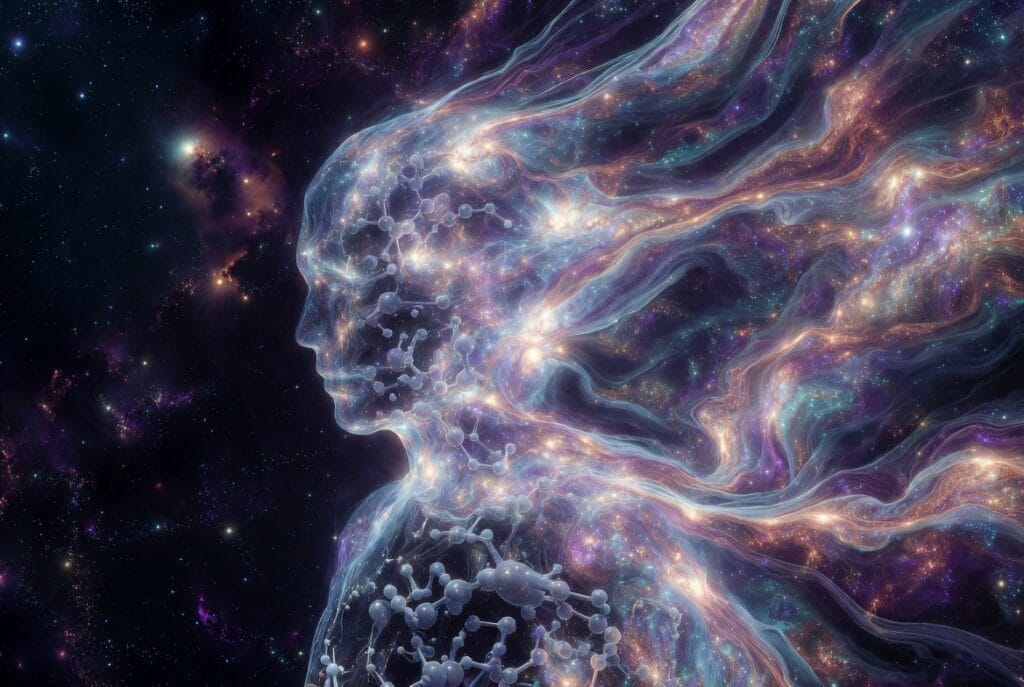
Modern science is beginning to look past biological cells. Interestingly, researchers are now exploring the potential for plasma-based life. Unlike us, these entities would not require DNA or a physical body; instead, they could exist as complex, self-organizing energy patterns within the high-energy environments of stars or gas clouds.
In this framework, life is defined as information-based life—a complex pattern of energy rather than a biological organism. Let me explain it in a very simple way which might sound weird for you, for instance, suppose I say an alien could be a form of energy that can live at a very high temperature like a molten state, and this could be very possible.
The Ancient Bridge: Science Meets ‘Atma’
The reason this plasma-based consciousness hypothesis (this is just a speculation, which few researchers are proposing, imagine a computer that is not made of solid matter, but of electromagnetic waves and ionized gas) is so compelling lies in the intersection of science and ancient wisdom.
In the Hindu Puranas, the concept of ‘Atma’ (consciousness) is described as a non-physical entity, independent of the physical body.
If we define ‘Atma’ as non-physical information that transcends a physical container. Maybe this thought of mine simply drifted with my emotions, and instead of staying with actual fact, slipped into a philosophical mode.
Perhaps we aren’t just searching for biological organisms; we might be looking for a higher state of consciousness that manifests as energy.
Redefining the Search for Exotic Life Forms
To truly discover life, we must move beyond traditional biosignatures. Our instruments must be upgraded to detect information entropy and strange energy patterns, which I believe isn’t possible with today’s technology.
We need to shift our focus from “habitability” to “complexity.” We may finally understand why the universe seems so quiet. That doesn’t mean the universe is empty; it’s that we’re unaware or deaf to a language of energy we haven’t yet learned to understand.
For decades, the search for extraterrestrial intelligence (SETI) has focused on radio signals or faint cosmic whispers. If you’re curious, I’ve written a related piece exploring a much bigger possibility — check it out here
If we really want to find aliens, then we need to move beyond biosignature logic and consider some other concepts. Some researchers have explored unconventional ideas like plasma-based entities, but our current tools and understanding still have real limitations — which might be exactly why we haven’t found them yet. It is also possible that they are present among us and are silently noticing our every activity.
Honestly, the more I think about it, the deeper and more numb I feel — and perhaps that numbness is where real curiosity begins.










[…] could take forms very different from those on Earth. We explored that possibility in our article, Why We Haven’t Found Exotic Life Forms Beyond Carbon, which examines why scientists continue to focus on carbon-based chemistry while remaining open to […]