
“Some of the biggest decisions in history aren’t made on the battlefield. They’re made around negotiation tables, where the consequences may not become clear for decades.”
In the previous article of our Russia–Ukraine Conflict Decoded series, we explored how the Soviet Union collapsed and how fifteen independent nations emerged from its ruins. Among them was Ukraine—a country that had finally achieved independence but suddenly found itself facing some of the most complex challenges of the post-Soviet era.
Independence brought freedom, but it also brought uncertainty.
How would a newly formed state protect its borders? How would it rebuild its economy? And perhaps the most difficult question of all—what should Ukraine do with the nuclear weapons left behind on its territory?
When the Soviet Union disappeared in 1991, Ukraine unexpectedly inherited the world’s third-largest nuclear arsenal, behind only the United States and Russia.
On paper, it looked like an enormous strategic advantage.
But the reality was far more complicated.
The missiles were on Ukrainian soil, but possessing nuclear weapons and independently controlling a nuclear arsenal were two very different things. Ukraine had to weigh its security concerns against economic realities and growing international pressure to prevent nuclear proliferation.
This chapter explores one of the most debated decisions in modern diplomatic history: why Ukraine agreed to surrender its nuclear arsenal, what it received in return, and why that decision continues to influence global security debates today.
To understand this moment properly, we need to look beyond today’s arguments and return to the uncertain years immediately after the Soviet collapse—when Ukraine was trying to decide what kind of country it wanted to become..
If Nuclear Weapons Make Countries Safer, Why Did Ukraine Give Them Up?
Imagine waking up one morning and discovering that your country has suddenly become one of the world’s biggest nuclear powers.
Not because you spent decades building nuclear weapons.
Not because you won a war.
But because an empire collapsed overnight.
That was Ukraine’s reality in late 1991.
Just weeks earlier, the Soviet Union had ceased to exist. Fifteen independent countries emerged almost overnight, each trying to figure out what independence actually meant. Governments had to be built, economies had to be rebuilt, and millions of people were suddenly living in countries that hadn’t existed a few months earlier.
Ukraine was one of them.
But unlike most newly independent nations, Ukraine inherited something no one had expected.
Thousands of nuclear weapons.
On paper, it looked extraordinary.
The country now had around 1,900 strategic nuclear warheads, long-range ballistic missiles, heavy bombers capable of delivering nuclear strikes and an enormous military infrastructure left behind by the Soviet Union.
Only the United States and Russia possessed larger nuclear arsenals.
At first glance, that sounds like an incredible advantage.
After all, nuclear weapons are often described as the ultimate deterrent. Countries that possess them are generally considered much harder to attack because the potential consequences are catastrophic.
So why would any government voluntarily give them away?
It’s a question that still sparks debate more than thirty years later.
The simple answer is that the situation wasn’t nearly as straightforward as it looked.
And that’s where the real story begins.
The Weapons Were in Ukraine. That Didn’t Mean Ukraine Controlled Them.
One of the biggest misconceptions surrounding this chapter of history is the belief that Ukraine suddenly became a fully operational nuclear superpower the moment it declared independence.
The reality was far more complicated.
Yes, the missiles were stationed on Ukrainian territory.
Yes, the nuclear warheads were physically inside Ukraine.
But ownership on a map and operational control are not the same thing.
The Soviet Union had built its nuclear forces as a single military system. Decisions about launching strategic nuclear weapons were never meant to be made by individual republics. They were coordinated through a centralized command structure in Moscow, using highly secure communication networks, launch authorization procedures and technical systems that remained tied to what had once been the Soviet military.
Think of it like inheriting an advanced aircraft.
You may own it legally.
That doesn’t automatically mean you know how to fly it—or even have the keys.
Ukraine inherited the hardware.
Building an independent command system capable of safely maintaining and operating that arsenal would have required years of technical work, enormous financial resources and complex political decisions.
None of that existed in 1991.
This detail is often missing from online discussions.
People usually ask why Ukraine “gave away” nuclear weapons.
A better question might be:
What exactly did Ukraine inherit in the first place?
The answer lies somewhere between ownership and control.
That distinction would shape every negotiation that followed.
The World Wasn’t Just Watching. It Was Nervous.
The Cold War had finally ended.
For decades, the United States and the Soviet Union had dominated global nuclear politics. Despite the dangers of their rivalry, the world had grown used to the idea that only a handful of countries controlled the largest nuclear arsenals.
The collapse of the Soviet Union suddenly changed that equation.
Ukraine wasn’t the only country with Soviet nuclear weapons on its territory.
Belarus and Kazakhstan had inherited them as well.
For a brief moment in history, the world faced an unexpected possibility.
Instead of one Soviet nuclear superpower becoming one Russian nuclear state, there could be four separate countries possessing parts of the former Soviet arsenal.
That prospect alarmed leaders across the political spectrum.
Washington feared the global effort to prevent nuclear proliferation could begin to unravel.
Moscow argued that the Soviet strategic arsenal had always functioned as a single force and should remain under one successor state.
Despite their many disagreements after the Cold War, the United States and Russia found themselves pursuing the same objective.
Neither wanted new nuclear powers emerging from the ruins of the Soviet Union.
For Ukraine, that created an uncomfortable reality.
The country suddenly possessed one of the world’s largest nuclear arsenals.
At the same time, two of the world’s most influential governments were encouraging it to give those weapons up.
The question was no longer whether negotiations would happen.
The real question was this:
If Ukraine agreed to surrender its nuclear arsenal, what would it receive in return?
Ukraine Had One Question: “What Happens After the Missiles Are Gone?”
Owning nuclear weapons was one problem.
Deciding what to do with them was another.
By early 1992, Ukraine’s leaders found themselves under growing international pressure. Washington wanted the former Soviet republics to become non-nuclear states. Moscow insisted that the Soviet nuclear arsenal had always been one strategic force and should ultimately remain under Russia’s control.
On paper, both countries agreed on the destination.
Ukraine should give up its nuclear weapons.
The difficult part was everything in between.
From Kyiv’s perspective, the question wasn’t simply “Should we keep the missiles?”
It was much more practical.
“If we give them up, who guarantees our future security?”
That wasn’t paranoia.
It was a reasonable question for a country that had existed as an independent state for only a few months.
History has a habit of making difficult decisions look obvious in hindsight. But in 1992, nothing about Ukraine’s future looked certain. The Soviet Union had disappeared, the economy was struggling, political institutions were still taking shape and no one could confidently predict what relations with Russia would look like ten or twenty years later.
Giving away the world’s third-largest nuclear arsenal wasn’t just another policy decision.
It was the biggest national security decision the country had ever faced.
A Deal Was Easy to Announce. Much Harder to Negotiate.
Many summaries jump straight from the collapse of the Soviet Union to the Budapest Memorandum, almost as if the agreement appeared overnight.
It didn’t.
The negotiations lasted for years.
In May 1992, the United States, Russia, Belarus, Kazakhstan and Ukraine signed what became known as the Lisbon Protocol, an agreement connected to the earlier START I nuclear arms reduction treaty.
For diplomats, it solved an immediate legal problem.
The Soviet Union no longer existed, yet START I had been signed with the Soviet Union. The Lisbon Protocol formally recognised Belarus, Kazakhstan and Ukraine as successor states for implementing the treaty and committed them to eventually joining the Treaty on the Non-Proliferation of Nuclear Weapons (NPT) as non-nuclear states.
On the surface, it looked like an important breakthrough.
In reality, the hardest conversations were only beginning.
Ukraine wasn’t refusing to discuss denuclearisation.
It simply wanted answers before making an irreversible decision.
Who would pay for dismantling the missiles?
What would happen to the highly enriched uranium inside the warheads?
Would Ukraine receive compensation?
And perhaps most importantly…
What would replace the security that nuclear weapons seemed to provide?
Those weren’t minor details.
They were the heart of the negotiations.
The Cost of Keeping the Arsenal
People often assume Ukraine could simply have decided to keep every nuclear weapon indefinitely.
In practice, that would have been far more complicated.
Maintaining a strategic nuclear force is one of the most expensive responsibilities any country can undertake.
Missiles require constant maintenance.
Warheads must be securely stored and regularly serviced.
Highly trained personnel, specialised facilities and advanced command systems are essential to keep an arsenal safe and operational.
Ukraine was trying to build a new country while its economy was shrinking rapidly after the Soviet collapse.
Factories were struggling.
Inflation was soaring.
Government finances were under enormous strain.
Simply maintaining day-to-day public services was becoming difficult.
Building an entirely independent nuclear command structure on top of those challenges would have required enormous political and financial resources.
That reality gradually shifted the debate.
The question was no longer whether nuclear weapons had value.
Everyone understood they did.
The real question became whether Ukraine could realistically afford to keep them—and whether there was another way to protect the country’s future.
The Search for Something More Valuable Than Missiles
As negotiations continued through 1993 and 1994, Ukraine’s position became increasingly clear.
If nuclear weapons were to leave Ukrainian territory, they would not leave without something in return.
Kyiv wanted three things.
First, financial compensation for the nuclear material being transferred.
Second, practical assistance with dismantling missiles and related infrastructure.
And third—by far the most important—clear international commitments that Ukraine’s independence, sovereignty and internationally recognised borders would be respected.
That final request would shape one of the most discussed diplomatic agreements of the post-Cold War era.
In December 1994, leaders gathered in Budapest to sign a document that many believed had solved one of Europe’s biggest security challenges.
Few realised that the wording of that agreement would later become almost as important as the agreement itself.
The document was called the Budapest Memorandum.
What the Budapest Memorandum Actually Promised — And Why That Difference Still Matters Today
When people look back at Ukraine’s decision today, they often ask a simple question:
“Didn’t the world promise to protect Ukraine?”
The answer isn’t a straightforward yes or no.
It’s more complicated than that.
And understanding that difference is one of the keys to understanding the Russia-Ukraine conflict itself.
On 5 December 1994, leaders from Ukraine, Russia, the United States and the United Kingdom met in Budapest, Hungary, to sign what became known as the Budapest Memorandum on Security Assurances.
For Ukraine, this wasn’t just another diplomatic ceremony.
It marked the end of a historic chapter.
In return for joining the Treaty on the Non-Proliferation of Nuclear Weapons (NPT) as a non-nuclear state, Ukraine agreed to eliminate the strategic nuclear arsenal it had inherited after the Soviet Union collapsed.
It was one of the largest voluntary nuclear disarmament efforts in modern history.
At the time, many world leaders praised it as a victory for diplomacy.
On paper, everyone seemed to leave the table satisfied.
But diplomacy often depends on language.
And sometimes, a single word can change how history judges an agreement.
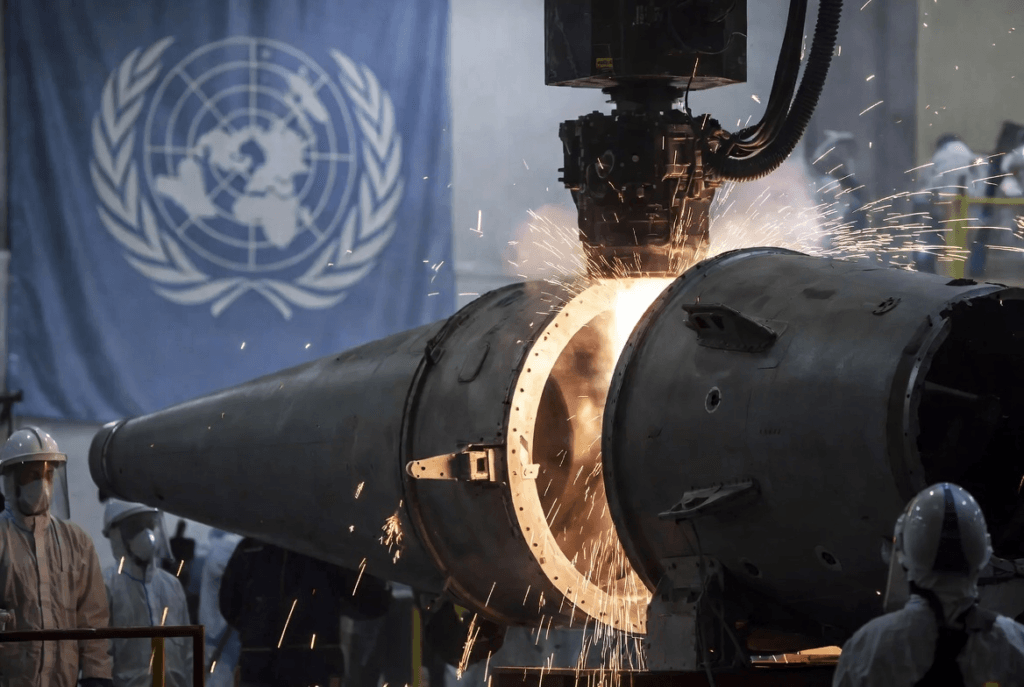
One Word Made All the Difference
If you search online today, you’ll often find people saying that the Budapest Memorandum guaranteed Ukraine’s security.
Technically, that’s not what the document says.
It offered security assurances.
At first glance, those two phrases sound almost identical.
They aren’t.
A security guarantee is usually backed by a legal obligation or treaty requiring countries to respond under certain conditions.
The best-known example is NATO’s Article 5. While each ally decides the nature of its response, an attack on one member is treated as an attack on all, creating a formal collective defence commitment.
The Budapest Memorandum worked differently.
It wasn’t a military alliance.
It wasn’t a mutual defence treaty.
It didn’t require the United States or the United Kingdom to send troops if Ukraine were attacked.
Instead, the signatories reaffirmed several principles they said they would respect.
These included respecting Ukraine’s independence, sovereignty and existing borders, refraining from the threat or use of force against Ukraine, avoiding economic coercion and seeking action through the United Nations Security Council if Ukraine became the victim of aggression involving nuclear weapons.
Those commitments were politically significant.
But they weren’t written in the same legal framework as a collective defence treaty.
That distinction would later become the centre of an international debate.
Did Ukraine Know the Difference?
This question still divides historians, diplomats and legal scholars.
Some argue that Ukrainian leaders understood exactly what they were signing.
Others believe they expected the political commitments made by major nuclear powers to carry much greater practical weight if Ukraine’s security was ever challenged.
Both sides agree on one point.
The memorandum reflected a belief that cooperation—not nuclear deterrence—would define Europe’s future after the Cold War.
In the mid-1990s, that didn’t seem unrealistic.
The Cold War had ended.
Russia was working with Western governments on many international issues.
Nuclear arms reduction was widely viewed as one of diplomacy’s greatest successes.
Many policymakers genuinely believed Europe was entering a more stable era.
Looking back today, it’s easy to judge those decisions with the benefit of hindsight.
The leaders negotiating in 1994 didn’t have that advantage.
They were making choices based on the world as they understood it then—not the world that would emerge decades later.
A Decision the World Still Debates
By 1996, all strategic nuclear warheads had been removed from Ukraine.
The country had completed the process of becoming a non-nuclear state.
For years, the Budapest Memorandum attracted relatively little public attention.
It existed mainly as a diplomatic document known to policymakers and specialists.
That changed dramatically in the twenty-first century.
As tensions between Russia and Ukraine grew, the memorandum returned to the centre of international debate.
Some argued that Ukraine had surrendered its most powerful deterrent in exchange for political commitments that ultimately proved insufficient.
Others responded that the memorandum had never been designed as a military defence treaty and should not be interpreted as one.
The debate continues today.
What almost everyone agrees on, however, is that the Budapest Memorandum became far more important after it was signed than it appeared on the day the ink dried.
Sometimes history works that way.
An agreement that seems routine at the time can become one of the most closely examined documents decades later.
The End of One Question. The Beginning of Another.
By giving up its nuclear arsenal, Ukraine answered one of the biggest security questions facing Europe after the Cold War.
The immediate fear of several new nuclear states emerging from the Soviet collapse had faded.
But another issue was already beginning to reshape the continent.
Across Central and Eastern Europe, countries that had spent decades under Soviet influence were looking west.
Many wanted to join an alliance they believed could provide long-term stability and security.
That alliance was NATO.
For those countries, NATO represented protection.
For Russia, it increasingly represented something very different.
And that disagreement would become one of the defining geopolitical arguments of the next three decades.









After seeing what happened to Ukraine after denuclearizing, what incentive do nuclear-threshold states like Iran have to completely dismantle their enrichment programs in exchange for Western diplomatic promises?
[…] we explored why Ukraine chose to give up the world’s third-largest nuclear arsenal under the Budapest Memorandum. While that decision reflected hopes for a more peaceful Europe, another historic development was […]