
Wrapping Up the First Chapter
Before we step into the bustling markets of the Tang and Song dynasties, it’s worth pausing at the edge of that first great fracture. When we look back at the origins of ancient China—from the ritual bronzes of the Shang to the hard-forged central authority of the Qin and the expansive peace of the Han—we see a civilisation learning how to hold itself together. The early foundations were built on soil, blood, and bureaucracy, establishing the core idea that a continent-sized realm should be governed as a single moral and political universe.
Yet, as the Han dynasty dissolved in 220 CE, that grand experiment broke apart. The centuries that followed proved that unity is never permanent; it has to be constantly re-engineered. And that brings us directly to the threshold of the medieval golden age—to the dynasty that picked up the pieces, dug the canals, and inadvertently set the stage for the most sophisticated economy the world had ever seen.
Rebuilding the Realm: The Tang and Song Dynasties
The centuries after the Han collapsed in 220 CE were not kind to unity. For roughly three and a half hundred years, China fractured into rival kingdoms, northern dynasties, and southern courts — a long, bruising intermission that later historians would label, with characteristic understatement, the Period of Disunion. Outsiders rode in from the steppe and set up their own regimes. The imperial idea survived, but only as a memory and an ambition.
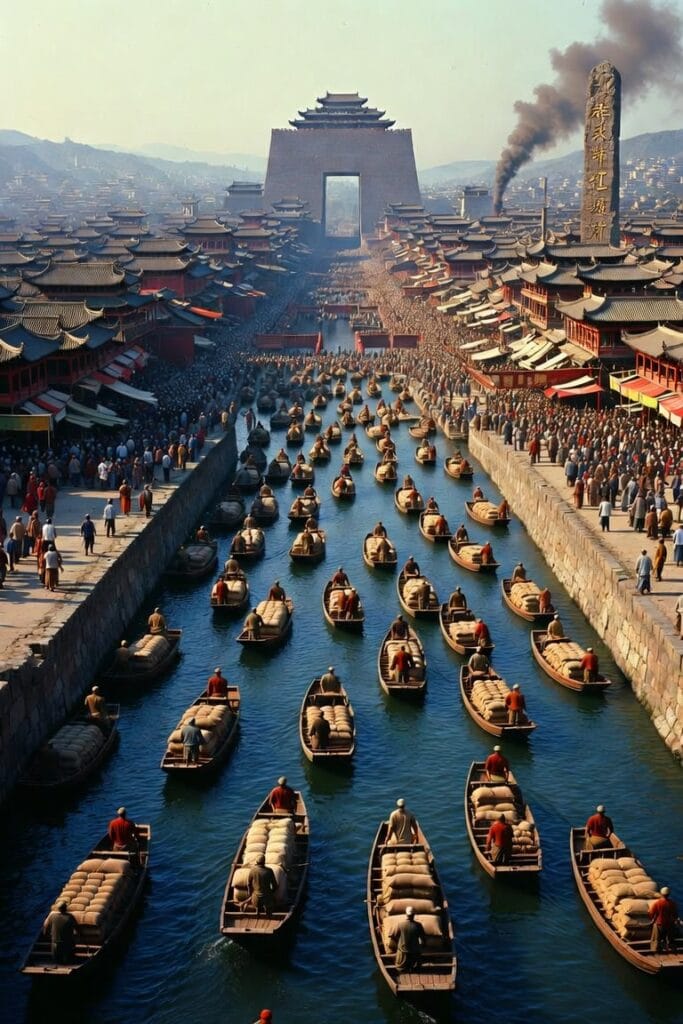
What brought China back was not conquest from the center but a short, sharp dynasty that did the unglamorous work of reconnecting the country. The Sui (581–618 CE) reunified the realm, and in doing so they built something that would matter more than any battle: the Grand Canal, a vast artificial waterway linking the agricultural south — the rice bowl around the Yangtze — to the political north. It was an act of state vision on a staggering scale, completed at enormous human cost. But it stitched the economy of China together in a way no road network ever had. When the Sui collapsed from overreach, they handed their successors a reunited, canal-connected empire. It was the perfect foundation for a golden age.
The Tang: China Opens to the World
The dynasty that followed, the Tang (618–907 CE), is the era Chinese people still look back on as a high point of culture and confidence. Its capital, Chang’an (modern Xi’an), was the largest city in the world — a sprawling metropolis of perhaps a million people, laid out in a grid, its walls enclosing a cosmopolitan babel of Persian, Arab, Sogdian, Turkic, and Korean traders, monks, and diplomats. This was China at its most outward-facing: curious, absorptive, secure enough in itself to borrow from everywhere.
The Silk Road, reopened and protected by Tang garrisons, reached its medieval peak. Camel caravans brought western horses, glass, grapes, and new fashions into China, and carried silk, porcelain, and paper out toward Central Asia, the Middle East, and eventually Europe. Buddhism, entering China centuries earlier, flowered under the Tang — pilgrims like Xuanzang trekked to India and back for scriptures, and monasteries became major landholders and intellectual centers. Poetry, painting, and music all surged. The names still taught to every Chinese schoolchild — Li Bai, Du Fu — wrote in the Tang.
Beneath the glamour, the Tang also refined the machinery of state. The examination system, which tested candidates on the Confucian classics and literary skill, matured into a real route to office — not yet the dominant path it would become, but a growing mechanism for recruiting a literate, non-hereditary bureaucracy. The dream was that talent, not birth, should govern. Like much of the Tang, it was an aspiration imperfectly realized but powerfully influential.
The Tang eventually rotted from within — provincial military governors grew too powerful, a catastrophic rebellion in 755 shattered the court’s authority, and the dynasty limped to its end in 907. But it left a template of cosmopolitan, exam-governed, Silk-Road-connected empire that every later dynasty would measure itself against.
The Song: The Economy That Should Have Changed the World
And then came the Song (960–1279 CE) — and here is where the story of China takes a turn that still fascinates historians. Because what happened under the Song was, by any reasonable definition, an economic revolution, and it happened roughly seven centuries before anything comparable in Europe.
The Song never controlled as much territory as the Tang. After 1127, having lost the north to invaders, they retreated south of the Yangtze and ruled from Hangzhou as the “Southern Song.” Militarily, they were the weaklings of imperial history, buying off nomadic enemies with tribute rather than defeating them. But economically and technologically, they were the most advanced society on Earth.
Agriculture transformed. Early-ripening rice varieties imported from Southeast Asia, especially Champa rice, allowed double and even triple cropping — two or three harvests a year where there had been one. The south became an agricultural engine of staggering productivity, and the Grand Canal carried that grain north to feed cities and armies. Farmers shifted toward cash crops — sugar, tea, oranges, cotton, silk — grown for the market rather than mere subsistence. A genuine commercial economy took root, with specialized regions producing for distant buyers.
Cities exploded. Kaifeng, the Northern Song capital, held around a million people and ran on coal and iron from nearby mines — an industrial hum that Europe would not match for centuries. Hangzhou, the southern capital, was described by visitors as the greatest city they had ever seen, its markets so dense you could walk for miles under shop awnings. Urban life loosened old restraints: curfews that had locked Tang cities at night were dropped, and a lively, restless commercial culture emerged, with restaurants, theaters, tea houses, and a publishing industry churning out books for a literate public.
The Four Great Inventions (and a Few More)
The Song gave the world the cluster of breakthroughs often called China’s Four Great Inventions, several of which matured precisely in this era.
Printing evolved significantly when woodblock publishing expanded into a true mass industry, producing books, classics, calendars, medical texts, and government notices in quantities unimaginable in a manuscript-copying world. Around the 1040s, a craftsman named Bi Sheng pushed the concept further by inventing movable type, arranging baked clay characters on an iron plate. The idea was ahead of its materials, as the thousands of characters in the Chinese language made movable type less efficient than it later proved for alphabetic languages, but the conceptual breakthrough was securely in place four centuries before Gutenberg.
Song Dynasty: Paper currency was invented
Paper money emerged to solve a thoroughly modern problem. As trade outstripped the supply of bronze coin, merchants in Sichuan began issuing promissory notes. By the early eleventh century, the Song government took the extraordinary step of issuing official paper currency, establishing the earliest state-backed paper money in world history to service an economy too large and fast-moving for heavy metal to handle.
The compass also transformed navigation. Described in Song texts, the magnetic compass made long-distance sea trade across the South China Sea and Indian Ocean far safer and more reliable. Chinese junks—large, multi-masted, watertight-compartmented ships—became the dominant carriers of Asian maritime trade.
Gunpowder, known earlier as an alchemical curiosity, was developed under the Song into real weaponry, including bombs, flamethrowers, and early rockets. This foreshadowed a military revolution that would, ironically, be turned back on China by the very European powers it later armed.
Add to these breakthroughs porcelain of an unprecedented quality, advances in metallurgy fueled by coal, mechanical clocks, astronomical instruments, and a flood of printed encyclopedias and treatises, and you have a society that, by the year 1100, was running the most sophisticated economy and the most advanced technology on the planet. By some estimates, Song China produced a quarter or more of total world economic output. Whatever the exact figure, the relative gap between China and the rest of Eurasia was, in this era, enormous.
The Paradox of Power Without Power
Here is the haunting question the Song poses. If China was so advanced — its economy so rich, its technology so far ahead — why did the Industrial Revolution not happen there? Why did the Song not become the Britain of the eleventh century, and why, instead, did the dynasty fall to Mongol horsemen in 1279?
Historians have argued about this for generations. Some point to the sheer scale of China’s internal market: with so many people and so much demand at home, there was less pressure to seek overseas expansion or radical labor-saving innovation than in resource-scarce, competitive Europe. Others note that the Song state, though economically dynamic, was politically cautious — wealth was taxed and channeled, but the empire itself was militarily weak, spending its surplus on tribute and defense rather than conquest. Still others argue that the very strengths of Chinese bureaucracy — its stability, its meritocratic continuity — could become a conservative force, smoothing disruptive innovation into administrative routine rather than letting it overturn the social order.
Whatever the cause, the result was a civilization that came breathtakingly close to an industrial breakthrough and then, for a constellation of reasons, did not cross that threshold. The energy dissipated. The Mongols rode in. And the torch of sustained industrial transformation, centuries later, would be seized by a small island in northwest Europe instead.
What the Golden Age Left Behind
The Tang and Song mattered far beyond their own lifetimes. They established what a fully realized Chinese civilization could look like at its peak: cosmopolitan and self-confident, commercially vibrant and technologically inventive, governed by a literate meritocracy, integrated by canals and coastal shipping into a single vast market. They showed that the state could be the patron and organizer of economic life on a grand scale — an idea that, dormant for long stretches, would echo all the way down to the developmental state of the twentieth and twenty-first centuries.
They also left a quiet warning. Brilliance is not the same as dominance. A society can be the richest and cleverest in the world and still be conquered, if it does not convert its wealth into security. The Song’s wealth dazzled. It did not save them.








[…] the China Rise series explored how the Tang and Song dynasties transformed China into the world’s most advanced economic and technological powerhouse. For […]