
Last Updated: July 24, 2026
Political movements rarely emerge overnight. Most spend years building local networks, recruiting volunteers, raising funds, and gradually earning public attention. The Cockroach Janta Party (CJP) followed a completely different path.
It did not begin inside a political office, a university campus, or an election campaign. Instead, it was born in the middle of a national online debate that unfolded within hours.
In May 2026, a controversial remark made during proceedings in India’s Supreme Court spread rapidly across television broadcasts, news websites, and social media. As millions reacted to different interpretations of the comment, memes, satire, and political criticism flooded the internet. What initially looked like another short-lived online controversy soon transformed into something much larger.
Within days, a previously unknown initiative calling itself the CJP appeared online. Its unusual name immediately attracted curiosity, but its rapid growth reflected something deeper than internet humour. Thousands of young people frustrated by unemployment, competitive examinations, and what they viewed as a lack of institutional accountability began engaging with the movement. Before long, online discussions evolved into organised protests, legal disputes, and nationwide political debate.
The movement’s rise has also highlighted a broader transformation in modern politics. Unlike traditional political organizations that rely on years of grassroots expansion, digital-era movements can now gain national attention within days through social media alone. CJP has become one of the clearest examples of how internet culture, political satire, and public dissatisfaction can intersect to create a movement that quickly reaches beyond the digital world.
At the same time, the story remains deeply contested. Supporters describe CJP as a legitimate youth movement demanding accountability and transparency. Critics dismiss it as an internet-driven protest lacking long-term political direction. Government authorities have defended actions taken against some of the movement’s online platforms as necessary to maintain public order, while civil liberties advocates have questioned whether those actions raised concerns about freedom of expression.
As these debates continue, one thing is beyond dispute: within just a few months, CJP has become one of the most closely watched political stories in India.
This article explains how that happened—from the controversy that triggered the movement and the people behind it to its demands, legal challenges, and the questions that may determine its future.
Quick Facts
| Topic | Details |
|---|---|
| Full Name | Cockroach Janta Party (CJP) |
| Founded | 16 May 2026 |
| Founder | Abhijeet Dipke |
| Nature | Youth-led satirical movement and pressure group |
| Registered Political Party? | No. As of July 24, 2026, CJP is not registered with the Election Commission of India (ECI). |
| Primary Focus | Examination accountability, youth issues, institutional transparency |
| Major Platform | Social media and public demonstrations |
| Current Status | Active (Developing Story) |
Table of Contents
- What Is the Cockroach Janta Party?
- How Did CJP Begin?
- Who Is Abhijeet Dipke?
- How Did the Movement Go Viral?
- Timeline of Major Events
- What Does CJP Stand For?
- Government Response
- Legal Challenges
- Major Controversies
- Where Does CJP Stand Today?
- Frequently Asked Questions
- Editorial Methodology
- Sources
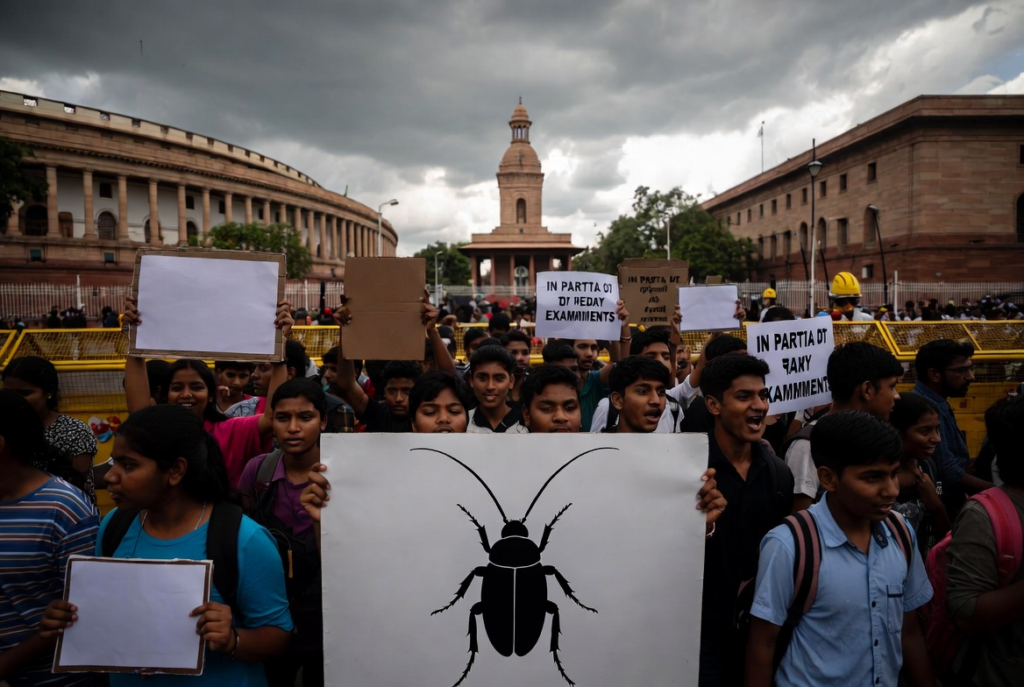
What Is the Cockroach Janta Party (CJP)?
Despite its name, the Cockroach Janta Party (CJP) is not a registered political party. This distinction is important because many people encountering the movement for the first time assume that it functions like established political organizations that contest elections under the supervision of the Election Commission of India.
Instead, CJP describes itself as a citizen-led movement that uses political satire, digital activism, and public demonstrations to campaign on issues affecting young Indians. While the movement emerged from a specific controversy, its messaging gradually expanded to include broader concerns such as examination transparency, unemployment, institutional accountability, and democratic participation.
The choice of the word “Cockroach” was intentionally provocative. Rather than avoiding the label after it became controversial, the movement adopted it as its identity, turning an expression that many considered insulting into a political symbol. Throughout history, protest movements in different countries have occasionally reclaimed labels used against them as a form of resistance. CJP’s founders argue that this was precisely their intention.
Unlike conventional political parties, CJP has no publicly declared electoral structure, no announced candidates, and no official recognition from the Election Commission. Its activities have instead focused on online campaigns, public meetings, peaceful demonstrations, and advocacy around issues it believes deserve greater public attention.
This distinction matters because much of the public discussion surrounding CJP often blurs the line between a protest movement and a political party. At present, available public records indicate that it remains the former rather than the latter.
How Did the Cockroach Janta Party Begin?
The origins of CJP can be traced back to events that unfolded over just a few days in May 2026.
On 15 May 2026, the Supreme Court of India was hearing a case related to allegations involving fake academic degrees. During the proceedings, remarks made by Chief Justice Surya Kant quickly became the focus of public attention after portions of the exchange began circulating online.
Many social media posts and some early reports interpreted the remarks as referring broadly to unemployed young people by comparing them to “cockroaches” or “parasites.” The comments spread rapidly across digital platforms, triggering widespread criticism and emotional reactions from many users who believed unemployed youth had been unfairly targeted.
As the controversy intensified, the Chief Justice later clarified that his remarks had been taken out of context. According to that clarification, the comments were directed at individuals accused of using fraudulent academic qualifications to enter professional fields such as law and journalism—not at unemployed citizens in general.
By the time that clarification reached the wider public, however, the debate had already taken on a life of its own.
The following day, 16 May 2026, communications professional Abhijeet Dipke launched the Cockroach Janta Party through a dedicated website and social media accounts. The movement introduced itself with the slogan “Voice of the Lazy & Unemployed,” deliberately embracing the controversial language that had dominated public discussion only hours earlier.
The timing was significant. Public frustration over employment opportunities, competitive examinations, and educational reforms had already been growing for months. As a result, many observers viewed the viral controversy not as the sole cause of the movement but as the spark that ignited existing dissatisfaction among sections of India’s youth.
Within days, CJP had moved beyond internet satire. Online registrations increased rapidly, its social media accounts attracted extraordinary attention, and mainstream media began covering what had started as a seemingly spontaneous digital campaign.
The movement’s transformation from an online reaction into a nationwide political story demonstrated how quickly public discourse can evolve in the digital era. What once might have remained a brief social media trend instead became a sustained conversation about governance, accountability, protest, and the role of young people in shaping political debate.
Why This Story Matters
At first glance, the Cockroach Janta Party may appear to be just another internet phenomenon. Yet its rise reflects several larger trends shaping contemporary India: the growing influence of social media on political communication, increasing youth engagement with public issues, the speed at which online narratives can influence real-world events, and the challenges governments face in responding to decentralized digital movements.
Whether CJP ultimately develops into a lasting organization or gradually fades from public attention, its emergence has already become an important case study in how political activism is changing in the digital age.
Who Is Abhijeet Dipke?
Every political movement has a recognizable face. For the Cockroach Janta Party, that person is Abhijeet Dipke.
Until May 2026, Dipke was largely unknown outside political and communications circles. Within weeks of launching CJP, however, he found himself at the center of one of India’s fastest-growing political controversies. His interviews began appearing across national media, his social media accounts attracted hundreds of thousands of followers, and his name became closely associated with a movement that had rapidly outgrown its satirical beginnings.
Unlike many established political leaders, Dipke did not enter public life through elections or traditional party structures. His background is rooted in communications and digital campaigning, experience that would later shape the movement’s online-first strategy.
Education and Professional Background
Abhijeet Dipke is from Chhatrapati Sambhajinagar (formerly Aurangabad) in Maharashtra.
According to publicly available information, he earned a Master’s degree in Public Relations from Boston University, a background that helps explain the movement’s carefully crafted messaging and its effective use of digital communication during its early days.
Before founding CJP, Dipke was associated with the Aam Aadmi Party (AAP) as a social media volunteer between 2020 and 2023. Although he was never a prominent public face of the party, the experience exposed him to political communication, online campaigning, and volunteer-based digital mobilization.
These experiences proved valuable when he launched CJP. Rather than building a traditional organization with local offices and district committees, the movement relied heavily on social media, volunteer participation, and rapid digital outreach.
The Decision That Changed Everything
On 16 May 2026, less than twenty-four hours after the Supreme Court controversy dominated public discussion, Dipke launched the Cockroach Janta Party.
The choice of name was deliberate.
Instead of rejecting the “cockroach” label that had become the focus of public outrage, Dipke embraced it. In doing so, he attempted to transform what many perceived as an insult into a symbol of protest.
The movement’s opening slogan—
“Voice of the Lazy & Unemployed.”
—was equally provocative.
Supporters interpreted it as political satire aimed at highlighting the frustrations of unemployed youth. Critics argued that the slogan oversimplified complex economic issues and relied too heavily on internet culture. Regardless of opinion, the branding achieved its immediate objective: it captured public attention.
In the crowded world of online political campaigns, visibility is often the first challenge. CJP solved that problem almost instantly.
Becoming the Public Face of the Movement
As media interest grew, Dipke naturally became the movement’s principal spokesperson.
Within CJP, he describes his role as the National Convener, presenting himself not as a conventional party president but as a coordinator of a broader citizen-led campaign.
In interviews, his messaging has consistently emphasized themes such as educational accountability, examination reforms, transparency in public institutions, and youth participation in democratic processes.
At the same time, his prominence also made him the primary target of criticism.
Political opponents questioned the movement’s long-term objectives, while supporters viewed attacks against him as attempts to discredit a growing protest campaign. As with many rapidly expanding online movements, the public discussion increasingly shifted from the organization’s demands to its leadership.
Personal Attacks and Security Concerns
As CJP’s popularity increased, so did the pressure on its founder.
In public statements during May 2026, Dipke identified himself as a Dalit, saying that he had received caste-based abuse on social media after the movement gained national attention. His comments added another dimension to an already polarized public debate, with discussions expanding beyond the movement’s demands to include questions of online harassment and social discrimination.
The situation escalated further on 24 May 2026, when reports emerged that a crowd had gathered outside his family’s residence in Maharashtra. Local police subsequently deployed security personnel as a precaution.
Around the same period, several websites and social media accounts falsely claiming to represent CJP also appeared online. Some reportedly attempted to imitate the organization’s branding or direct users to unofficial donation and registration pages.
The emergence of fake platforms highlighted one of the challenges faced by rapidly growing digital movements: popularity can attract not only supporters but also impersonators seeking attention, influence, or financial gain.
A Different Kind of Political Leadership
Whether one agrees with CJP’s objectives or not, Dipke represents a new generation of political organizers whose influence has been built almost entirely in the digital space.
Unlike many traditional leaders, he did not first establish a grassroots political network before gaining national visibility. Instead, widespread online engagement came first, followed by media attention, public demonstrations, and legal battles.
This sequence reflects a broader shift in political communication.
In previous decades, newspapers and television often determined which movements reached national prominence. Today, social media platforms can accelerate that process dramatically. A campaign launched from a laptop or smartphone can, under the right circumstances, dominate national headlines within days.
CJP’s rise illustrates how political influence in the digital era is no longer measured solely by electoral success or organizational size. Visibility, engagement, and the ability to shape public conversation have become increasingly important forms of political capital.
Whether Dipke ultimately becomes a long-term political figure or remains closely associated only with CJP’s early growth is a question that only time will answer. For now, however, he remains the individual most closely identified with one of India’s most unusual protest movements.
How Did CJP Go Viral?
If the Supreme Court controversy provided the spark, social media supplied the fuel.
The Cockroach Janta Party did not spend months building local committees, organizing rallies, or recruiting district-level workers. Instead, it expanded at a pace rarely seen in Indian political activism by using the internet as its primary organizing tool.
Within just a few days of its launch, the movement reported extraordinary growth across multiple platforms. According to figures released by the organization, more than 100,000 people registered within the first 72 hours. Its Instagram account reportedly gained millions of followers within its first week, making it one of the fastest-growing political accounts in India during that period.
While independent verification of all membership and follower statistics remains difficult, there is little dispute that CJP experienced an unusually rapid rise in online visibility. National news organizations, digital media outlets, and political commentators all took notice, amplifying the movement far beyond its original audience.
Why Did People Pay Attention?
Several factors appear to have contributed to CJP’s rapid expansion.
First, the movement emerged at a moment when public discussion around unemployment, competitive examinations, and educational accountability was already intense. Rather than introducing entirely new issues, it connected itself to frustrations that many young people were already expressing.
Second, its branding was unlike anything seen in mainstream Indian politics. The name “Cockroach Janta Party” was intentionally provocative, making it difficult to ignore. Whether people supported or criticized the movement, they were talking about it—and in the age of social media, attention often spreads faster than agreement.
Third, CJP communicated in the language of the internet. Memes, short videos, satirical graphics, and viral posts allowed complex political arguments to travel quickly across platforms frequented by younger audiences.
Instead of relying on lengthy speeches or formal press conferences, the movement embraced formats that were already familiar to millions of users.
From Screens to Streets
One of the defining moments in CJP’s evolution came when its online popularity began translating into offline participation.
What had started as a digital campaign gradually expanded into public demonstrations, gatherings at Jantar Mantar, and eventually the large “Chalo Parliament” march in July 2026.
This transition mattered because it demonstrated that the movement’s influence was no longer limited to social media metrics. Regardless of differing views about its size or political future, CJP had shown an ability to mobilize people beyond the digital world—a challenge that many online campaigns fail to overcome.
That shift also marked the point at which the movement attracted greater attention from government agencies, law enforcement authorities, and the courts, setting the stage for the legal and political confrontations that followed.
The Timeline: From a Viral Controversy to a Nationwide Movement
The rise of the Cockroach Janta Party happened at an extraordinary pace. In just over two months, it evolved from a satirical online campaign into a movement that found itself at the center of legal challenges, street protests, and national political debate.
The timeline below traces the movement’s major milestones and explains why each event mattered.
| Date | Event | Why It Mattered |
|---|---|---|
| 15 May 2026 | A remark made by Chief Justice Surya Kant during Supreme Court proceedings became the subject of widespread public debate after circulating online. | The controversy created the conditions that would lead to CJP’s formation. It also sparked a larger discussion about unemployment, public perception, and institutional communication. |
| 16 May 2026 | Abhijeet Dipke launched the Cockroach Janta Party through its website and social media platforms. | What began as an online satirical response quickly attracted national attention, demonstrating how rapidly digital campaigns can emerge. |
| 21 May 2026 | The Ministry of Electronics and Information Technology (MeitY) ordered the blocking of CJP’s X account under Section 69A of the Information Technology Act, citing national security concerns based on Intelligence Bureau inputs. | This marked the movement’s first major confrontation with the government and shifted public discussion toward digital rights and freedom of expression. |
| 23 May 2026 | A backup X account associated with the movement was also blocked. Digital rights organizations criticized the decision, while authorities maintained it was necessary under existing legal provisions. | The issue expanded beyond politics into a broader debate over online censorship and state powers. |
| 24 May 2026 | Police deployed security outside Abhijeet Dipke’s family residence following reported threats. Fake websites and unofficial CJP accounts also began appearing online. | The movement’s rapid popularity was now producing real-world consequences for its leadership and creating challenges around misinformation and impersonation. |
| Late June 2026 | Protests began at Delhi’s Jantar Mantar, with demonstrators demanding accountability over the NEET examination controversy. | CJP had successfully moved beyond digital activism, demonstrating an ability to organize physical protests. |
| 28 June 2026 | Environmental activist Sonam Wangchuk joined the demonstrations through a hunger strike. | Support from a nationally recognized public figure significantly increased media attention and broadened the movement’s visibility. |
| 6–7 July 2026 | The Delhi High Court ordered the restoration of CJP’s X account after government authorities informed the court that circumstances had changed following the completion of the NEET examination. | The decision represented an important legal development and underscored the role of judicial oversight in disputes involving digital platforms. |
| 18 July 2026 | Sonam Wangchuk was taken to hospital after an extended hunger strike. | His hospitalization renewed public attention at a time when the movement was preparing for larger demonstrations. |
| 19 July 2026 | CJP announced plans for its “Chalo Parliament” march. Delhi Police denied permission and imposed restrictions under the Bharatiya Nagarik Suraksha Sanhita (BNSS). | The disagreement highlighted the tension between protest rights and public order in the lead-up to a major demonstration. |
| 20 July 2026 | Thousands of demonstrators participated in the “Chalo Parliament” march. Clashes between protesters and police followed, leading to injuries, arrests, and sharply conflicting accounts of the events. | This became the defining moment in CJP’s evolution, transforming it from a digital campaign into a movement associated with one of the year’s most significant protest confrontations. |
| 21–22 July 2026 | Abhijeet Dipke announced that CJP would not organize another march through Delhi streets in the immediate future, citing safety concerns, while emphasizing that the movement itself would continue. | The announcement reflected a strategic shift from direct confrontation toward sustaining the movement through other forms of activism. |
| 23 July 2026 | The Union Government announced plans to establish fast-track courts for paper leak cases. On the same day, CJP called for nationwide peaceful demonstrations, while the Delhi High Court agreed to hear a public interest litigation concerning the July 20 events. | Political, legal, and public responses began unfolding simultaneously, illustrating the movement’s growing national significance. |
| 24 July 2026 | Demonstrations were planned across multiple districts in India. Security measures in Delhi were strengthened, including restrictions around central areas and several Metro stations. | By this stage, CJP had developed from a viral online campaign into a nationwide protest movement attracting sustained political and media attention. |
More Than a Protest: What Does CJP Actually Stand For?
When the Cockroach Janta Party first appeared online, many observers dismissed it as another internet meme that would disappear within a few days.
That prediction proved inaccurate.
Although satire remained an important part of its identity, the movement gradually began presenting itself as a platform for broader public concerns. Its campaigns increasingly focused on accountability, transparency, and educational governance rather than internet humor alone.
The evolution was significant because it allowed CJP to appeal not only to people who enjoyed its unconventional branding but also to individuals frustrated with issues affecting millions of students and job seekers across the country.
The Central Demand: Accountability Over NEET
Among all the issues raised by CJP, one demand has remained remarkably consistent.
The movement has repeatedly called for the resignation of Union Education Minister Dharmendra Pradhan, arguing that political accountability should be established over alleged irregularities surrounding the National Eligibility-cum-Entrance Test (NEET-UG).
For many supporters, the issue extends beyond a single examination.
Every year, millions of students compete for a limited number of medical seats through one of the country’s most competitive entrance examinations. Allegations involving paper leaks or procedural failures therefore generate widespread public concern because they directly affect years of preparation, family finances, and future careers.
By linking itself to this issue, CJP positioned its campaign around a matter that resonated with a much larger audience than social media alone.
Beyond NEET
In addition to examination-related concerns, the organization has published broader proposals on its official platforms, including reforms aimed at improving institutional accountability and democratic governance.
These proposals have included suggestions relating to educational reform, transparency, political ethics, and constitutional institutions.
However, an important distinction should be made.
Unlike developments such as court proceedings or government notifications—which can be independently verified—many of these proposals originate directly from CJP’s own publications. They should therefore be understood as the movement’s stated positions rather than independently established facts.
For readers evaluating the movement, separating verified events from organizational aspirations is essential.
From Political Satire to Civic Activism
One of the most interesting aspects of CJP’s development has been the gradual shift in its public identity.
Initially, much of the attention focused on its unusual name, satirical messaging, and viral social media content.
As protests expanded, however, the movement increasingly emphasized policy issues, public accountability, and democratic participation.
Whether this evolution represents a long-term strategic transformation or simply reflects the movement’s response to changing political circumstances remains open to debate.
What is clear is that by July 2026, CJP was being discussed less as an internet joke and more as a participant in national conversations about education, governance, and public protest.
Why Its Message Resonated
Political movements rarely gain widespread attention because of branding alone.
Their success often depends on whether they express concerns that already exist within society.
For many young Indians, the issues highlighted by CJP—competitive examinations, employment opportunities, institutional accountability, and access to fair public systems—were not new. They had been subjects of public discussion long before the movement emerged.
In that sense, CJP did not create these debates.
Instead, it became one of the most visible platforms through which those frustrations were expressed.
This distinction helps explain why the movement continued attracting attention even after the original controversy that inspired its name began fading from the headlines.
How CJP Went From an Internet Joke to a National Movement
When the Cockroach Janta Party first appeared online, many observers assumed it would disappear as quickly as it had arrived.
India’s internet has seen countless viral campaigns over the years. Most capture attention for a few days before fading into obscurity. CJP seemed destined for the same fate.
Instead, the opposite happened.
Within days of its launch, the movement reported an extraordinary surge in public engagement. According to figures shared by the organization, more than 100,000 people registered within the first 72 hours, while its social media accounts experienced explosive growth. Instagram, in particular, became the movement’s strongest platform, attracting millions of followers in a remarkably short period.
Although some of these numbers come from the organization itself and cannot all be independently verified, there is little disagreement that CJP became one of India’s fastest-growing political conversations during that period. Mainstream television channels, newspapers, digital publications, and independent creators all began discussing the movement, creating a feedback loop in which media attention generated even more public interest.
But numbers alone do not explain why CJP spread so quickly.
The movement succeeded because it emerged at the intersection of three powerful forces already shaping India’s political landscape: growing frustration among young people, the speed of social media, and the power of political satire.
For many young Indians, concerns over employment opportunities, competitive examinations, and institutional accountability had been building long before May 2026. CJP did not create those frustrations; it provided a language—and a symbol—through which many people chose to express them.
Its branding also broke away from the conventions of Indian politics. Traditional parties usually rely on formal speeches, campaign slogans, and carefully managed public appearances. CJP embraced memes, short videos, internet humour, and visual storytelling. Supporters could engage with political issues in the same digital spaces where they consumed entertainment, making the movement feel familiar to a generation that spends much of its time online.
Another factor behind its growth was the movement’s decentralized nature. Unlike established political organizations, CJP did not depend on district offices or local committees during its early expansion. Much of its momentum came from ordinary users sharing content, creating memes, and participating in discussions without waiting for instructions from a central leadership. In many ways, the movement grew organically, shaped as much by its supporters as by its founders.
That online momentum eventually spilled into the real world.
As public interest continued to grow, demonstrations began appearing beyond social media feeds. Protesters gathered at Delhi’s Jantar Mantar, one of the country’s best-known venues for public demonstrations, demanding accountability over the NEET examination controversy. What had started as a digital campaign was now becoming a physical movement.
This transition marked an important turning point.
Many internet campaigns generate impressive engagement but struggle to mobilize people offline. CJP crossed that barrier. Whether one agreed with its message or not, the movement had demonstrated that it could bring people together beyond smartphone screens.
With greater visibility, however, came greater scrutiny.
Questions about its leadership, funding, political objectives, and long-term strategy began attracting attention from journalists, government agencies, and political commentators. The movement was no longer being judged only by the creativity of its social media campaigns but also by its ability to organize responsibly, communicate clearly, and respond to increasing public expectations.
The Turning Point: When the Government Responded
Every movement reaches a moment when it must decide whether it is simply reacting to events or becoming a lasting political force.
For CJP, that moment came less than a week after its launch.
On 21 May 2026, the Ministry of Electronics and Information Technology (MeitY) directed X to block the movement’s official account under Section 69A of the Information Technology Act, citing national security concerns based on inputs from the Intelligence Bureau.
A backup account created shortly afterward was also blocked.
For supporters, these actions reinforced their belief that the movement was being silenced because it had become politically inconvenient. Digital rights organizations questioned the government’s decision, arguing that restrictions on online speech should be transparent and subject to meaningful oversight.
Government authorities, however, presented a different explanation. Officials maintained that the temporary restrictions were intended to prevent misinformation and maintain public order during a sensitive period surrounding the NEET examination.
The disagreement quickly moved beyond social media.
Instead of asking whether CJP was merely a viral campaign, public debate shifted toward a broader question:
How far should governments be allowed to regulate political expression on digital platforms?
That question would eventually reach the courts.
In early July, the Delhi High Court heard petitions concerning the blocked accounts. During the proceedings, the government informed the court that the circumstances which had prompted the original order had changed following the completion of the NEET examination.
The court subsequently directed that the account be restored.
Although the ruling did not settle the wider debate over online censorship, it became one of the movement’s most significant legal victories. More importantly, it demonstrated that CJP was no longer simply fighting for public attention—it was becoming involved in legal questions concerning digital rights, government authority, and freedom of expression.
For many observers, this was the moment when CJP stopped being viewed as an internet phenomenon and began being treated as a serious political movement.
More Than Satire: What Does CJP Actually Want?
The movement’s unusual name often attracts the most attention, but focusing only on its branding risks overlooking the issues that have sustained it beyond its initial viral success.
At the centre of CJP’s campaign is a demand for greater accountability in India’s education system, particularly in relation to the NEET-UG medical entrance examination.
The organization has repeatedly called for the resignation of Union Education Minister Dharmendra Pradhan, arguing that responsibility should be established for alleged irregularities surrounding the examination process.
For millions of Indian families, this issue extends well beyond politics.
Each year, approximately two million students compete in NEET for a limited number of medical seats. Allegations involving paper leaks, examination security, or procedural failures therefore carry enormous consequences, affecting years of preparation, financial investment, and future career opportunities.
By placing this issue at the heart of its campaign, CJP connected itself to concerns that already existed across the country.
Beyond NEET, the movement has also spoken about institutional transparency, educational reform, democratic accountability, and political ethics. Some of these proposals appear on the organization’s official platforms, while others have been articulated through speeches and public statements.
It is important, however, to distinguish between verified developments and the movement’s own policy positions.
Court orders, government notifications, and official records can be independently verified. Policy proposals published by CJP, on the other hand, represent the organization’s stated aspirations rather than established facts or government commitments.
Maintaining that distinction is essential for understanding the movement fairly.
The next section will examine how CJP’s growing visibility led to nationwide protests, the “Chalo Sansad” march, and the controversies that transformed it into one of India’s most debated political stories.
Editorial note: This draft deliberately avoids taking sides. Wherever facts remain disputed—such as protest attendance, injury figures, or allegations made by either side—they will be presented with attribution in the next section rather than stated as uncontested facts. This approach strengthens the article’s credibility and aligns with high editorial standards.
Frequently Asked Questions (FAQ)










[…] the first article of our Cockroach Janta Party (CJP) series, we explored how a satirical online campaign evolved into one of India’s […]
[…] of clashes between protesters and security personnel quickly spread across television broadcasts and social media. Rather than reducing […]