Previously, the China Rise series explored how the Tang and Song dynasties transformed China into the world’s most advanced economic and technological powerhouse. For centuries, no other civilization matched China’s wealth, technological sophistication, or economic influence. Yet history offers few permanent advantages. The same civilization that once led the world would eventually watch others overtake it.
That transformation unfolded during the Yuan, Ming, and Qing dynasties. Across six centuries, China remained one of the richest and most powerful empires on Earth, but its relationship with the outside world gradually changed. Security increasingly took precedence over expansion, stability became more valuable than experimentation, and policies that addressed immediate challenges quietly reshaped the empire’s long-term trajectory.
Historians often describe this evolution as China turning inward. It was neither a single decision nor a sudden break with the past. Instead, it emerged over generations through a series of choices that appeared sensible in their own time but collectively altered the course of Chinese history—and, ultimately, the balance of global power.
The Yuan: Rule From the Steppe
In 1279, the Mongols completed their conquest of China, establishing the Yuan Dynasty (1271–1368). For the first time, the entire Chinese empire came under the rule of a foreign people. Its founder, Kublai Khan—the grandson of Genghis Khan—made his capital in present-day Beijing and adopted the title of Chinese emperor while continuing to rule as a Mongol khan.
The conquest had been devastating, but the empire that followed proved more pragmatic than many expected.
Rather than dismantling China’s administrative system, the Yuan preserved much of it while reshaping power to favor their own ruling elite. The civil service examination system was only partially restored, and society was formally divided along ethnic lines. Mongols occupied the highest positions, their allies followed, while northern and southern Chinese were assigned progressively lower status. Unsurprisingly, resentment simmered among the educated Chinese elite.
Even so, the Yuan presided over something remarkable.
By uniting territories stretching from Eastern Europe to the Pacific, the Mongols created the largest contiguous land empire in history. The era that historians call the Pax Mongolica brought an unusual degree of security to the Silk Road. Merchants, diplomats, missionaries, and travelers crossed Eurasia with a freedom unseen for centuries, carrying not only goods but also ideas, technologies, religions, and disease across continents.
Europe watched with fascination.
Accounts attributed to the Venetian merchant Marco Polo described a China whose wealth, sophisticated cities, and efficient administration seemed almost unimaginable to European readers. Whether every detail reflected firsthand experience or stories gathered from others remains debated, but the impact of his writings is beyond question. For generations, they shaped Europe’s vision of the East as a civilization of immense prosperity and refinement.
Yet the Yuan Empire rested on unstable foundations.
Successive floods, recurring famines, outbreaks of plague, factional struggles within the court, and growing peasant unrest steadily weakened the dynasty. By the mid-fourteenth century, rebellion had spread across much of the empire. In 1368, Zhu Yuanzhang—a former peasant who had spent time as a Buddhist monk before emerging as a rebel commander—captured the Yuan capital and drove the Mongols back onto the steppe.
His victory did far more than replace one ruling house with another.
It marked the beginning of the Ming Dynasty and the emergence of a new political philosophy. After nearly a century of foreign rule, restoring stability became the overriding priority. That determination would rebuild China—but it would also encourage a more cautious vision of its place in the world.
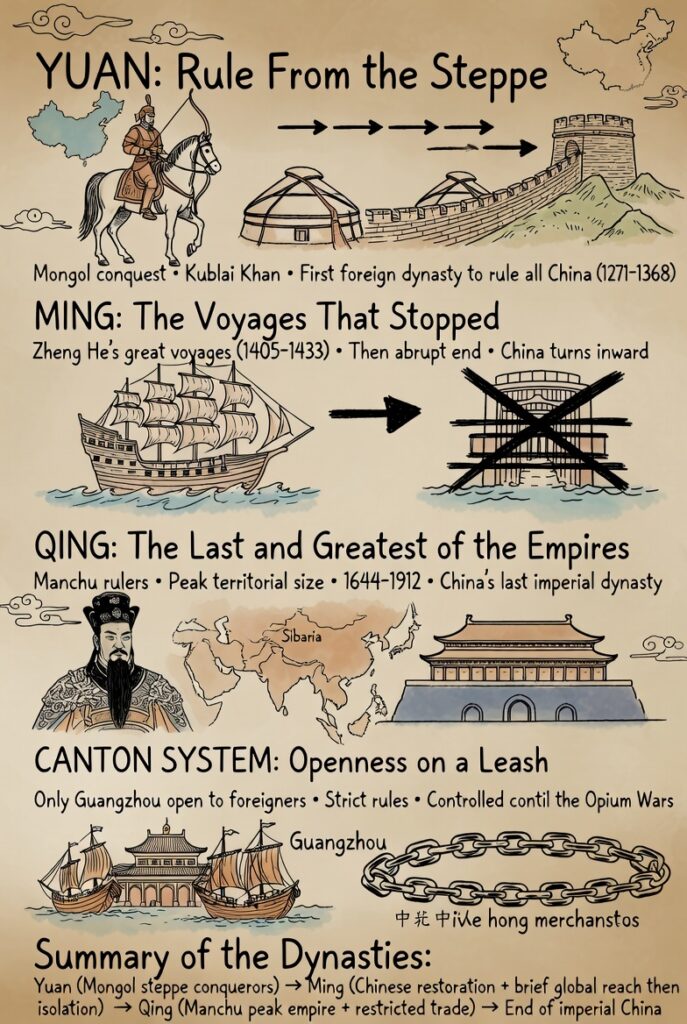
The Ming: The Voyages That Stopped
The fall of the Yuan marked more than the end of Mongol rule. It ushered in a dynasty determined to restore Chinese authority and ensure that foreign conquest would never happen again.
When Zhu Yuanzhang founded the Ming Dynasty in 1368, he inherited a country exhausted by decades of war. Stability became his overriding mission. As the Hongwu Emperor, he concentrated power in the throne, dismantled the office of the prime minister, tightened control over the bureaucracy, and promoted an economy rooted in agriculture rather than commerce. Order, not expansion, became the guiding principle of the new dynasty.
Yet one of the greatest maritime chapters in world history unfolded during the Ming’s early decades.
Between 1405 and 1433, the Yongle Emperor commissioned seven extraordinary naval expeditions under the command of Admiral Zheng He. These were not voyages of exploration in search of unknown lands. China already possessed sophisticated maps, advanced shipbuilding techniques, and extensive trading networks. The fleets were designed to project imperial prestige, strengthen diplomatic ties, and reinforce the tributary system that placed China at the center of regional affairs.
The scale of the expeditions astonished contemporaries. Zheng He’s treasure fleets carried tens of thousands of sailors, soldiers, diplomats, translators, physicians, and craftsmen across Southeast Asia, the Indian Ocean, the Arabian Peninsula, and the East African coast. Some contemporary accounts describe the largest vessels as dwarfing anything Europe would launch for generations, although historians continue to debate their exact dimensions.
For a brief moment, Ming China possessed the resources, technology, and organizational capacity to become the dominant maritime power of its age.
Then the voyages stopped.
The decision did not come from a sudden rejection of exploration but from changing priorities inside the imperial court. Influential Confucian officials questioned the enormous cost of the expeditions, arguing that they produced little practical benefit while draining the treasury. At the same time, the greatest strategic threat still lay beyond the northern frontier, where renewed Mongol pressure demanded soldiers, fortifications, and resources.
Faced with competing priorities, the court redirected its attention inland.
Shipyards that had once produced some of the world’s largest vessels fell silent. Long-distance expeditions were abandoned, and overseas ventures gradually lost official support. Some historical accounts even suggest that records of the voyages were deliberately destroyed, although the extent of that destruction remains debated among historians.
This gradual retreat marked the beginning of what many historians describe as China turning inward. It was not an isolationist policy imposed overnight, nor did foreign trade disappear entirely. Instead, the empire increasingly viewed maritime expansion as a costly distraction from the challenges closer to home.
From the Ming court’s perspective, the decision was entirely rational. Every existential threat the dynasty had faced had come across the northern steppe, not from the sea. Rebuilding and extending the Great Wall promised greater security than maintaining enormous fleets that sailed thousands of miles from home. With finite resources, the choice seemed obvious.
History, however, rarely reveals the consequences of strategic decisions immediately.
While the Ming concentrated on defending its land frontiers, European kingdoms were entering an age of relentless maritime expansion. Portuguese navigators rounded Africa, Spanish expeditions crossed the Atlantic, and new sea routes gradually reshaped the global economy. Trade, wealth, and influence increasingly flowed across the oceans.
China remained prosperous throughout this period, but its relationship with the wider world was beginning to change. The empire still traded extensively, and private merchants continued operating despite official restrictions. Silver mined in the Americas reached Chinese markets through Spanish Manila, becoming a vital part of the Ming economy. Commerce never disappeared.
The official outlook, however, had shifted. The empire expected the world to come to China rather than China seeking opportunities beyond its shores. Over time, that mindset became embedded in imperial policy.
By the time famine, rebellion, and the Manchu invasion brought the Ming Dynasty to an end in 1644, China turning inward was no longer a temporary response to immediate threats. It had become a defining feature of imperial strategy, one that the Qing Dynasty would inherit—and reinforce.
The Qing: The Last and Greatest of the Empires
The Ming Dynasty fell in 1644, but China did not descend into prolonged fragmentation. Instead, another foreign power seized the opportunity.
The Manchus, a people from China’s northeastern frontier, crossed the Great Wall, captured Beijing, and established the Qing Dynasty. Like the Mongols centuries earlier, they arrived as conquerors. Unlike the Yuan, however, they built an empire that would endure for nearly three centuries.
The Qing understood a lesson that had eluded many conquerors before them: military victory alone could not secure China. To rule such a vast civilization, they embraced the institutions that had governed it for centuries. The Confucian bureaucracy remained intact, the civil service examination system continued, and the emperor presented himself as the legitimate Son of Heaven. At the same time, the Manchu elite carefully protected their own identity, maintaining separate military institutions and preserving political control at the highest levels of government.
The result was one of the most stable imperial administrations in Chinese history.
Under the Kangxi Emperor (1661–1722) and his grandson, the Qianlong Emperor (1735–1796), the Qing reached the height of their power. Their armies expanded China’s frontiers deep into Central Asia, bringing Xinjiang, Tibet, Mongolia, and Taiwan firmly within the imperial system. Much of the territory that defines modern China’s borders today took shape during this remarkable period of expansion.
Prosperity followed.
New World crops such as maize and sweet potatoes increased agricultural output, allowing cultivation in regions that had previously supported little farming. Combined with decades of relative peace, food production surged and the population exploded. By the end of the eighteenth century, China’s population had grown to roughly 300 million—an extraordinary figure for its time.
The economy expanded alongside it.
Chinese silk, porcelain, and tea were coveted across the globe, while merchants from Europe competed fiercely for access to Chinese markets. By some economic estimates, China accounted for close to one-third of global economic output around 1800. Few states could rival its wealth, productive capacity, or administrative sophistication.
From Beijing, there appeared to be little reason for concern.
The empire was prosperous, politically stable, and territorially secure. The Qing court viewed China not simply as one great power among many but as the natural center of civilization. Foreign kingdoms were expected to acknowledge the emperor’s superiority through the tributary system, reinforcing an international order that had existed for centuries.
That confidence would gradually become the dynasty’s greatest weakness.
While the Qing presided over an empire at the height of its traditional power, the balance of power beyond Asia was beginning to shift. Across Europe, scientific inquiry was accelerating, commercial capitalism was expanding, and technological innovation was gathering pace. New methods of manufacturing, finance, navigation, and warfare were transforming states that had once looked to China as the world’s most advanced civilization.
These changes unfolded slowly at first, making them easy to underestimate.
From the Qing court’s perspective, European merchants remained distant traders seeking Chinese goods. They arrived with silver, purchased tea, silk, and porcelain, and departed. There was little evidence to suggest that these small maritime kingdoms would soon become global empires capable of projecting military power across every ocean.
That assumption proved costly.
The Qing remained committed to preserving an international order that had served previous dynasties well, even as the foundations of global power were shifting beneath it. The empire was still wealthy, influential, and respected, but the world beyond its borders was changing far faster than Beijing recognized.
This was the deeper consequence of China turning inward. The issue was not complete isolation—China continued to trade and remained one of the world’s largest economies. The danger lay in growing strategic complacency. Success bred confidence, and confidence gradually hardened into the belief that the existing order required little adaptation.
By the early nineteenth century, that confidence would face its greatest test. The collision between an industrializing West and a self-assured Qing Empire was no longer a distant possibility. It was rapidly becoming inevitable.
The Canton System: Openness on a Leash
Contrary to popular belief, the Qing Dynasty did not seal China off from the outside world. Foreign trade continued, but it operated under increasingly strict imperial control.
By the mid-eighteenth century, the Qing court had concentrated nearly all legal trade with Western merchants in a single southern port: Canton, now Guangzhou. Known as the Canton System, the arrangement required foreign merchants to conduct business through a small group of licensed Chinese trading houses. They could not travel freely into China’s interior, negotiate directly with imperial officials, or remain in the country beyond the trading season.
From Beijing’s perspective, the system worked exactly as intended.
China exported products the world eagerly sought—tea, silk, and porcelain—while receiving silver in return. European merchants competed for access to Chinese markets, not the other way around. The Qing court saw little reason to alter an arrangement that reinforced the empire’s long-held belief that China stood at the center of the civilized world. Foreign traders were welcome, but only on imperial terms.
Britain viewed the situation very differently.
As British demand for Chinese goods surged, so did frustration with the restrictions imposed at Canton. Merchants wanted broader access to Chinese markets, permanent diplomatic representation, and the freedom to trade throughout the empire. The Qing court rejected these requests, convinced that foreign powers had little to offer beyond silver and that China’s existing system required no fundamental change.
The disagreement reflected more than competing commercial interests. It exposed two entirely different views of the world. Britain increasingly embraced open trade and global commerce, while the Qing Empire remained committed to a hierarchical order in which foreign states were expected to adapt to China’s rules.
At first, the system appeared to validate Beijing’s confidence. Silver continued to pour into China, commerce flourished, and the empire remained immensely wealthy. Yet beneath this prosperity, deeper structural problems were becoming impossible to ignore.
China’s population had expanded at an unprecedented pace, placing enormous pressure on farmland, local administration, and state finances. The bureaucracy struggled to govern a society far larger than the institutions designed to manage it. Corruption spread through every level of government, reaching even the imperial court. During the later years of the Qianlong Emperor’s reign, the rise of the notoriously corrupt official Heshen became a symbol of an administration increasingly burdened by patronage and inefficiency.
More troubling still, the balance of technological power had quietly shifted.
Centuries earlier, Song China had led the world in innovation, pioneering advances in engineering, printing, metallurgy, and navigation. By the late eighteenth century, that advantage had disappeared. Across Europe, the Industrial Revolution was transforming economies through steam power, mechanized manufacturing, modern finance, and increasingly sophisticated military technology.
The Qing Empire remained prosperous, but prosperity was beginning to conceal stagnation.
Its craftsmen still produced the world’s finest porcelain and silk. Its scholars preserved one of history’s richest intellectual traditions. Yet while China refined achievements from earlier centuries, Europe was creating entirely new industries, new weapons, and new methods of projecting power across the globe.
The gap did not emerge overnight. It widened gradually, decade after decade, until it became impossible to ignore.
The Cost of Turning Away
The decline of imperial China cannot be traced to a single emperor, one disastrous policy, or one defining mistake. It unfolded over centuries through a succession of decisions that made sense within their own historical context.
The Yuan Dynasty focused on holding together the largest land empire the world had ever seen. The Ming redirected resources toward defending the northern frontier after decades of foreign occupation. The Qing preserved stability across a vast multinational empire while carefully managing foreign commerce through tightly controlled institutions.
Each decision addressed immediate challenges. None appeared irrational at the time.
Collectively, however, they encouraged a broader pattern that historians often describe as China turning inward. Maritime ambition gradually gave way to continental security. Commercial openness became increasingly regulated. Preserving stability came to matter more than embracing change.
This shift did not impoverish China overnight. On the contrary, the empire remained one of the world’s wealthiest and most sophisticated civilizations well into the eighteenth century. That prosperity, however, also fostered confidence that the existing order required little adaptation, even as the rest of the world was entering an age of unprecedented transformation.
Europe followed a different path.
Oceanic exploration evolved into global trade. Global trade fueled colonial empires. Colonial wealth financed scientific research, industrialization, and military innovation. Advances in technology reinforced economic power, which in turn expanded political influence. By the beginning of the nineteenth century, European states possessed capabilities that would have seemed unimaginable only a few generations earlier.
China had not suddenly become weak. The world around it had become dramatically stronger.
For centuries, imperial governments had measured security by the strength of their borders and the stability of their institutions. They now faced rivals whose power rested on factories, steam engines, industrial production, global finance, and blue-water navies—developments that had largely unfolded beyond China’s strategic horizon.
The consequences would soon become impossible to avoid.
For generations, imperial China had stood at the center of the world’s largest economy, commanded immense resources, and regarded itself as the natural heart of civilization. That confidence was not born of arrogance alone—it reflected centuries of genuine achievement.
History, however, rarely rewards nations that assume yesterday’s success guarantees tomorrow’s security.
The story of China turning inward is therefore not one of sudden isolation or inevitable decline. It is the story of how a series of practical decisions, each reasonable in its own time, gradually left one of history’s greatest civilizations less prepared for a rapidly changing world.
The consequences would arrive with stunning force.
In the nineteenth century, British warships would appear off China’s coast carrying not tribute, but demands. The empire that had long dictated the terms of foreign trade would find itself confronting industrial powers capable of reshaping the global balance of power through technology, finance, and military force.
The collision between these two worlds would mark the beginning of one of the most traumatic chapters in Chinese history.
Article 4 explores that turning point—the Opium Wars and the beginning of the Century of Humiliation, a period that continues to shape China’s worldview and geopolitical ambitions today.