To the Government of India,
Seven weeks after the student protests began, the Modi Government’s education minister, Dharmendra Pradhan, resigned. In his resignation statement, he said he was stepping down so that student anger would not be “exploited by forces hostile to the nation.”
For many students, however, the resignation raised a different question: why did accountability arrive only after weeks of protests, arrests, and mounting public pressure?
This letter is not written to celebrate a resignation. It is written to ask why it took so long—and what it cost the country in the process.
1. Silence Deepened Student Anger
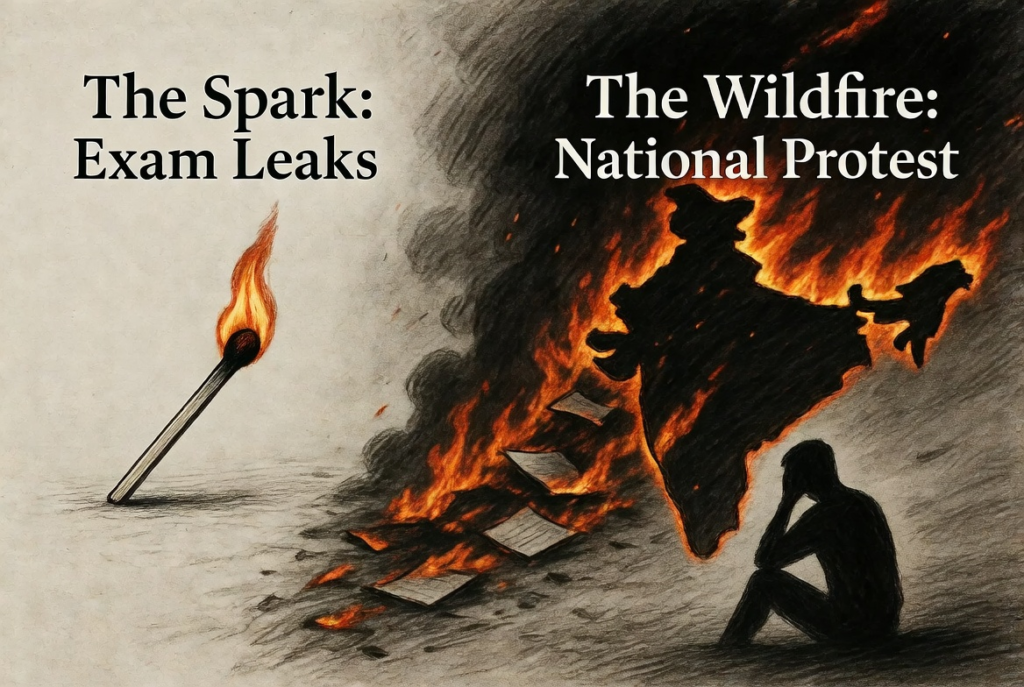
When the protests began on June 7, they were driven by one issue: millions of students discovered that examinations shaping their futures—whether for university admissions or government jobs—had allegedly been compromised by paper leaks. Reports suggested that leaked papers were being sold for large sums of money, leaving many deserving candidates questioning whether merit still mattered.
To be fair, the government did act on the investigative front. The CBI took over the inquiry and subsequently arrested multiple individuals across several states, including alleged intermediaries, coaching-centre operators, and others suspected of involvement in the leak network. Investigations and charge sheets followed.
But investigations alone could not answer the question students were asking: who would take responsibility for the failure of the system itself?
For weeks, students who had spent years preparing for these examinations felt they received little direct reassurance from those politically responsible for the institutions overseeing them. As the protests intensified, much of the public debate shifted away from the students’ concerns and toward questions about the protests themselves. Allegations about political influence and external interference began dominating television debates, while many students felt their original grievance was being overshadowed.
A government responsible for one of the world’s largest student populations cannot afford to treat the concerns of its young citizens primarily as a law-and-order challenge. Public trust is strengthened through dialogue, not prolonged silence.
2. The Response Came Too Late
By the time Prime Minister Narendra Modi publicly addressed the issue, demonstrations had already spread beyond Delhi into numerous cities.
His remarks acknowledged that examination paper leaks were a serious issue and highlighted the progress of ongoing investigations. Yet many protesters believed the broader demand for political accountability remained unanswered.
This reflects a larger governance challenge. Public engagement appeared to come only after the movement had grown too large to ignore and after veteran education reformer Sonam Wangchuk had undertaken a prolonged hunger strike in solidarity with the students.
Leadership is often judged not only by the actions eventually taken, but by how quickly governments respond before public frustration reaches a breaking point.
3. When Policing Replaced Dialogue
Perhaps the most consequential decision came when students marching toward Parliament were met with police action instead of meaningful engagement.
Images of clashes between protesters and security personnel quickly spread across television broadcasts and social media. Rather than reducing tensions, the confrontation appeared to intensify public attention and broaden support for the movement in several parts of the country.
Every democracy has a responsibility to maintain public order. But it also has an equally important responsibility to ensure that peaceful grievances are heard before confrontation becomes unavoidable.
When dialogue is delayed and policing becomes the dominant response, public trust becomes far more difficult to rebuild.
4. Modi Government Accountability Arrived Too Late
Education Minister Dharmendra Pradhan described his resignation as a moral decision.
If so, many will naturally ask why that moral responsibility arrived only after weeks of protests, widespread public criticism, and sustained political pressure.
Had accountability been demonstrated much earlier, this episode might have remained an administrative crisis rather than evolving into a national political controversy.
That may be the most important lesson from these events.
HIGH POWERED TASK FORCE on examination reforms under the leadership of Shri Nandan Nilekani constituted.@NandanNilekani pic.twitter.com/mMpmPdIEL5
— Narendra Modi (@narendramodi) July 26, 2026
Small grievances rarely remain small when they are left unanswered.
When governments engage early, difficult situations can often be resolved through dialogue. When they wait, frustration grows, narratives harden, and trust becomes increasingly difficult to restore.
History offers several reminders of this reality. Nepal and Sri Lanka, despite having political systems and circumstances very different from India’s, both witnessed youth-led movements that expanded well beyond their original grievances after prolonged public frustration. The comparison is not a prediction for India, but a reminder that governments rarely benefit from allowing legitimate concerns to remain unresolved.
Opposition parties will always seek political advantage during moments of public dissatisfaction. That is the nature of democratic politics. Precisely for that reason, the responsibility to respond early rests primarily with the government. Prompt engagement is often the most effective way to prevent genuine public grievances from being overtaken by political opportunism or other disruptive forces.
A resignation that follows sustained public pressure may satisfy immediate political demands, but it also invites a deeper question: could the crisis have been prevented altogether through earlier accountability?
Democracies are tested not when everything is calm, but when public trust begins to fracture. Listening early is almost always less costly than responding after anger has already spread.
Whether this episode becomes a lasting lesson in governance—or simply another chapter in India’s political history—will depend on how future governments respond when citizens ask not for confrontation, but to be heard.
— Editorial Desk, iRitvik