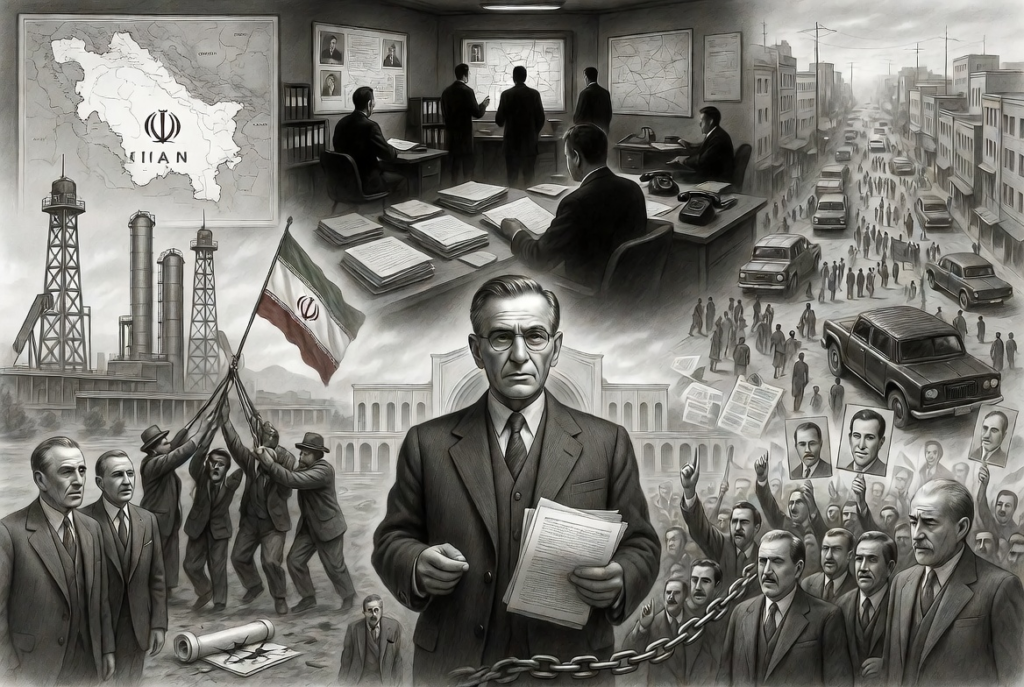
The CIA coup in Iran was not announced to the world with tanks crossing borders or declarations of war. It unfolded through political maneuvering, intelligence planning, and a rapidly escalating crisis inside Tehran. When the dust settled on 19 August 1953, Prime Minister Mohammad Mossadegh had been removed from power, Shah Mohammad Reza Pahlavi was returning to Iran, and one of the Cold War’s most controversial covert operations had entered history.
The decisions made during those weeks would shape US-Iran relations for decades and continue to influence political debates long after the Cold War had ended.
In the previous chapter of US–Iran Conflict Decoded, we explored why Iran decided to nationalize its oil industry in 1951. For millions of Iranians, nationalization represented an attempt to reclaim control over the country’s most valuable natural resource after decades of foreign dominance. For Britain, however, the decision threatened economic interests that had been built over generations.
Negotiations followed. So did economic pressure, legal disputes, and diplomatic efforts. None produced a lasting settlement.
As the crisis deepened, it also began to intersect with another defining conflict of the era—the Cold War. What London initially viewed as an oil dispute was increasingly interpreted in Washington as a strategic problem unfolding on the Soviet Union’s southern frontier.
Within that changing international landscape, British and American officials began discussing an option that had once seemed extraordinary: removing Iran’s elected prime minister through a covert operation.
More than seventy years later, the CIA coup in Iran remains one of the most studied episodes of the Cold War. To some, it was a strategic decision shaped by the geopolitical anxieties of the early 1950s. To others, it marked a turning point that undermined Iran’s democratic development and planted the seeds of decades of mistrust between Tehran and Washington.
This chapter examines how the crisis reached that point, why the United States changed its approach, how Operation Ajax was planned, and why the events of 1953 continue to shape US–Iran relations today.
Key Takeaways
- The oil dispute alone did not trigger the coup; Cold War concerns increasingly influenced Western decision-making.
- Britain sought American assistance after diplomatic and economic efforts failed to reverse Iran’s oil nationalization.
- Operation Ajax combined political planning, intelligence work, and support for forces opposed to Mossadegh’s government.
- The coup restored the Shah’s authority but also left a political legacy that continues to influence US–Iran relations.
Why Britain Looked to Washington
By the end of 1952, British policymakers faced an uncomfortable reality. Nearly every peaceful option they had pursued since Iran nationalized its oil industry had failed to produce the outcome they wanted.
Economic sanctions had placed severe pressure on Iran’s finances but had not persuaded Prime Minister Mohammad Mossadegh to reverse nationalization. International legal proceedings also failed to restore Britain’s previous position, while repeated diplomatic initiatives ended without a breakthrough. London found itself confronting a government that remained politically committed to its decision despite mounting economic difficulties.
The issue extended beyond the immediate loss of oil revenues.
British officials worried that accepting Iran’s decision without resistance could encourage similar demands elsewhere. At a time when Britain still maintained important political and economic interests across different parts of the world, the nationalization of the Anglo-Iranian Oil Company was viewed as a challenge whose consequences might reach far beyond Iran itself.
Yet Britain’s ability to influence events inside Iran was steadily diminishing.
Diplomatic relations between the two countries deteriorated, limiting London’s access to political developments on the ground. Intelligence operations also became increasingly difficult. If Britain hoped to alter the course of the crisis, it would almost certainly need support from a partner with greater international influence.
That partner was the United States.
Washington, however, did not immediately share Britain’s preferred course of action.
During President Harry S. Truman’s administration, American officials generally believed the dispute could still be resolved through negotiation. Although the United States valued its close relationship with Britain, many policymakers also recognized that Iranian demands for greater control over national resources reflected broader political changes taking place across the post-war world.
For nearly two years, Washington attempted to encourage compromise rather than confrontation.
That approach would begin to change only after a new administration entered the White House.
Why Washington Changed Its Position
When the oil crisis first erupted, the United States did not immediately support Britain’s calls for covert action against Mohammad Mossadegh. During President Harry S. Truman’s administration, Washington viewed the dispute primarily as a disagreement between two allies that might still be resolved through negotiation.
Historical records maintained by the U.S. Department of State’s Office of the Historian show that American policy gradually shifted as Cold War strategic concerns became increasingly central to decision-making American diplomats encouraged both sides to seek a compromise, hoping Britain could protect its commercial interests while Iran retained greater control over its own resources.
That approach reflected more than simple caution.
Many officials in Washington accepted that demands for economic independence were becoming increasingly common across Asia, Africa, and the Middle East as former colonies and developing nations sought greater control over their own affairs. From that perspective, Iran’s decision to nationalize its oil industry was controversial, but it was not entirely unexpected.
The difficulty was that compromise became increasingly difficult with every passing month.
Mossadegh could not easily retreat from nationalization without damaging his credibility at home. For many Iranians, the issue had become inseparable from national pride and political independence. Britain, meanwhile, remained unwilling to accept an outcome that permanently ended its dominant position in Iranian oil. As negotiations repeatedly stalled, Washington found itself mediating a dispute in which neither side appeared willing to make the concessions necessary for an agreement.
The international environment was also changing.
By the early 1950s, Cold War rivalry had become the central framework through which American foreign policy was often viewed. The Berlin Blockade, the Communist victory in China, and the Korean War had reinforced fears in Washington that regional crises could quickly become strategic opportunities for the Soviet Union. Policymakers increasingly evaluated local conflicts not only on their own merits but also in terms of how they might affect the global balance of power.
Iran inevitably drew attention within that broader strategic picture.
Sharing a long border with the Soviet Union and occupying a key position in the Middle East, Iran mattered for reasons that extended well beyond its oil fields. American intelligence assessments warned that prolonged political instability could weaken the Iranian state and create opportunities for the communist Tudeh Party, which had grown in influence during the period. Although historians continue to debate how close Iran actually came to a communist takeover, there is broad agreement that these concerns weighed heavily on decision-makers in Washington.
A change in leadership inside the White House further altered the conversation.
When Dwight D. Eisenhower became president in January 1953, his administration adopted a more assertive approach toward containing Soviet influence. Key figures such as Secretary of State John Foster Dulles and CIA Director Allen Dulles believed that the Cold War demanded greater willingness to use covert operations where they considered strategic interests to be at risk.
By then, Britain was no longer asking Washington to help resolve an oil dispute.
It was arguing that political instability in Iran threatened the security of the wider region.
Whether that assessment accurately reflected conditions inside Iran remains the subject of historical debate. What matters is that it persuaded enough senior American officials to reconsider their earlier position. The question was no longer whether negotiations might succeed. It was whether the United States could afford to remain a spectator if they failed.
That shift in thinking created the conditions for one of the CIA’s earliest and most controversial covert operations.
Planning Operation Ajax
Once Washington decided to cooperate with Britain, attention turned from diplomacy to planning.
The operation that emerged was designed to influence Iran’s political landscape without deploying American or British military forces. Instead of an invasion, intelligence agencies sought to exploit existing political divisions inside the country while strengthening those who supported the Shah.
The plan eventually became known as Operation Ajax, although it involved far more than a single day of activity.
British intelligence officers from MI6 had already spent months studying the political situation in Iran, but their ability to work inside the country had been severely reduced after diplomatic relations deteriorated. American involvement therefore became essential. The CIA possessed greater resources, broader international reach, and, from London’s perspective, the political influence needed to carry the operation forward.
Responsibility for coordinating the CIA’s efforts fell to Kermit Roosevelt Jr., an experienced intelligence officer who had worked extensively in the Middle East. His assignment was not to command troops or direct a battlefield campaign. Instead, he was tasked with coordinating contacts inside Iran, assessing rapidly changing political conditions, and helping oversee a complex operation that depended on secrecy rather than military force.
The strategy combined several different methods. Declassified documents and historical research indicate that the operation sought to build support among influential political figures, strengthen ties with military officers loyal to the Shah, encourage public demonstrations, and use newspapers and other channels to shape public opinion. None of these measures alone would have been enough to determine Iran’s future. Together, however, they formed a coordinated attempt to influence the outcome of an already unstable political crisis.
It is important not to reduce the events of 1953 to a simple story of outside powers controlling Iran’s destiny.
The country was already deeply divided over the monarchy, the future of oil nationalization, economic hardship, and the direction of its constitutional system. Operation Ajax succeeded because it entered an existing political struggle rather than creating one from nothing. Foreign involvement played a significant role, but it interacted with domestic tensions that had been building for years.
By the summer of 1953, those tensions were approaching a breaking point.
The carefully prepared plans were about to be tested under circumstances that would prove far less predictable than their architects had imagined.
The Coup That Changed Iran Forever
By August 1953, Iran’s political crisis had reached a point where compromise seemed increasingly unlikely. Months of negotiations had failed, the economy was struggling under the weight of the oil dispute, and trust between the monarchy and Prime Minister Mohammad Mossadegh had largely collapsed. Behind the scenes, the preparations for Operation Ajax were complete. What remained uncertain was whether the plan would actually work.
The first attempt suggested it would not.
During the night of 15 August 1953, officers loyal to Shah Mohammad Reza Pahlavi attempted to remove Mossadegh after the Shah signed royal decrees dismissing him from office. The operation quickly unraveled. Mossadegh had already been alerted to the plan, several officers involved in the mission were arrested, and news of the failed attempt spread rapidly through Tehran. For a brief moment, it appeared that the covert operation had collapsed before achieving any of its objectives.
The Shah reacted by leaving Iran, first for Baghdad and later for Rome. His departure reinforced the impression that Mossadegh had weathered the crisis and remained firmly in control of the government. Even within American and British circles, there was uncertainty about whether months of planning had ended in failure.
Yet the political situation inside Iran remained far more fluid than it appeared.
Over the following days, Tehran witnessed a series of demonstrations, counter-demonstrations, and rapidly shifting political alliances. Supporters of different factions filled the streets, newspapers carried conflicting accounts of events, and senior military officers weighed their options as the balance of power became increasingly uncertain. What had begun as a failed operation gradually evolved into a broader struggle over who would control the country’s future.
On 19 August 1953, the crisis reached its decisive moment.
Large crowds gathered across Tehran as military units loyal to the Shah moved against positions controlled by Mossadegh’s government. Fighting broke out in several parts of the capital, including around government buildings and the Prime Minister’s residence. By the end of the day, Mossadegh had fled his home, key institutions were under the control of forces supporting the monarchy, and the government he had led since 1951 had effectively collapsed.
Within days, Shah Mohammad Reza Pahlavi returned to Iran.
For his supporters, the events of August 1953 marked the restoration of constitutional authority after months of political instability. They argued that the monarchy had prevented the country from descending into deeper chaos during an exceptionally dangerous period of the Cold War.
Mossadegh’s supporters reached a very different conclusion.
To them, the fall of the Prime Minister represented the removal of a democratically elected leader through a covert operation supported by foreign powers. That interpretation became deeply embedded in Iran’s political memory and would continue to influence public attitudes toward both Britain and the United States for decades.
The debate over Operation Ajax has never been solely about what happened during those four days in August. It has always been about how much weight should be given to foreign involvement compared with Iran’s own internal political divisions. Most historians agree that the CIA and MI6 played an important role in the operation. They also acknowledge that the coup succeeded in a country already divided by disagreements over the monarchy, constitutional authority, economic policy, and the future direction of the Iranian state.
Understanding those two realities together is essential. The coup cannot be explained only through foreign intervention, nor can it be understood by ignoring it.
A Victory With Lasting Consequences
The immediate political objective of Operation Ajax had been achieved. Mossadegh was removed from power, the Shah returned to the throne, and a government more closely aligned with Western interests took office. From Washington and London, the operation appeared to demonstrate that covert action could resolve a strategic crisis without the need for direct military intervention.
History, however, rarely ends with immediate victories.
The restoration of the Shah strengthened Iran’s relationship with the United States throughout the 1950s and 1960s. American economic assistance increased, military cooperation expanded, and Iran gradually became one of Washington’s most reliable partners in the Middle East. At the same time, the monarchy consolidated political authority, leaving progressively less space for organized opposition within the country’s political system.
For many Iranians, the memory of 1953 never disappeared.
Even those born long after the coup grew up hearing it discussed as a defining moment in modern Iranian history. Political leaders, academics, journalists, and ordinary citizens repeatedly returned to the events of August 1953 when debating Iran’s relationship with the West. The episode became part of the national conversation about sovereignty, foreign influence, and the limits of outside involvement in domestic politics.
Looking back from the present, Operation Ajax achieved far more than the removal of a prime minister.
It reshaped the political relationship between Iran and the United States for a generation. At the same time, it created a legacy of suspicion that neither side would find easy to overcome. Long before the 1979 Islamic Revolution transformed the region, the foundations of mistrust had already been laid during those turbulent days in Tehran.
The consequences of that decision would continue to unfold over the next quarter-century, eventually producing another turning point that neither Washington nor Tehran fully anticipated.
Conclusion
The events of August 1953 lasted only a few days, but their consequences stretched across generations.
Operation Ajax removed Mohammad Mossadegh from power and restored Shah Mohammad Reza Pahlavi to the center of Iranian politics. In the short term, the operation appeared to achieve its objectives. Britain saw an opportunity to protect its strategic interests after the oil crisis, while the United States believed it had helped secure an important partner during one of the most tense periods of the Cold War.
History, however, is rarely measured by immediate results alone.
The political order established after the coup brought Iran closer to Washington for the next quarter-century, yet it also left behind questions that never completely disappeared. How much influence should foreign powers exercise inside another sovereign nation? Can short-term geopolitical goals create long-term political costs? And what happens when a government loses the confidence of part of its own population while gaining the support of outside allies?
Those questions did not end in 1953.
They resurfaced repeatedly during the Shah’s rule and became impossible to ignore by the late 1970s, when growing public unrest challenged the very system that Operation Ajax had helped preserve.
For many historians, the significance of the coup lies not only in the fall of one prime minister but in the chain of events it set in motion. The mistrust that developed between Iran and the United States was shaped by many decisions over many decades, yet the summer of 1953 remains one of its defining reference points.
To understand the modern relationship between Tehran and Washington, the story cannot end with the coup.
In many ways, that is where the next chapter begins.
Continue the Series
The CIA-backed coup restored Shah Mohammad Reza Pahlavi to power and ended the immediate political crisis that followed Iran’s oil nationalization. Yet stability came at a price. Over the next twenty-five years, Iran would become one of America’s closest allies in the Middle East while political opposition continued to grow beneath the surface.
The next chapter explores The Shah’s Iran: America’s Closest Ally in the Middle East—how the monarchy consolidated power, why Washington invested heavily in the Shah’s government, and how the tensions of that era eventually led to the 1979 Islamic Revolution.
US–Iran Conflict Decoded
Previous: Why Iran Nationalized Its Oil
Current: The CIA Coup That Changed Iran Forever
Next: The Shah’s Iran: America’s Closest Ally in the Middle East