Whenever we talk about the Andaman Islands or look at a map, we’re momentarily struck by how integral this small island is to India. We often wonder, out of curiosity, what happens here—whether it’s a tourist destination. Some of us know it as the place where the British sent freedom fighters to Cellular Jail — the infamous ‘Kala Pani’ punishment. What other significance does it hold? Perhaps most of us don’t know this. Let’s decode the Andaman Islands today. Do you know the strategic importance of the Andaman Islands? These islands aren’t just an island group, but India’s greatest asset in the Indian Ocean region. Located at the gateway to the Strait of Malacca, they function like a permanent, unsinkable aircraft carrier, giving India an unparalleled tactical advantage.
Why Andaman and Nicobar Islands are India’s Strategic Edge
Let’s delve a little deeper and understand why we said this above. We all know that aircraft carriers are mobile; they can be moved from one place to another, right? But the biggest threat to them is missile or torpedo attacks; they can be targeted by the enemy at any time. However, if we talk about the Andaman and Nicobar Islands, they are stable and strong, and this is their biggest advantage.
Let’s move on and try to understand their advantages.
The first thing we noticed is that aircraft carriers have a limited fuel and ammunition capacity, but these islands can accommodate large storage facilities, fuel depots, and permanent runways. This allows India to conduct continuous, long-term naval and air operations without the need for frequent refuelling.
If you look at the map, these islands are located at the mouth of the Malacca-Strait and allow India to deploy warships and aircraft at any time. This makes it nearly impossible for foreign powers, including China, to pass through this vital maritime corridor undetected— though that potential depends on how well it’s actually utilised. I just think this is only possible if India strategically develops these islands and strengthens its relations with neighbouring countries. It’s also worth asking — do we currently have advanced enough military technology and naval assets to fully capitalise on this advantage?
Our Indian Air Force and Navy can project power over a large part of Southeast Asia from this base, ensuring India remains a major security provider in the Indian Ocean, a crucial requirement given the current environment.
Now let’s talk about the project and its benefits.
The Great Nicobar Development Project: It will prove to be a major game-changer. Let’s find out how.
The Great Nicobar Development Project is one of India’s largest infrastructure projects, aimed at strengthening national security and economic growth.
Key components of the project:
International Container Transshipment Terminal (ICTT): By building a major port near the Strait of Malacca, India aims to become a major hub for global maritime trade. This is important because currently, approximately 75% of India’s transshipped cargo goes through foreign ports like Colombo or Singapore. This is revenue, time, and strategic control that India is essentially ceding to other countries. The ICTT aims to change this.
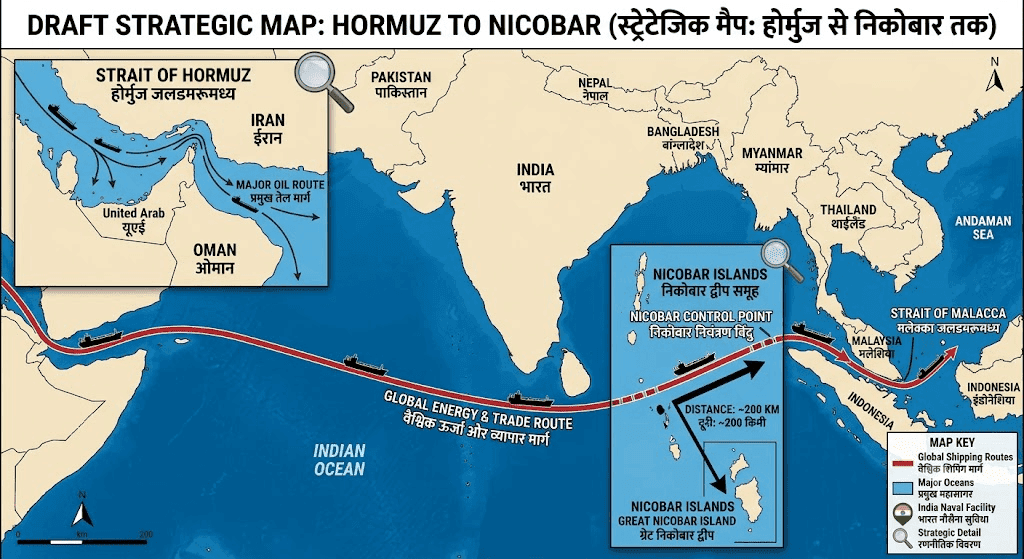
The project’s biggest advantage is that it provides the Indian Navy with a permanent logistics base, significantly increasing operational efficiency and maritime domain awareness. The project includes an international airport, a solar-powered power plant, and a modern township, which will transform the islands into self-sufficient powerhouses.
Another significant advantage of this project is that, despite its remote location from Delhi, it will bridge the gap between the islands’ economies and the mainland, enabling India to emerge as a global trade leader.
These are the positive aspects we’ve discussed, but let’s now address the challenges.
There’s no doubt that this project is a “game-changer,” but it also poses some significant challenges that must be carefully addressed.
The project is located in an ecologically sensitive zone. Large-scale construction poses a threat to rare wildlife and dense rainforests. As Rahul Gandhi (LOP) has mentioned several times through his official X account.
This #WorldEnvironmentDay, I want to ask every young Indian one question:
— Rahul Gandhi (@RahulGandhi) June 5, 2026
What kind of India do you want to inherit?
One where rainforests have been bulldozed for casinos, coral reefs erased from maps, tribal communities pushed off their land, and the air we breathe turned into… https://t.co/Wci4BNkGQu
Environmentalists believe that dredging activities and increased ship traffic could threaten coral reefs and sea turtle nesting sites.
The safety, culture, and land rights of Particularly Vulnerable Tribal Groups (PVTGs), such as the Shompen people, remain a top priority and a major concern for environmentalists.
China may view this development as an attempt to “encircle” its energy supply lines, which could lead to increased submarine patrols in the Indian Ocean.
India must first ensure that its development projects do not alienate Southeast Asian neighbors like Indonesia and Malaysia, emphasizing that this infrastructure is for regional trade and collective security.
These islands are located in a seismically active zone, and when it comes to infrastructure, advanced engineering should be given greater importance so that the infrastructure can easily withstand future disasters such as earthquakes and tsunamis.
Indeed, the Great Nicobar Development Project is a litmus test for India. Balancing economic ambition and national security with environmental and social responsibility is crucial. I believe that through this project, India can strengthen its position as a global maritime power. And as India strengthens its hold on the Strait of Malacca, it can also effectively resolve the “Malacca Dilemma,” ensuring that the Indian Ocean remains a region of peace and stability.
Read Further:
- Strait of Malacca Overview (Britannica): https://www.britannica.com/place/Strait-of-Malacca
- Great Nicobar Development Project Details (PIB): https://pib.gov.in/PressReleasePage.aspx?PRID=1779836
- Understanding Maritime Choke Points (EIA): https://www.eia.gov/international/analysis/world-oil-transit-chokepoints