
A narrative feature on artificial intelligence, trust, and the biggest misunderstanding of the digital age.
On June 26, 2026, I published The Truth About AI, a summary article intended to give readers a practical introduction to artificial intelligence. It explained the fundamentals of large language models, the reasons AI systems can produce different responses, and why critical thinking remains essential when using these tools.
The response to that article made one thing clear: a single overview could only scratch the surface. Artificial intelligence is no longer one story—it is a collection of interconnected stories. That realization led to this series, where each article examines one question in depth, building a broader understanding of one of the most important technologies of our time.
In November 2022, something unusual happened. A chatbot that almost no one outside the tech industry had heard of suddenly captured the world’s attention. Within weeks, students were using it to complete assignments. Lawyers asked it to summarize legal documents. Software engineers began writing code with its help, while doctors experimented with drafting clinical notes. Marketers discovered it could produce advertising copy in seconds. By early 2023, ChatGPT had become the fastest-growing consumer application in history—a milestone that signalled something far more than the launch of another tech product. It marked the moment artificial intelligence entered everyday life.
Artificial intelligence had quietly crossed a line.
For decades, AI had mostly existed behind the scenes—powering search engines, recommending movies, filtering spam, and translating languages. Most people never noticed it. Then, almost overnight, AI became something they could talk to.
The world reacted with a mixture of excitement and fear.
Some believed humanity had created a digital genius. Others warned that machines were becoming too intelligent to control. Headlines proclaimed the arrival of a new technological revolution, while social media filled with predictions ranging from limitless prosperity to human extinction.
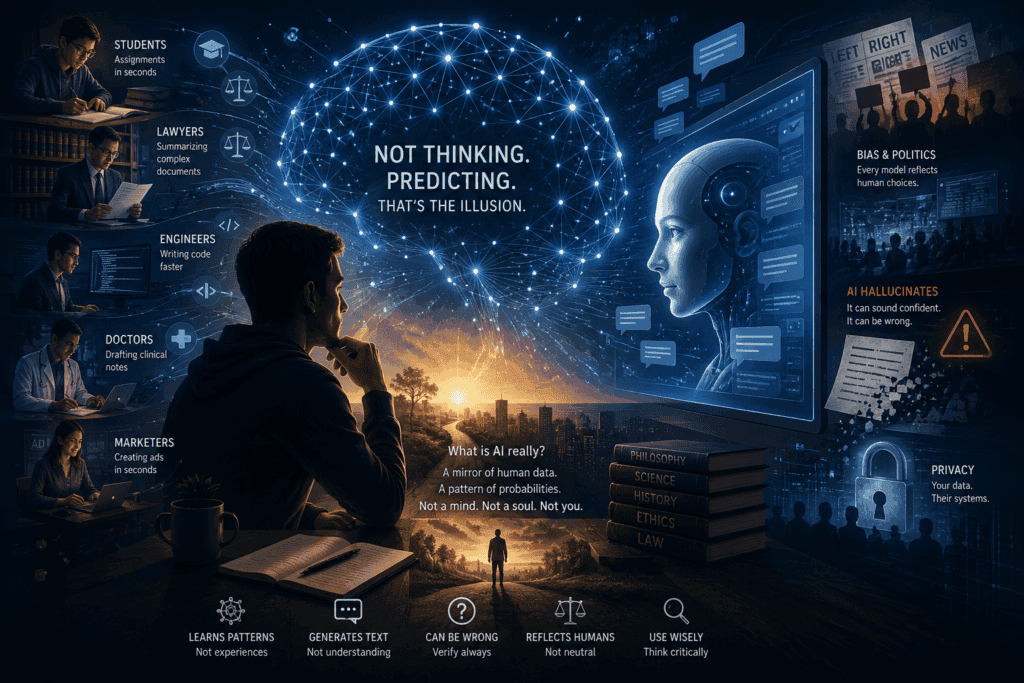
Yet beneath the excitement lay a more fundamental question.
What exactly are we talking to?
The answer is less mysterious—and far more fascinating—than many people imagine.
The Greatest Illusion AI Has Created
Imagine walking into a library larger than any ever built.
Its shelves stretch beyond the horizon. Inside are millions of books, scientific papers, news reports, websites, public conversations, programming manuals, and historical documents collected over decades.
Now imagine asking someone who has spent years studying that library a question.
You might assume they are thinking deeply before answering.
But what if they are doing something different?
What if, instead of reasoning like a human, they have become extraordinarily good at recognizing patterns?
That is closer to how today’s most advanced AI systems work.
Behind ChatGPT, Google’s Gemini, Anthropic’s Claude, xAI’s Grok, Meta’s Llama, and many other modern chatbots is a technology called a Large Language Model (LLM).
The phrase sounds intimidating, but the underlying idea is surprisingly simple.
Language follows patterns.
Certain words naturally appear together. Ideas tend to follow recognizable structures. Questions are usually answered in predictable ways.
After training on enormous amounts of text, an LLM learns these relationships—not by memorizing every sentence, but by building mathematical representations of how language behaves.
When you ask it a question, it generates a response by predicting the most likely sequence of words that should come next.
This is why AI can write essays, explain quantum physics, translate languages, compose poems, and generate software code using the same underlying technology.
It is not switching between different brains.
It is applying the same statistical model to different kinds of language.
Prediction Is Not the Same as Understanding
Here is where one of the biggest misunderstandings begins.
Because AI writes in fluent English, remembers context, and often explains complex topics with remarkable clarity, people naturally assume it understands what it is saying.
Humans have evolved to associate fluent language with intelligence.
When someone speaks confidently, we instinctively assume they know what they are talking about.
AI takes advantage of that psychological shortcut.
In reality, today’s leading AI models do not possess consciousness, self-awareness, emotions, or personal experiences.
They have never watched a sunrise.
They have never felt fear.
They have never celebrated a birthday.
They do not know what happiness feels like.
What they possess instead is something remarkably different: an extraordinary ability to model language.
That distinction matters.
An AI can describe grief without ever experiencing loss.
It can explain democracy without voting.
It can write about love without ever feeling affection.
This does not make its answers useless.
It simply means its intelligence is fundamentally different from ours.
Researchers often describe modern AI as a powerful prediction engine rather than a thinking mind.
That may sound like a small distinction.
It is not.
It changes how we should interpret every answer AI gives.
Why AI Sometimes Invents Facts
If AI has read so much information, why does it occasionally make obvious mistakes?
Why does it confidently cite books that do not exist?
Why does it invent court cases?
Why does it create fake academic references?
The answer lies in how language models generate text.
An LLM is designed to produce responses that are statistically plausible—not automatically verified.
Most of the time, those predictions are remarkably accurate.
Sometimes they are not.
Researchers call these errors hallucinations—situations where an AI generates information that sounds convincing but is factually incorrect.
The term can be misleading because AI is not “imagining” anything.
It is producing language that fits learned patterns, even when those patterns do not correspond to reality.
This is why journalists, lawyers, researchers, doctors, and business professionals are increasingly encouraged to verify important AI-generated information instead of accepting it at face value.
The technology can dramatically improve productivity.
It should not replace independent verification.
Why Different AI Models Give Different Answers
One of the most common questions people ask is surprisingly simple.
“If all these AI models are based on large language models, why don’t they always agree?”
The answer reveals something important about the AI industry.
Although OpenAI, Google, Anthropic, Meta, xAI, and other developers build systems using similar scientific foundations, their products are not identical.
Each company makes thousands of decisions during development.
Which data should be included?
Which sources should be excluded?
How should harmful content be handled?
How cautious should the model be?
How much creative freedom should users have?
How should uncertainty be expressed?
These decisions influence the personality of the final product.
Some models prioritize creativity.
Others emphasize factual consistency.
Some are optimized for software engineering.
Others perform exceptionally well in long-form writing or scientific reasoning.
The differences often reflect engineering priorities rather than intelligence itself.
Think of them as chefs working from the same basic ingredients but following different recipes.
The kitchens may look similar.
The meals do not.
The Human Fingerprints Inside Every AI
One of the biggest myths surrounding artificial intelligence is that it is completely objective.
In reality, every AI system reflects countless human decisions.
Engineers decide what data should be used during training.
Researchers design safety systems.
Companies establish policies for controversial topics.
Legal teams interpret copyright law.
Governments introduce regulations.
Human reviewers evaluate model responses during training.
None of these decisions automatically make an AI biased.
But they do mean that AI does not emerge from a political or cultural vacuum.
Every model reflects choices made by people.
Sometimes those choices are technical.
Sometimes they are ethical.
Sometimes they are legal.
And occasionally they become political.
Understanding this distinction is essential.
The real question is often not whether an AI has bias.
It is where that bias comes from, how transparent it is, and whether users understand its limitations.
Why People Trust AI So Easily
Perhaps the most surprising discovery is not about machines.
It is about us.
Psychologists have long known that humans tend to trust systems that communicate confidently.
This phenomenon appears repeatedly in aviation, medicine, finance, and automation.
AI amplifies it.
When an answer arrives instantly, written in polished language with perfect grammar and persuasive structure, it feels authoritative.
But confidence and correctness are not the same thing.
A well-written mistake is still a mistake.
That is why many universities now teach students not simply how to use AI, but how to question it.
The goal is no longer memorizing every fact.
The goal is learning which facts deserve verification.
Ironically, the rise of AI may make one uniquely human skill more valuable than ever before:
Critical thinking.
The Beginning of a Bigger Story
Artificial intelligence is often described as a race to build smarter machines.
But that may not be the real story.
The larger question is not whether AI can imitate intelligence.
It already can.
The real question is who decides how these systems are built, what information they learn from, what limits they should have, and whose values they ultimately reflect.
That conversation moves far beyond computer science.
It enters the worlds of politics, business, privacy, journalism, and global power.
And that is where the next chapter begins.










[…] the first article explained how artificial intelligence works, this one explores a far more uncomfortable question: Who decides […]