
What Exactly Are the SDGs, and Why Do They Matter?
You’ve probably heard the term thrown around, but many people still wonder: “What are the SDGs, anyway?”
Simply put, the Sustainable Development Goals (SDGs) are a collection of 17 global targets set by the United Nations. Think of them as a roadmap to build a better, more sustainable world by 2030. These goals tackle the big issues—like wiping out poverty, achieving zero hunger (that’s SDG 2), and ensuring quality healthcare for everyone (SDG 3). Once you dive into what these goals are all about, you realize they aren’t just international jargon; they are the ultimate blueprint for national development and a higher quality of life for all of us.
How Do India and China Compare on the SDG Index?
Learning about the SDGs is one thing, but it’s fascinating to see how different nations are actually putting them into practice.
Currently, China ranks 49th on the global index, while India sits at 94th. When we look at these two side-by-side, it’s clear that while India has made significant strides, there is still a noticeable gap to bridge. Rather than getting caught up in political finger-pointing, the real conversation should be about how both nations can continue refining their systems to hit those 2030 benchmarks and improve the well-being of their citizens.
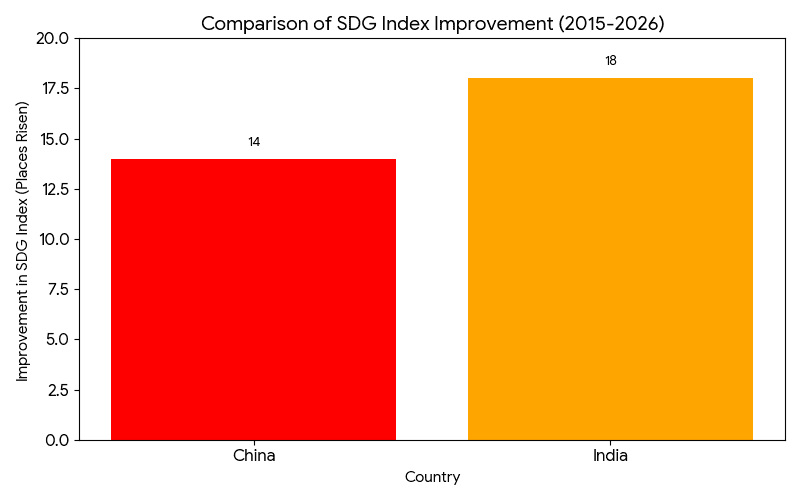
When it comes to the SDGs, let’s examine how China has significantly improved its ranking.
Most notably, China has effectively incorporated these targets directly into its “Five-Year Plans,” making them mandatory for all government departments.
Beyond mere planning, they have also mastered “targeted poverty relief,” using granular data to identify families in need based on actual needs and ensure that assistance reaches the right people.
They have also relied heavily on digital infrastructure to deliver healthcare to remote areas, a crucial component of their development approach. Finally, their system is built on accurate statistics, allowing them to track progress and quickly address obstacles.
Comparing India and China reveals two very different playbooks. China operates on a highly centralized, “top-down” model, where 45 government agencies work together under a single command structure. India, on the other hand, has made remarkable progress, climbing 18 places since 2015. India is charting its own unique path by leveraging digital governance, particularly the JAM Trinity, which allows the government to bypass intermediaries and deliver aid directly to citizens’ bank accounts.
But we must also keep in mind that despite good intentions, translating these global goals into reality is difficult, but not impossible. Often, different parts of the government work in silos, lacking coordination, leading to wasted resources. Local political agendas sometimes take precedence, delaying the rollout of services to rural areas that need them most. Furthermore, the lack of real-time monitoring leads to significant data gaps, making it difficult to see who is lagging behind at any given time.
Looking ahead, India has an opportunity to accelerate its progress through several essential reforms. Implementing an integrated digital dashboard will create a single source for tracking funds from the national level to the village level. Increasing public transparency around schemes like Ayushman Bharat will build greater trust, and focusing a higher percentage of GDP on healthcare will strengthen the country’s backbone.
Finally, strengthening village councils by empowering them to make greater decisions based on local needs will ensure better resource management.
This should be a mission focused not on rankings but on ensuring every citizen has access to a framework that truly improves their lives.
Read Further:











[…] have long noted this feedback loop: in China, the need to manage water helped birth the state, and the state, once born, justified itself partly […]