
In the first article of our Russia–Ukraine Conflict Decoded series, we explored why the Russia-Ukraine War didn’t begin in 2022. To understand how Europe eventually reached its biggest conflict since World War II, we must first understand the collapse of the Soviet Union—an event that reshaped Europe and changed global politics forever..
Like every article in this series, this one is based on historical records and credible sources. Where historians or governments interpret events differently, I will present those perspectives fairly so you can form your own conclusions.
To understand why the Soviet Union collapsed, it helps to forget the image of an unstoppable superpower for a moment.
By the late 1980s, the cracks were already visible.
From the outside, the Soviet Union still looked enormous. It possessed one of the world’s largest armies, thousands of nuclear weapons and influence that stretched across Eastern Europe. Yet behind that image of strength, the country was struggling with problems that had been building for years.
The Soviet economy had slowed dramatically.
Unlike market economies, where businesses compete and prices are largely shaped by supply and demand, the Soviet system relied on central planning. Government officials in Moscow decided what factories would produce, how much they would produce and where those goods would be sent.
For decades, that model had helped transform the Soviet Union into an industrial and military power.
Over time, however, it became increasingly inefficient.
Factories often focused on meeting production targets rather than making products people actually needed. Innovation slowed. Consumer goods were frequently in short supply. Long queues outside shops became a familiar sight in many cities, while everyday items that people in Western countries took for granted were often difficult to obtain.
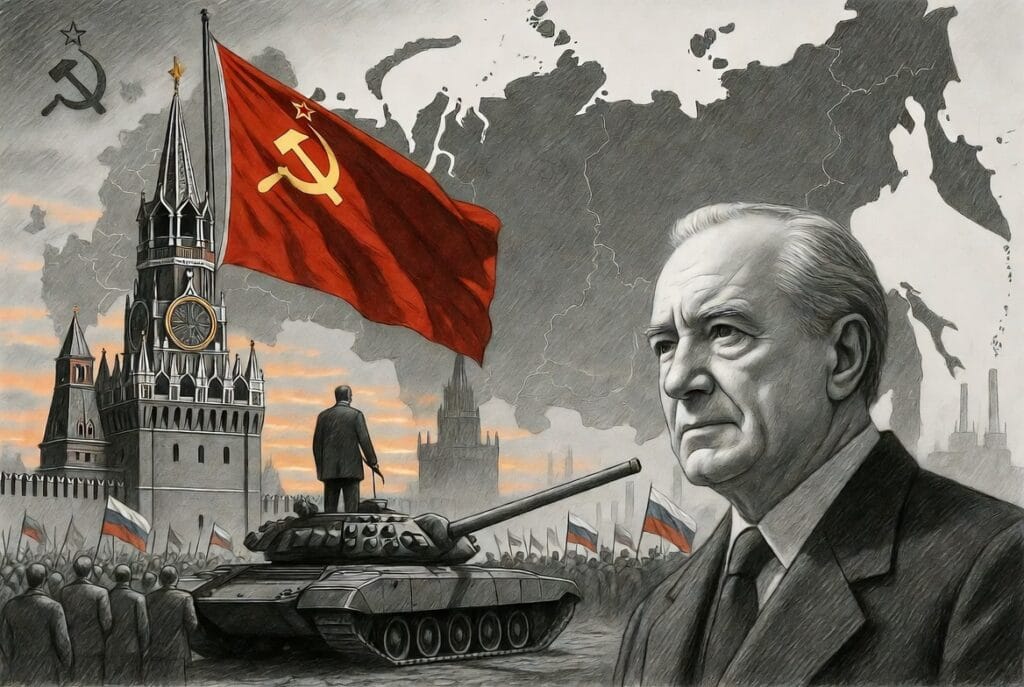
At the same time, the Soviet government continued spending enormous amounts on defence.
The Cold War had become an expensive competition with the United States. Both superpowers invested heavily in nuclear weapons, advanced military technology and global influence. Maintaining that rivalry placed a growing burden on an economy that was already under pressure.
Then came another costly challenge.
In 1979, the Soviet Union sent troops into Afghanistan, expecting a short military operation. Instead, it became a long and exhausting war that lasted almost a decade. Thousands of Soviet soldiers were killed, billions of rubles were spent and public confidence in the government began to weaken.
Many historians compare its impact on the Soviet Union to the way the Vietnam War affected the United States—not identical in every respect, but similarly damaging to public confidence and national morale.
By the middle of the 1980s, it had become increasingly clear that the Soviet system needed major reforms.
That responsibility fell to a relatively young leader named Mikhail Gorbachev.
When Gorbachev became General Secretary of the Communist Party in 1985, he inherited a country that remained powerful on paper but was becoming weaker beneath the surface.
Rather than preserving the system exactly as it was, he believed it could be saved only through change.
His reform programme became known by two Russian words that would soon enter political vocabulary around the world.
The first was Perestroika, meaning restructuring.
Its goal was to modernise the Soviet economy by introducing limited market reforms, improving productivity and giving businesses more flexibility than the rigid central planning system had allowed.
The second was Glasnost, meaning openness.
For decades, Soviet citizens had lived under strict censorship. Newspapers, television and public discussion were tightly controlled by the state. Glasnost relaxed many of those restrictions, allowing greater freedom of expression and encouraging public debate about problems that had previously been hidden.
Gorbachev hoped these reforms would strengthen the Soviet Union.
Instead, they exposed just how many problems had accumulated over decades.
As censorship weakened, people openly criticised corruption, economic failures and government mismanagement. Nationalist movements inside several Soviet republics began demanding greater autonomy, and in many cases, complete independence.
The more freedom people gained to speak, the more difficult it became for Moscow to keep such a vast multinational state united.
What had started as an attempt to reform the Soviet Union gradually became a process that challenged its very existence.
By the end of the decade, the question was no longer whether the Soviet Union needed change.
The question was whether it could survive at all.
The Coup That Changed Everything
By the summer of 1991, the Soviet Union was hanging together by little more than hope and uncertainty.
Across the country, reform had created expectations that the old system could no longer satisfy. Some people believed Gorbachev’s changes had gone too far. Others believed they had not gone far enough. While republics such as Lithuania, Latvia and Estonia were openly pushing for independence, hardline members of the Communist Party feared the Soviet Union itself was slipping away.
The tension reached its breaking point in August 1991.
On 19 August, a group of senior Soviet officials announced that President Mikhail Gorbachev was unable to perform his duties because of an alleged illness. In reality, Gorbachev had been isolated at his holiday residence in Crimea while members of his own government attempted to seize power.
The plotters declared a state of emergency.
Their objective was simple.
Stop the reforms.
Restore central control.
Prevent the Soviet Union from breaking apart.
On paper, they appeared to have the advantage.
They controlled key government institutions.
They had the support of parts of the military and the security services.
Armoured vehicles rolled into Moscow, and many expected the coup to succeed within hours.
Instead, something unexpected happened.
Thousands of ordinary citizens poured into the streets.
People began building makeshift barricades around the Russian parliament building, known as the White House, where the elected president of the Russian Soviet Republic, Boris Yeltsin, had taken a stand against the coup.
One image from those dramatic days would become one of the defining photographs of the twentieth century.
Standing on top of a military tank, Boris Yeltsin addressed the crowd and called on soldiers and civilians to resist the coup peacefully.
The speech lasted only a few minutes.
Its impact lasted much longer.
As television images spread across the world, the coup leaders found themselves losing momentum. Some military units refused to act against civilians. Others remained neutral. The unity that the plotters had expected never fully materialised.
After just three days, the coup collapsed.
Gorbachev returned to Moscow.
But by then, the Soviet Union had suffered a blow from which it would never recover.
Ironically, the men who had tried to save the Soviet system had accelerated its collapse.
The failed coup shattered what little confidence remained in the central government. Republic after republic declared independence. Political authority shifted rapidly from Soviet institutions to the governments of the individual republics.
Among those republics, none mattered more than Ukraine.
Without Ukraine, the Soviet Union would lose one of its largest populations, some of its most important industries, and vast agricultural resources. Keeping the Union together without Ukraine was becoming increasingly unrealistic.
The question was no longer whether change was coming.
The only uncertainty was how quickly it would happen.
By the end of 1991, the answer would become clear.
The Soviet Union, one of the most powerful states in modern history, was entering its final months.
Ukraine’s Vote That Changed History
On 1 December 1991, Ukrainians went to the polls to answer a single question.
Should Ukraine become an independent state?
Unlike many historic moments that are remembered for dramatic speeches or violent confrontations, this one was decided quietly—through ballot boxes.
The result surprised even some of the strongest supporters of independence.
More than 90 percent of voters backed the proposal, with a turnout exceeding 80 percent. What made the outcome even more significant was that support for independence was not limited to one part of the country. Every region voted in favour, although by different margins.
For Ukraine’s political leadership, the referendum provided something that could not easily be challenged—democratic legitimacy.
This was no longer a declaration made by politicians in Kyiv.
It was a decision endorsed by millions of Ukrainian citizens.
Within days, countries around the world began recognising Ukraine as an independent nation. Poland and Canada were among the first. Soon afterward, recognition came from the United States, the United Kingdom and many other governments.
For the international community, another former Soviet republic had peacefully taken its place on the world map.
For Moscow, however, the implications were much deeper.
Ukraine was not just another republic leaving the Soviet Union.
It was the second-largest republic after Russia, home to more than fifty million people at the time, a major industrial powerhouse and a crucial part of the Soviet economy. It also contained key military facilities, important Black Sea ports and some of the most productive farmland in Europe.
Without Ukraine, the Soviet Union was no longer the same country.
Many historians argue that once Ukraine voted for independence, the survival of the Soviet Union became virtually impossible.
The Meeting That Ended a Superpower
Less than a week after the Ukrainian referendum, three political leaders met in a government residence deep inside the Belovezh Forest, in what is now Belarus.
The meeting was not announced with great ceremony.
There were no cheering crowds outside.
No grand speeches were delivered to the world.
Inside the residence were:
- Boris Yeltsin, President of Russia.
- Leonid Kravchuk, President of Ukraine.
- Stanislav Shushkevich, leader of Belarus.
Their discussion would change world history.
On 8 December 1991, they signed what became known as the Belavezha Accords.
The document contained a sentence that stunned the world.
It declared that the Soviet Union had ceased to exist as a subject of international law and geopolitical reality.
In its place, the three leaders proposed a new organisation—the Commonwealth of Independent States (CIS)—designed to maintain cooperation between the newly independent republics without recreating the Soviet Union itself.
Other republics soon joined the agreement.
Although not every former Soviet republic became a member, the message was unmistakable.
The Soviet Union was finished.
Remarkably, one of the most powerful states in modern history had come to an end without a civil war across its entire territory or a foreign army marching into its capital.
Its collapse was driven largely by political decisions, economic decline, competing national identities and the growing inability of the central government to hold together a vast multinational state.
For many observers around the world, it was an almost unimaginable conclusion to the Cold War.
A New Map, A New Europe
When the Soviet Union disappeared, the map of Europe changed overnight.
Fifteen independent countries suddenly had to build their own governments, economies, foreign policies and national identities.
For some, the transition would be relatively peaceful.
For others, it would prove long and painful.
Russia inherited the Soviet Union’s permanent seat on the United Nations Security Council, most of its nuclear arsenal and the responsibility of becoming the legal successor state.
But inheriting the Soviet Union was not the same as replacing it.
Russia was now a nation-state rather than the centre of a multinational empire.
Its borders had changed.
Its influence had shrunk.
Its economy was entering one of the most difficult periods in its modern history.
Ukraine faced a different challenge.
It had gained independence, but it also inherited enormous responsibilities. It needed to build state institutions, establish its own foreign policy, create an independent military and redefine its relationship with both Russia and the wider world.
None of these decisions came with simple answers.
Both countries were stepping into an uncertain future, carrying the weight of a shared past while trying to build separate national identities.
At the time, few people imagined that their relationship would one day dominate global headlines.
Most hoped that the end of the Cold War would bring a more stable and peaceful Europe.
History, however, had other plans.
The collapse of the Soviet Union was not just the end of a superpower.
It was the beginning of a completely new geopolitical era.
Borders that had existed for decades disappeared.
New nations emerged almost overnight.
Old alliances faded, while new security questions began to take shape.
For Ukraine, independence marked the birth of a sovereign state with the freedom to choose its own future.
For Russia, the same event represented the loss of territory, influence and a political order that had defined its place in the world for generations.
Those two very different experiences would shape the thinking of both countries for decades to come.
The war that erupted in 2022 cannot be explained without first understanding this moment.
Because before there were disputes over NATO, Crimea or Donbas, there was 1991—the year an empire collapsed, and a new Europe was born. Continue….




[…] the previous article of our Russia–Ukraine Conflict Decoded series, we explored how the Soviet Union collapsed and how fifteen independent nations emerged from its ruins. Among them was Ukraine—a country that […]