
For decades, the search for extraterrestrial intelligence (SETI) focused heavily on listening for narrowband radio signals or faint technosignatures. But in recent years, observational astronomy has shifted toward a much larger frontier: scanning the night sky for the physical footprints of hyper-advanced societies using the Kardashev scale.
If we ever confirm the existence of a Type II civilization, it won’t just mean we share the universe with others—it will mean we’ve found a species capable of harnessing the complete, raw energy output of an entire star. But how do astrophysicists actually measure this scale, what did recent surveys find, and how do we separate genuine anomalies from cosmic optical illusions?
Part 1: Understanding the Kardashev Scale Explained
To grasp what a Type II civilization looks like, it helps to take a brutally honest look in the mirror. Back in 1964, Soviet astronomer Nikolai Kardashev proposed a classification system based purely on energy consumption:
- Type 0: Dependent on organic matter and fossil fuels (coal, oil, gas). We harvest Earth’s evolutionary leftovers rather than mastering its planetary systems.
- Type I: Controls 100% of the energy available on its home planet, including weather patterns, geothermal forces, and advanced renewables or fusion.
- Type II: Captures and utilizes the entire energy output of its parent star.
- Type III: Commands the energy budget of an entire galaxy.
Sagan’s Mathematical Scale
Astrophysicist Carl Sagan later refined the Kardashev scale model into a continuous formula using total power consumption in watts:
When you plug our current global energy consumption (roughly $2 \times 10^{13}\text{ Watts}$) into Sagan’s equation, humanity lands at roughly 0.73.
How Far Away Are We?
Part 2: What Did Scientists Detect? The Theory of Type II
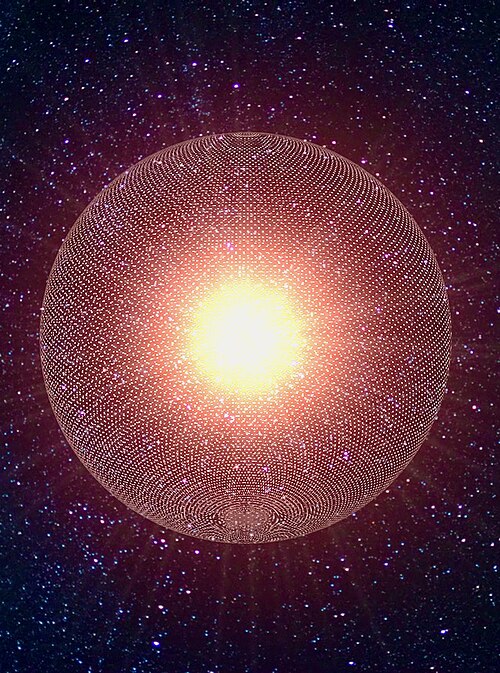
Way back in 1960, theoretical physicist Freeman Dyson floated a fascinating hypothesis: if a civilization outgrows its home planet, it will naturally turn its eyes toward its parent star. To capture all that raw power, they would build a colossal megastructure—a dense swarm of solar collectors, orbital habitats, and mirrors encompassing the star. Today, we call this a Dyson Sphere.
While a true Dyson Sphere would block a star’s visible starlight, physics dictates that energy cannot simply vanish. The absorbed radiation must eventually be expelled as waste heat. Because of this, astronomers searching for Type II civilizations aren’t looking for green men; they’re hunting for unexplained infrared excess.
Project Hephaistos and the M-Dwarf Search
This exact premise drove Project Hephaistos (Suazo et al., 2024, published in MNRAS). A team of researchers combed through astronomical data from the WISE, Gaia, and 2MASS space telescopes, analyzing roughly five million stellar profiles.
Out of that massive dataset, they flagged a small handful of M-dwarf stars displaying anomalous infrared radiation that didn’t neatly fit natural phenomena like circumstellar dust rings or debris disks. Naturally, the astrobiology community sat up straight.
Part 3: The Reality Check—Cosmic Coincidences and AGN Contamination
Whenever headlines flash about potential alien megastructures, the excitement is palpable. But the beauty—and frustration—of modern science is the pursuit of rigorous peer review.
The Plot Twist: Subsequent follow-up research introduced a heavy dose of skepticism. High-resolution radio observations of the candidate stars revealed that the infrared signals weren’t coming from the M-dwarfs at all. Instead, astronomers uncovered AGN (Active Galactic Nucleus) contamination—distant background galaxies that happened to line up precisely behind the stars in our line of sight, tricking our telescopes into seeing an artificial heat excess.
Ultimately, researchers concluded that at least some, and potentially all, of the Project Hephaistos candidates are likely observational illusions rather than interstellar engineering marvels.
The Bottom Line
The search for a Type II civilisation using frameworks like the Kardashev scale pushes the absolute limits of observational astrophysics. Project Hephaistos gave us a brilliant look at how machine learning and massive data pipelines can automate the search for anomalies. But subsequent follow-ups remind us of the golden rule of science: extraordinary claims require ruling out every mundane, distant galactic coincidence first.












[…] For decades, the search for extraterrestrial intelligence (SETI) has been looking for simple radio signals or faint cosmic whispers. However, a groundbreaking report by Morning Overview suggests that astronomers may have stumbled upon something infinitely more massive: evidence of a Type II Civilization. Read Full Analysis Here: https://iritvik.com/kardashev-scale-breakthrough-evidence-of-a-star-powered-civilization/ […]