In the race for the stars, a recurring pattern defines our greatest achievements and our deepest failures. We call it a metaphorical cycle of insatiable desire that compels nations, corporations, and civilizations to leap through impossible technical challenges, only to find that the underlying hunger remains unquenched. Whether gazing at the red dust of Mars or grappling with the clutter of space debris, the mechanism is the same: as we push the boundaries of space exploration sustainability, we are all striving forward, fueled by an appetite that refuses to be satisfied.
The Mars Dilemma: A Race for Subsurface Riches
As humanity shifts its gaze toward the Martian subsurface, we aren’t just exploring for the sake of science. We are responding to resource scarcity. Earth’s reserves are finite, and the race to secure minerals, water, and strategic dominance on Mars is a profound survival hurdle.
The irony is that the technology, the trillions of dollars, and the sheer will required to harvest Mars present a challenge that grows more complex with every passing year. We are feeding a planetary ambition that demands more than we can currently provide.
The “Musk” Factor: The Man Who Chases the Frontiers
When discussing the expansion toward Mars, one name stands above the rest: Elon Musk. Framing the Martian mission with a singular, driving intensity, Musk has often noted that becoming a multiplanetary species serves as “life insurance for life collectively” and a necessary step to ensure human consciousness survives.
Musk’s perspective challenges us to accelerate beyond our perceived limits. Yet his ambition highlights the essence of our dilemma: when we treat Mars as a survival necessity rather than solely a scientific frontier, we risk bringing our terrestrial appetite for consumption to a new world. Is this vision a roadmap for human salvation, or is it the ultimate leap into a cycle that never ends?
The Human Element: An Evolving Conversation
While exploring this concept, a vital question emerges: Is this merely a mechanical drive for progress, or are we trapped in a cycle where every milestone we clear simply reveals a larger one? Our ongoing discussion suggests that humanity has turned continuous space expansion into a survival strategy. Every step—from drilling into Martian soil to expanding satellite constellations—satisfies our immediate drive but leaves us looking toward the next objective. We find ourselves in a race without a finish line, proving that our greatest challenge isn’t the technology itself, but the momentum that demands we never stop.
The Space Debris Crisis: The Challenges Left Behind
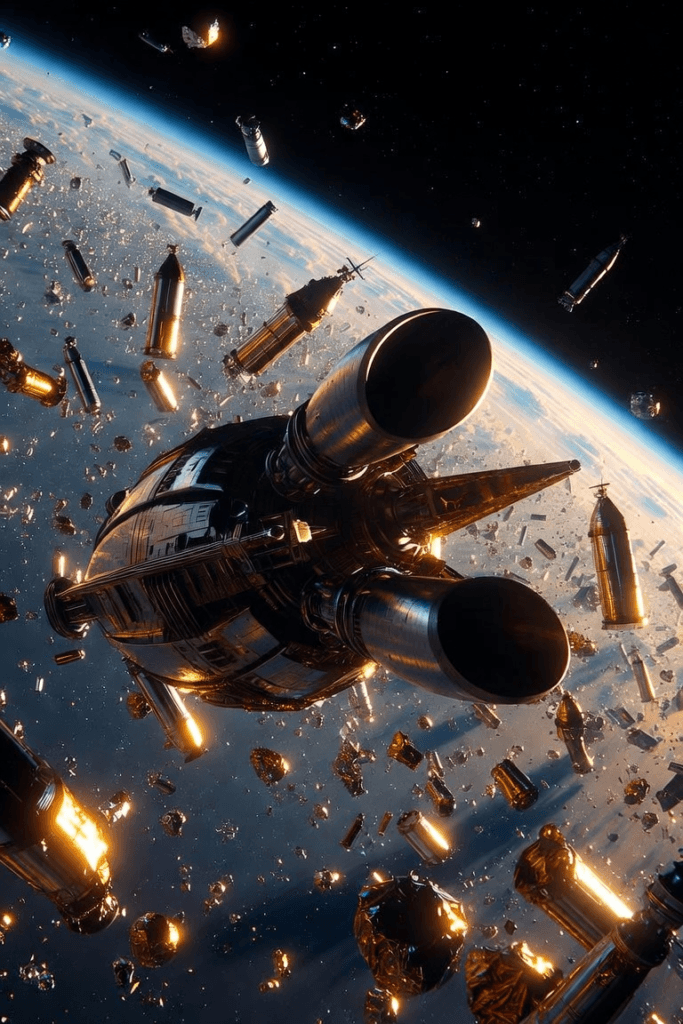
This relentless push forward has left us with a dangerous side effect: orbital debris. In our rush to reach further, we have turned Low Earth Orbit into a junkyard. We mastered the challenge of launching satellites, but we failed to account for long-term sustainability. Now, we are constrained by the very technology that was supposed to liberate us, growing so dependent on data that we risk making space too crowded to navigate safely.
Conclusion: Stopping the Cycle
Are we destined to keep accelerating without pause, or can we step back and reevaluate our trajectory?
The lesson is profound: if we treat Mars simply as a resource pit and space as an infinite dumping ground, we will bring the exact same patterns of depletion and negligence to every frontier we touch. True progress lies not in how fast we can push forward, but in cultivating sustainability alongside our ambition.
Disclaimer: This editorial provides an analytical perspective on the intersection of space exploration and sustainability. It does not reflect the official position of any government or space agency.