
Artificial intelligence is often judged by what users can see—a chatbot answering questions, an AI generating images or software writing code. Far less attention is paid to the AI computing power working behind every one of those breakthroughs. Yet that invisible resource has quietly become one of the biggest competitive advantages in the global AI race.
The shift has happened surprisingly quickly. Just a few years ago, discussions about AI focused on chatbots, algorithms and research breakthroughs. Today, the conversation inside the technology industry has changed. Companies are investing unprecedented amounts in specialised processors, AI supercomputers and massive computing clusters because they understand a simple reality: without enough computing power, even the most talented AI researchers cannot build the next generation of AI.
In the previous article, AI Infrastructure: The Hidden World Behind Every AI Model, we explored the physical backbone of artificial intelligence—from data centres and high-speed networks to the enormous energy systems that keep modern AI running. That infrastructure has become indispensable to the AI revolution, but it answers only one part of the story.
Building the infrastructure does not automatically create powerful AI. The next challenge is AI computing power—the ability to combine thousands of advanced processors into a single system capable of training and running frontier AI models.
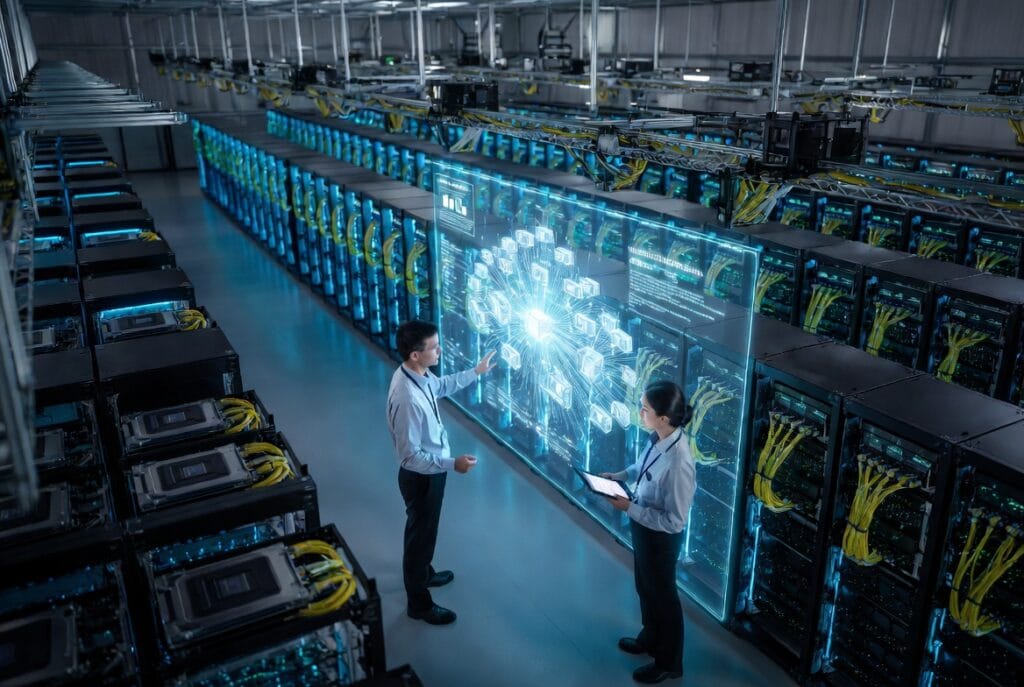
Inside these facilities, thousands of advanced processors must work together seamlessly to perform trillions of calculations every second. Harnessing that collective processing power has become one of the biggest competitive advantages in artificial intelligence.
That is where the real race begins.
Chips Start the Journey. Compute Finishes It.
Owning an advanced AI chip is not the same as owning advanced artificial intelligence.
A modern AI model is not trained on a single processor. Instead, thousands of specialised chips work together inside high-performance computing clusters. Every processor performs part of the workload, while ultra-fast networks constantly exchange information between them. Remove enough processors from the system, and training slows dramatically. Remove most of them, and training becomes impossible.
This is why the industry’s attention has shifted from individual chips to AI computing power itself. Companies are no longer competing for hardware alone but for the computational capacity that hardware can deliver.
The value of a processor is no longer measured only by how fast it is. It is measured by how effectively thousands of processors can operate together as one enormous machine. That collective performance—rather than the capability of any individual chip—is what determines how quickly a company can develop increasingly powerful AI models.
For leading AI companies, compute has become the resource that defines ambition. Larger models require more training. More training demands more processors. More processors require larger facilities, stronger networks and enormous amounts of electricity. Each step increases both cost and complexity, making AI development one of the most resource-intensive fields in modern technology.
his growing demand has fundamentally changed the economics of artificial intelligence. A decade ago, building a successful technology company was largely about attracting talented engineers and writing better software. Today, success increasingly depends on whether an organisation can secure enough computing power to support its AI ambitions. As models become more sophisticated, compute is no longer just another technical requirement—it has become one of the most valuable assets in the AI industry.
That change explains why the world’s largest technology companies have dramatically increased their investment in AI infrastructure and computing capacity. The competition is no longer simply about developing the smartest AI model. It is about building the resources needed to train, improve and deploy those models faster than anyone else.
The Global Race for AI Computing Power
This is why the industry’s attention has shifted from individual chips to AI computing power itself. Companies are no longer competing for hardware alone but for the computational capacity that hardware can deliver.. AI is no longer viewed simply as another software product. It has become an infrastructure business that demands enormous long-term investment.
Over the past few years, Microsoft, Google, Amazon, Meta and xAI have committed unprecedented amounts of capital to expanding their AI capabilities. New data centres are being built, existing facilities are being upgraded and thousands of advanced GPUs are being deployed to support the growing demand for AI training and inference. According to the Stanford AI Index 2026, corporate investment in AI reached record levels, with much of that spending directed towards the infrastructure and compute needed to develop increasingly capable AI systems.
This investment reflects a simple reality. Building a frontier AI model is no longer just a research challenge—it is an engineering challenge that depends on access to enormous computational resources. The organisations capable of securing that capacity can train larger models, test new ideas more quickly and bring products to market at a pace that smaller competitors often struggle to match.
The rapid rise of Nvidia illustrates how valuable compute has become. Originally known for graphics processors used in gaming, the company found itself at the centre of the AI boom because its GPUs proved exceptionally well suited to the parallel calculations required by modern machine learning. Today, Nvidia’s hardware powers many of the world’s leading AI systems, while cloud providers continue expanding their GPU fleets to meet demand.
Yet the competition extends far beyond a single company. Every major technology firm is trying to secure enough computing power to support the next generation of AI. In many cases, the challenge is no longer whether companies can afford the investment, but whether enough advanced hardware can be produced and deployed quickly enough to meet demand.
When Compute Becomes a Strategic Resource
As computing power becomes more valuable, its importance extends beyond the technology industry.
Governments increasingly recognise that access to advanced compute will influence scientific research, economic competitiveness and national security. Just as semiconductors became a strategic technology during the global chip race, computing capacity is now emerging as another pillar of technological leadership.
This explains why countries are investing heavily in AI infrastructure, expanding high-performance computing facilities and encouraging domestic cloud capabilities. The objective is not simply to support today’s AI applications but to ensure their industries and researchers remain competitive as AI systems continue to evolve.
The conversation has also shifted from owning hardware to controlling capability. A warehouse filled with advanced processors means little if those processors cannot operate together efficiently. The true advantage lies in building integrated computing systems that combine hardware, software, networking and energy into a platform capable of training frontier AI models.
That combination is becoming increasingly difficult to replicate, giving countries and companies with large-scale compute a growing strategic advantage.
The Compute Divide
The AI revolution is often described as a global opportunity, but access to computing power tells a different story.
While cloud computing has made AI tools widely available, building frontier AI models remains concentrated among a relatively small number of organisations with the financial resources to invest billions of dollars in infrastructure. Universities, startups and many developing countries often rely on shared cloud services because constructing their own large-scale computing facilities is financially unrealistic.
This growing gap has sparked an important debate within the AI community. If only a handful of companies control the computing resources needed to develop the most advanced models, how competitive can the industry remain over the long term?
Some researchers argue that cloud platforms have lowered barriers by giving smaller organisations temporary access to powerful computing resources. Others believe the widening gap in compute ownership could eventually concentrate AI innovation among a limited number of technology giants.
The answer remains uncertain, but one thing is becoming increasingly clear. In the AI era, access to computing power is emerging as a competitive advantage in much the same way that access to capital, energy or natural resources shaped earlier industrial revolutions.
Artificial intelligence is often judged by what users can see—an answer from a chatbot, an image generated in seconds or software capable of writing code. Yet none of those achievements exist without the vast computing power working behind the scenes.
The AI race has therefore entered a new phase. Success is no longer determined solely by better algorithms or access to advanced semiconductor chips. Increasingly, it depends on who can build, finance and sustain the computing capacity required to train and deploy increasingly sophisticated AI models.
This shift is already reshaping the technology industry. Companies are investing billions of dollars in AI supercomputers, expanding data centres and competing for access to the hardware needed to support future AI development. At the same time, governments are beginning to treat computing power as a strategic national asset rather than just another technological resource.
The story of artificial intelligence is no longer just about software. It is about the physical systems, infrastructure and computational resources that make software intelligent in the first place.
Yet an even more important question now comes into focus.
If companies and governments are investing unprecedented amounts to build this extraordinary computing capacity, what are they ultimately trying to achieve?
For many of the world’s leading AI laboratories, the answer is no longer a better chatbot or a more capable image generator. Their ambition is far greater—to develop Artificial General Intelligence (AGI), a system capable of performing intellectual tasks across a wide range of domains with a level of flexibility that today’s AI has yet to achieve.
Whether that goal is within reach remains one of the most debated questions in modern technology.
In the next chapter of this series, we’ll examine why the global race for AGI has become one of the defining scientific and geopolitical competitions of the twenty-first century.












[…] dollars building the foundations of artificial intelligence. As explored in the previous chapter, AI Computing Power: Why It Shapes the Future of AI, advanced semiconductor chips have become strategic assets, vast data centres continue to expand […]