
AI infrastructure rarely dominates public conversations about artificial intelligence, yet it has quietly become one of the technologies that make the entire AI ecosystem possible. In the previous article, we traced the global AI race to Taiwan, where advanced semiconductor chips emerged as a strategic asset for governments and technology companies alike. But manufacturing those chips is only the beginning of the story
Once they leave the factory, they enter a world that most people never see—a world of vast data centres, enormous energy demands and computing systems operating on a scale that would have seemed unimaginable only a decade ago.
That hidden infrastructure has quietly become one of the most important foundations of the AI age.
Most people interact with artificial intelligence for only a few seconds at a time.
A student asks a chatbot to explain a difficult concept.
A programmer requests help debugging code.
A designer generates an image from a short description.
The answer appears almost instantly.
From the user’s perspective, it feels as though AI exists somewhere inside an invisible cloud, ready to respond whenever it is needed.
The reality is far more physical.
Every response generated by a modern AI system begins a journey through an enormous network of computers housed inside highly specialised data centres. These facilities rarely appear in technology advertisements, yet they perform the countless calculations required to train and operate today’s most advanced AI models.
Without them, even the most sophisticated algorithms would remain little more than lines of code.
This is one of the greatest misconceptions surrounding artificial intelligence.
Public attention often focuses on chatbots, image generators or the companies that build them. The infrastructure supporting those systems receives far less attention, even though it determines how quickly AI models can be trained, how many users they can serve and how reliably they operate.
The software captures headlines.
The infrastructure makes the software possible.
That distinction is becoming increasingly important as governments and technology companies invest billions of dollars in expanding their AI capabilities.
Only a few years ago, discussions about data centres were largely confined to engineers, cloud providers and enterprise technology. Today, they have become part of conversations about economic competitiveness, industrial policy and national security.
Artificial intelligence has changed the role these facilities play in the global economy.
They are no longer simply warehouses filled with servers.
They have become the factories of the digital age.
Inside a modern AI data centre, thousands of advanced processors work together continuously, performing vast numbers of mathematical operations every second. These processors communicate through ultra-fast networking systems designed to move extraordinary volumes of data with minimal delay. Around them, carefully engineered cooling systems prevent temperatures from rising high enough to damage sensitive hardware.
Everything inside the facility is designed for one purpose.
Keeping computation running without interruption.
The scale is difficult to appreciate until it is compared with something familiar.
A personal computer may process one person’s work at a time.
An AI data centre supports millions of requests from users around the world while simultaneously training increasingly sophisticated models that require weeks—or even months—of continuous computation.
This difference explains why artificial intelligence has become far more than a software industry.
It has become an infrastructure industry.
Building one of these facilities requires far more than purchasing powerful computers. Companies must secure suitable land, reliable electricity, high-capacity fibre-optic connections and advanced cooling technology before a single AI model can begin operating.
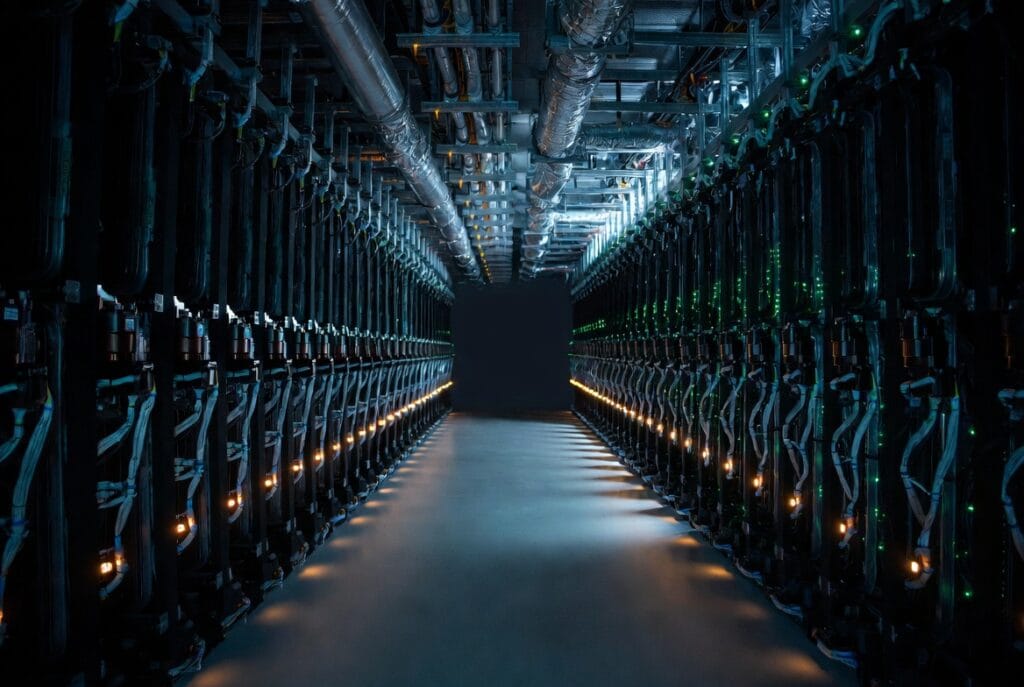
Each new generation of AI increases those demands.
As models become more capable, they also require greater computing capacity.
That growing demand has introduced a new word into conversations about artificial intelligence:
Compute.
Unlike software, compute cannot be downloaded.
It cannot be created overnight.
It must be built through years of investment in hardware, networking and physical infrastructure.
For technology companies, compute has become one of the most valuable resources in the AI era because it determines how quickly new models can be developed, tested and deployed.
For governments, it represents something equally significant.
Strategic capability.
This is one reason countries are paying much closer attention to data centres than they did only a few years ago. Computing infrastructure is increasingly viewed alongside energy networks, telecommunications systems and semiconductor manufacturing as part of a nation’s long-term technological resilience.
The conversation surrounding artificial intelligence has therefore changed in an important way.
Not long ago, people asked which company had built the smartest chatbot.
Today, policymakers are asking a different question.
Who has the infrastructure to support the next generation of artificial intelligence?
That question has no simple answer.
But it is already shaping investment decisions, industrial strategy and international competition across much of the world.
And it leads directly to another challenge—one that receives even less public attention than data centres themselves.
Power.
To be continued…
Read Further:
Stanford AI Index Report (2026): Essential for the latest data on model environmental impact, computing capacity, and global competitive dynamics.
IEA: Energy and AI (2025/2026 Updates): The definitive resource for the energy-AI nexus, including projections on electricity demand, infrastructure bottlenecks, and grid security.












[…] the previous article, AI Infrastructure: The Hidden World Behind Every AI Model, we explored the physical backbone of artificial intelligence—from data centres and high-speed […]