I have always been fascinated by history’s most mysterious enigmas, but the story of The Maiden of Llullaillaco hits differently. These girls were chosen for their perfection and noble blood, torn from their families to live in total, windowless seclusion in Cusco’s sanctuaries. Eventually, “The Maiden” was picked for the highest, most haunting honor in the Inca world: the Capacocha offering. Honestly, it’s a difficult concept to grasp—in Quechua, there isn’t even a word for “sacrifice.” To the Inca, she wasn’t being killed; she was being immortalized as a bridge between humanity and the gods who controlled their world.
For years, we were told she simply froze to death on that mountain. But honestly? Modern science has turned that theory upside down. After looking at the latest CT scans, it’s clear the story is much more complex. As she reached the 21,000-foot mark, the priests gave her heavy doses of chicha and coca leaves. It was meant to dull her senses and fight off the altitude, but it also paints a picture of a very controlled, final ritual. Her body was found sitting, hands resting perfectly—no struggle, no panic. Some experts think it was a deliberate, quiet asphyxiation, while others believe the combination of extreme altitude and sedation was the culprit. We still don’t have the definitive answer, and that mystery is what makes this story so heavy.
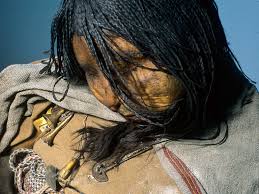
When I think about her—just fifteen years old—the fact that she remained so composed is what really stays with me. It’s profoundly unsettling, right? The way her hands were found folded so perfectly, as if she were just taking a nap, suggests she surrendered to her fate without a single moment of resistance.
Today, she rests in the Museum of High Mountain Archaeology (MAAM) in Salta, Argentina. Seeing her preserved like this… it’s not just looking at a mummy; it’s looking at a person. She remains a silent, haunting witness to an ancient empire, helping us understand the lives of the aclla, or “chosen women,” of the Inca.
What do you think? Does the idea of this being a “peaceful” transition make it easier to process, or does it make the whole ritual feel even more chilling? I’d love to hear your thoughts in the comments.
To explore more of the science behind this, check out the field notes from National Geographic and the preservation records on UNESCO.mperial capital of Cusco, walking across the driest deserts on earth to reach the volcano base.