
In the previous article, The AI Cold War, we explored how artificial intelligence has evolved far beyond Silicon Valley. Governments are no longer competing simply to build better AI models. They are competing for technological leadership, economic resilience and strategic influence in an increasingly digital world.
Yet every geopolitical competition has a foundation.
For artificial intelligence, that foundation is not software.
It is silicon.
Every time someone opens ChatGPT, asks Gemini a question or generates an AI image, they interact with the final layer of an extraordinarily complex technological system.
What remains invisible is everything that happens long before that response appears on a screen.
Months—and often years—before an AI model can answer a single question, engineers must design specialised processors. Those processors are then manufactured inside some of the most advanced factories ever built. Only after that immense engineering effort can companies begin training the AI models used by millions of people every day.
Artificial intelligence, in other words, starts long before anyone opens a chatbot.
It begins with semiconductor chips.
That simple reality has quietly transformed one small island in East Asia into one of the world’s most strategically important places.
Taiwan.
For decades, Taiwan was best known for its export-driven economy, vibrant democracy and world-class electronics industry. Outside technology circles, however, few people paid much attention to one company that was steadily becoming indispensable to the global digital economy.
Its name is Taiwan Semiconductor Manufacturing Company, better known as TSMC.
Unlike Apple, Microsoft or Nvidia, TSMC rarely appears in consumer advertising or launches products aimed at the general public. Most people have never visited its website or watched one of its corporate events. Yet there is a strong possibility that the smartphone in your pocket, the laptop on your desk and the cloud services you rely on every day all depend, in one way or another, on chips manufactured by TSMC.
For years, the company operated quietly behind the scenes while the world’s biggest technology brands captured public attention.
Artificial intelligence did not create TSMC’s importance.
It revealed it to the rest of the world.
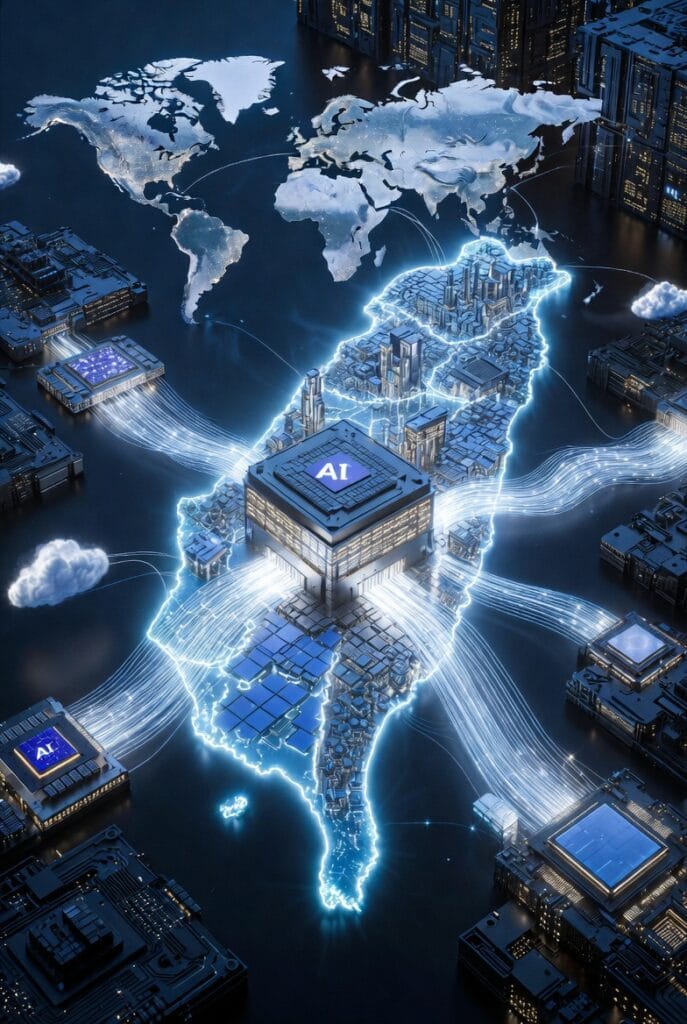
Modern AI systems require extraordinary computing power. Behind every advanced language model are thousands of specialised processors working together inside massive data centres. Designing those processors is a remarkable engineering achievement.
Manufacturing them is even more demanding.
Producing advanced semiconductors requires extreme precision, highly controlled clean-room environments and sophisticated lithography systems capable of etching microscopic circuits onto silicon wafers. Only a small number of manufacturers possess the expertise to produce chips at the leading edge of semiconductor technology.
TSMC is widely recognised as the global leader in that field.
Its position was not built overnight. It emerged through decades of investment, manufacturing expertise and a business model that focused on producing chips designed by other companies rather than competing with them. That strategy eventually made TSMC an essential manufacturing partner for many of the world’s largest technology firms.
When generative AI accelerated global demand for advanced processors, TSMC was already at the centre of the semiconductor ecosystem.
Suddenly, a company that had spent decades working largely behind the scenes found itself at the centre of an international conversation about technology, economics and national security.
Why This Matters Far Beyond Technology
At first glance, semiconductor manufacturing may appear to be a specialised industry with little relevance to everyday life.
In reality, it underpins much of the modern digital economy.
Every significant advance in artificial intelligence depends on hardware powerful enough to train increasingly complex models. That hardware relies on advanced semiconductor manufacturing, supported by a global supply chain that spans multiple countries and industries. Taiwan occupies a uniquely important position within that network.
This is why discussions about TSMC are no longer limited to engineers, investors or technology executives.
Its role is now part of conversations taking place in government offices, economic forums and national security meetings around the world.
Artificial intelligence may capture public attention through software.
But before software can reshape industries, economies or scientific research, someone has to manufacture the silicon that makes it possible.
For now, much of that story begins in Taiwan.
Next in this Series
Taiwan may manufacture many of the world’s most advanced AI chips, but manufacturing them is only part of the story. Why have governments become so concerned about semiconductor supply chains? And how did chips become one of the most valuable strategic assets in modern geopolitics?
In the next article, we’ll examine how semiconductors moved from factory floors to the centre of global diplomacy, economic strategy and national security.










[…] that make the entire AI ecosystem possible. In the previous article, we traced the global AI race to Taiwan, where advanced semiconductor chips emerged as a strategic asset for governments and technology […]