
In my view, it is crucial to distinguish between the two—social media loves stories of ‘unbreakable friendship,’ but when it comes to actual diplomacy, national interest often takes precedence. I have witnessed this myself: what is proclaimed most loudly online often does not align with the realities unfolding behind closed doors. Don’t you think the same?
The Historical Foundation of India-Israel Relationship
To understand this partnership, one must look beyond the screen. The foundation of India-Israel relations was not built on social media hype; it was forged in the heat of national security crises when few others were willing to stand by India.
Two historical milestones remain the bedrock of this relationship:
- The 1971 Conflict: During the war that led to the birth of Bangladesh, when international support for India was scarce, Israel quietly provided critical military assistance, intelligence, and ammunition. It was a partnership of necessity that recognized mutual interests long before it was publicly acknowledged.
- The 1999 Kargil War: Perhaps the most “atoot” (unbreakable) moment in history was during the Kargil conflict. When India faced severe challenges in high-altitude precision targeting, Israel stepped in, providing essential laser-guided bombs and advanced intelligence support.
What strikes me most about these two moments is that neither of them made headlines back then — they were quiet, almost secretive acts of support, which is very different from today’s public ‘brotherhood’ posts
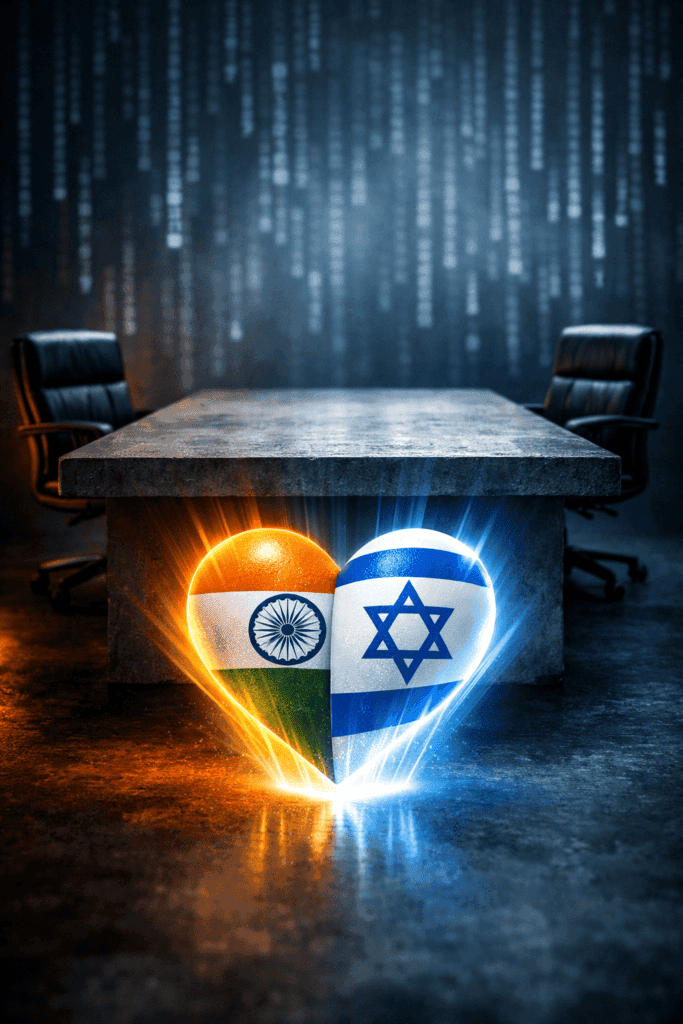
These events transformed India Israel relationship from a tentative diplomatic connection into a pragmatic partnership. These were not just gestures of “friendship”; they were affirmations of strategic convergence—a realization that both nations faced similar existential challenges in hostile neighborhoods.
”India Israel Relationship” Reality Check: Strategic Autonomy vs. Transactional Ties
Given the current geopolitical landscape, it is essential to move beyond the “best friend” mindset. India’s foreign policy is anchored in ‘strategic autonomy.’ While India attaches great importance to its partnership with Israel, it simultaneously maintains deep ties with Iran and Arab nations to ensure energy security and regional stability. The concept of ‘de-hyphenation’ applies here. You might be wondering what this term actually means; essentially, de-hyphenation refers to a country keeping its dealings with two mutually antagonistic nations separate and independent of one another. For instance, India is a good friend to Israel while simultaneously maintaining its relationship with Palestine. India does not view this partnership through the prism of its relations with other countries. Instead, it pursues a policy of ‘multi-alignment.’ This enables New Delhi to collaborate with Israel on advanced defense technology and space exploration, while simultaneously working with Tehran on key infrastructure projects like the Chabahar Port.
The “Radio Mute” Dilemma: Maturity or Muteness?
Critics often point to India’s measured response — or “radio mute” stance — during recent escalations in the Middle East as a sign of hesitation. But I’d argue that reading this as weakness misunderstands modern Indian statecraft entirely.
To me, India’s silence during flare-ups between Israel and its regional adversaries isn’t a lack of commitment — it’s strategic restraint. As an emerging “responsible power,” India seems to understand that entering the fray as a “proxy warrior” would undermine its global influence and jeopardize its domestic growth. By prioritizing dialogue and de-escalation, India positions itself as a credible mediator rather than a partisan stakeholder.
Conclusion: A Pragmatic Partnership
India-Israel relations are neither a fleeting social media trend nor merely an emotional alliance; here, if you were to ask for my opinion, I would say they represent a pragmatic partnership. This relationship is grounded in concrete national interests, historical trust, and a shared perspective on security.
We must also not forget that as the world moves towards transaction-based diplomacy, both nations have demonstrated a remarkable ability to adapt. The strength of this relationship is evident not in public statements, but in the quiet and sustained cooperation taking place behind closed doors.
One thing is absolutely clear: India is not becoming a pawn of any nation; instead, it is shaping an independent foreign policy rooted in its own interests—one that contributes to global stability while simultaneously ensuring the country’s security.
In reality, The way I see it, true strength is what was demonstrated during the Kargil conflict, when Israel provided assistance without seeking any credit. That is the real test—not what people are writing on X (Formely used)Twitter. What do you think? If you like this, do let me know in the comments.
In the high-stakes theater of global diplomacy, words are rarely just words; they are calculated instruments of statecraft. When Lee Jae-myung, South Korea’s Opposition Leader and head of the Democratic Party, recently branded Israeli Prime Minister Benjamin Netanyahu a “war criminal.. Read the Full Analysis Here : https://iritvik.com/south-korea-israel-netanyahu-war-criminal/
Read Further
- Observer Research Foundation (ORF): An excellent resource for expert analysis on India’s strategic autonomy and regional foreign policy.
- The Diplomat: Ideal for linking to objective reporting on the history and development of defense cooperation in Asia-Pacific affairs.
- Carnegie Endowment for International Peace: A premier source for in-depth research on India’s role as a “Responsible Power” and its multi-alignment strategy.
- Council on Foreign Relations (CFR): A highly authoritative source for broader context on global geopolitical trends and Middle East dynamics.









[…] In the age of social media, geopolitics is often reduced to hashtags and viral trends. Nowhere is this more evident than in the current discourse surrounding India Israel relationship. A quick scroll through platforms like X or Facebook reveals a narrative of “unbreakable brotherhood” and “unconditional solidarity.” While the warmth of this sentiment is undeniable, it is vital to distinguish between the public’s emotional projection and the cold, calculated mechanics of international diplomacy. Read the Full Analysis here : https://iritvik.com/india-israel-relations-geopolitics/ […]