
In our previous analysis, we labeled the Islamabad MoU as a “blueprint for failure.” Today, as the Trump administration officially shuts the door on any further negotiations with Tehran, it is clear that we are witnessing a systemic US Iran policy failure — not just a diplomatic setback, but a total breakdown of strategic foresight.
To understand how we reached this point, we must decode the sequence of errors that defined this collapse.
Decoding the Roots of the Policy Failure
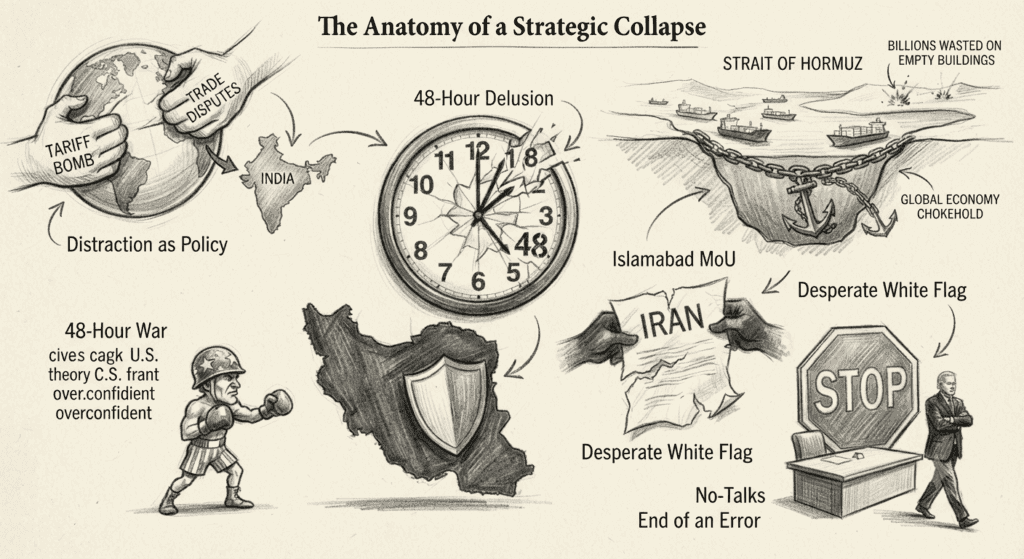
The genesis of this breakdown lies in a fundamental miscalculation of regional priorities. The administration’s initial “Tariff Bomb” strategy — which targeted even close allies like India — sent a signal of fragmentation. By prioritizing transactional trade disputes over cohesive coalition-building, the U.S. alienated key partners and created a vacuum in its regional resolve.
The 48-Hour Delusion
Perhaps the most damaging aspect of this failure was the “48-hour war” theory. This is my own read on the situation, not a confirmed fact: it looks to me like U.S. intelligence assessments may have leaned too heavily on narratives pushed by regional actors like Pakistan — actors who arguably had their own reasons to want a conflict. If that’s true, it would explain the strategic hubris behind assuming a surgical strike could cripple the Iranian regime in just two days. Either way, the U.S. committed to a conflict it seems conceptually unprepared for, and planned for a victory that never materialized.
The Forgotten Chokepoint: The Strait of Hormuz
While billions of dollars were incinerated in the deserts of Iran destroying empty buildings, the true battleground was ignored: the Strait of Hormuz. Iran played an asymmetric game, holding the global economy hostage at the Strait. By focusing on traditional military metrics rather than the geoeconomic reality of the Strait, the U.S. allowed Iran to dictate the pace of the conflict. The war escalated, and the U.S. found itself backed into a corner.
The Islamabad MoU: A Desperate Exit
When the conflict crossed the 90-day mark, the U.S. was no longer seeking a resolution; it was seeking an exit. The Islamabad MoU, negotiated under mediation that — in my view — came from parties with their own stake in prolonging the conflict, felt more like a sign of exhaustion than genuine diplomacy. It provided Iran with the legitimacy it craved while offering the U.S. nothing but a hollow promise of stability.
The “Islamabad Memorandum of Understanding” (MoU) is being sold as a historic path to peace. However, a deep dive into its 14 clauses reveals a much darker reality. Read Full Analysis Here: https://iritvik.com/islamabad-mou-failure-analysis/
Why the Door is Now Locked
Trump’s declaration that the ceasefire is “over,” even as technical talks with Iran continue in some form, feels, to me, like an admission of how fragile this entire process has become.
This administration seems to have finally recognized a few hard truths: that the mediation trap of using intermediaries with conflicting agendas was a fatal flaw, and that continued engagement only validated an agreement Iran seemed increasingly unlikely to honor. In my reading, the era of appeasement is over — without leverage, diplomacy risks becoming just a delay tactic for the other side.
The Islamabad MoU, I’d argue, was doomed from the start — built on shaky intelligence and overconfident military posturing. By closing the door on these negotiations, Washington may be trying to restore a shred of credibility, but the path forward, in my view, requires a complete overhaul of how the U.S. reads its regional partners and the harsh realities of the Middle East.
Read Further
- On the Misapplied Label of “Intelligence Failure”: Just Security – Iran, Trump, and the Misapplied Label of Intelligence Failure
- On Strategic Failure and Aerial Delusions: Cato at Liberty – A Strategic Failure in Iran
- On the Strait of Hormuz Chokepoint: Council on Foreign Relations – The Strait of Hormuz Already Faces a Tough Recovery
- Comprehensive Overview of the 2026 Conflict: Britannica – 2026 Iran War









[…] historical foundation of U.S.–Pakistan relations has rarely been rooted in shared values, but rather in shared contingencies. Throughout […]