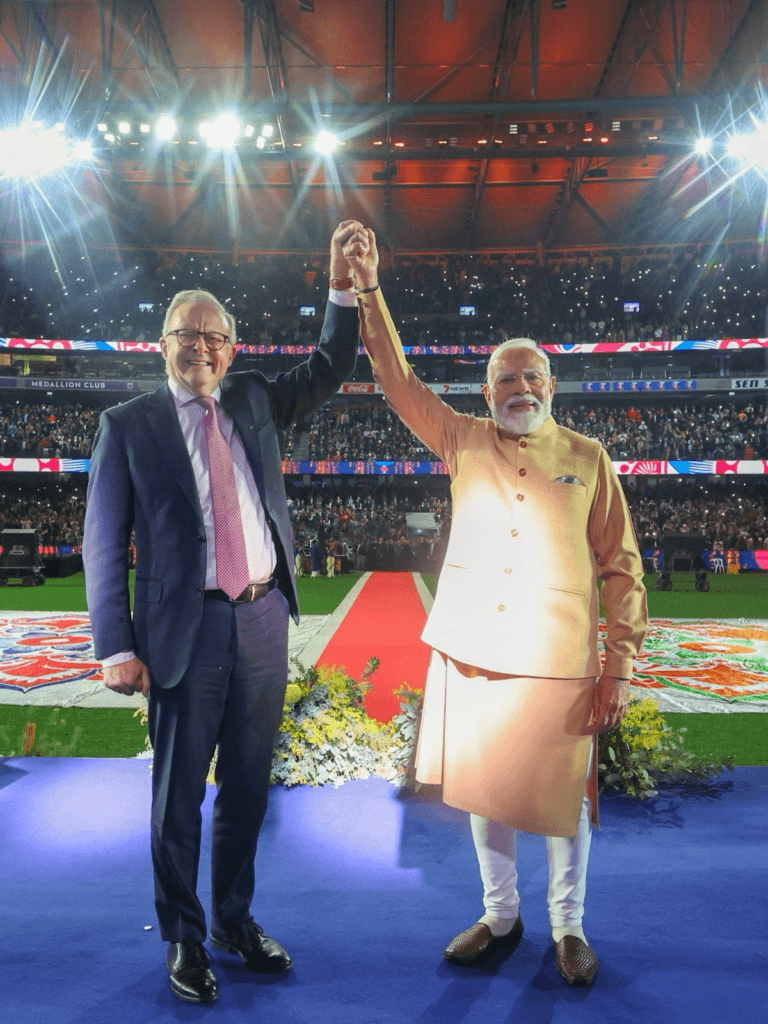
Prime Minister Narendra Modi’s recent visit to Australia marks a decisive shift toward a sophisticated “Strategic-Industrial Alliance”. By mapping the 18 outcomes announced by MEA spokesperson Randhir Jaiswal, we can see how New Delhi and Canberra are building a resilient architecture to secure the Indo-Pacific.
1. Strengthening Defense and Maritime Security
The two nations are moving beyond simple dialogue toward operational integration. Defense cooperation also took concrete shape during this visit. The most practical aspect I found was the Joint Declaration on Defense and Security Cooperation, which fosters industrial collaboration and innovation — it’s not just symbolic, but a step towards actual defense-manufacturing tie-ups. This was accompanied by the Maritime Security Collaboration Roadmap, which strengthens information-sharing and joint operational coordination. What stood out most concretely, though, was the MoU signed between the Indian Coast Guard and the Maritime Border Command — it directly advances coastal surveillance and law enforcement, not as a future roadmap, but as an immediate operational step. And a small but interesting detail — Australia has invited an Indian military instructor to the Australian Defence College for 2028-29, which shows long-term professional engagement.
2. Ensuring Energy Sovereignty
During the visit, both leaders prioritized energy security to reduce global dependency. Energy security was clearly a priority during this visit — and the most interesting part, I found, was that uranium supplies would begin to flow from Australia through the Civil Nuclear Agreement. This directly supports India’s energy diversification strategy, especially as we seek cleaner sources than coal. It also included a Joint Statement on Energy Security, a commitment to protecting energy flows between the two countries — though how much of this translates into actual uranium shipments soon, versus just diplomatic language, remains to be seen.
3. Technological and Digital Resilience
To hedge against digital vulnerabilities, the visit established a robust technology bridge. Cyber and critical-technology cooperation was also an important part of this visit — and honestly, it’s the area I think will matter most in the long term. The Partnership for Cyber and Critical Technologies strengthens both digital resilience and supply-chain security, which today has become an issue not just of defense but also of economic security.
List of outcomes (18 in total) : PM @narendramodi’s Official Visit to Australia
— Randhir Jaiswal (@MEAIndia) July 9, 2026
🇮🇳 🇦🇺 pic.twitter.com/4YTiIEL1pt
4. Transforming Human Capital
The visit introduced a new paradigm in education, moving from student mobility to institutional presence.
The visit also brought something genuinely new to education – moving beyond simply sending students to Australia, Australian institutions are now establishing themselves in India. Most notable is Flinders University’s plan to establish a campus in Bengaluru – the 8th Australian university to expand in India, which itself represents an interesting trend. A Centre of Excellence in Mining will also be established in Bhubaneswar, providing technology exchange and modern mining training. And NCVET has aligned its regulatory frameworks with Australian standards to boost skills development – it may seem small, but it could have a significant impact on workforce quality in the long term.
The Geopolitical Takeaway
I personally feel that the India-Australia Strategic Partnership has moved beyond just a trade relationship – India is now establishing itself in a more independent position in the Indo-Pacific, rather than being completely dependent on any one major power (like China or the US). This visit, in my view, is a concrete example of that larger strategy – while not as dramatic as a “geopolitical firewall,” it is genuinely significant.
In the age of social media, geopolitics is often reduced to hashtags and viral trends. Nowhere is this more evident than in the current discourse surrounding India Israel relationship. Read the Full Analysis here : https://iritvik.com/india-israel-relations-geopolitics/
Further Read:
- For India-Australia Bilateral Treaties: Ministry of External Affairs (MEA) – Treaty List
- For Comprehensive Strategic Partnership Updates: Department of Foreign Affairs and Trade (DFAT) – India Country Brief
- For Strategic Policy Dialogue and Engagement: Centre for Australia-India Relations (CAIR)