
The Diplomatic Fault Line: South Korea’s Stand on the ICC Warrants
In the high-stakes theater of global diplomacy, words are rarely just words; they are calculated instruments of statecraft. When South Korean President Lee Jae-myung recently branded Israeli Prime Minister Benjamin Netanyahu a “war criminal,” he did more than just break diplomatic decorum. He ignited a fierce debate over the future of South Korea-Israel relations at a time when the international community remains deeply fractured over the International Criminal Court’s (ICC) pending arrest warrants.
To casual observers, President Lee’s sharp rhetoric might look like a fleeting burst of political outrage. In reality, it signals a profound, underlying tension between South Korea’s treaty obligations, its economic dependencies, and a brewing nationalist desire to redefine its place on the global stage as a principled power.
The immediate catalyst for this diplomatic rupture hits close to home for the South Korean public. Tensions escalated sharply following Israel’s detention of two South Korean citizens who were intercepted while attempting to deliver humanitarian aid to the blockaded Gaza Strip. For any sovereign nation, the safety of its citizens abroad is an absolute red line. As a former human rights lawyer, President Lee’s response was characteristically unyielding. By aligning his stance with European nations that have pledged to uphold the ICC’s mandates, Lee is pushing a narrative that South Korea must act like a mature, principled global power, even if it means ruffling the feathers of traditional allies.
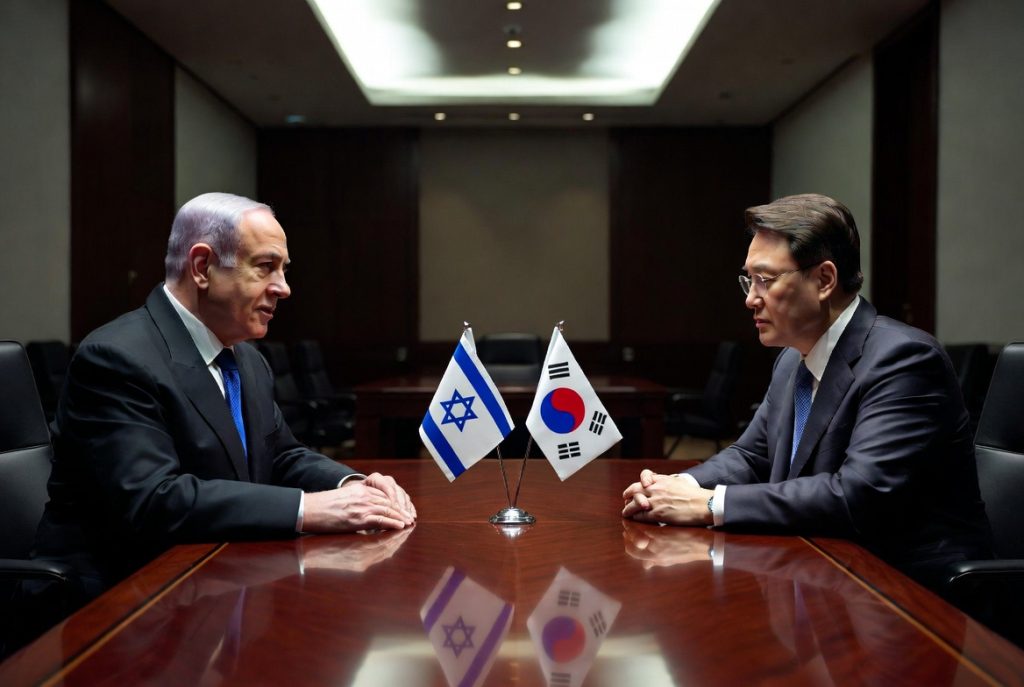
This raises a fascinating legal dilemma: if Netanyahu were to theoretically land in Seoul, would South Korea be forced to detain him? On paper, the answer is a definitive yes. As a signatory state to the Rome Statute, the country is legally bound to cooperate with the ICC—a factor that now weighs heavily on the current state of South Korea-Israel relations. President Lee himself emphasized this during a high-profile Cabinet briefing, suggesting that South Korea’s credibility on the world stage hinges on its adherence to international law.
However, the chasm between legal theory and realpolitik is vast. In the practical world of international relations, such an arrest is virtually impossible. Netanyahu’s security apparatus would simply never schedule a visit to a jurisdiction carrying even a nominal risk of detention. Furthermore, behind the fiery rhetoric of political leaders, South Korea’s seasoned bureaucratic machinery—the Foreign Ministry and the National Security Council—is already quietly working to contain the fallout, ensuring that the foundational architecture of the bilateral relationship remains intact.
Fears of a catastrophic military retaliation from Jerusalem are equally unfounded, neutralized by both geography and global alliance structures. Separated by more than 8,000 kilometers, Israel lacks the logistical footprint in East Asia to project direct military force against a state of South Korea’s magnitude. More importantly, both nations share a vital, overarching patron: the United States. Bound to Seoul by a robust Mutual Defense Treaty, Washington views both countries as indispensable pillars of its global security framework. Should the diplomatic chill threaten to boil over into a structural crisis, the White House would instantly intervene as a mediator, forcing both democratic allies back to the negotiating table.
Where the real damage could occur is in the quiet corridors of commerce. Despite their geopolitical differences, the two nations are deeply intertwined through a highly lucrative Free Trade Agreement. Seoul relies heavily on Israel’s cutting-edge defense technology—particularly advanced radar systems and specialized missile components—while Israel’s consumer market is heavily saturated with South Korean automobiles and tech giants.
Simultaneously, Seoul must perform a delicate balancing act with the wider Middle East. As an export-driven economy with virtually no natural resources, South Korea is overwhelmingly dependent on Arab and Muslim nations for its crude oil and liquefied natural gas. President Lee’s sharp rebuking of Israel serves as a subtle, pragmatic signal to Riyadh, Abu Dhabi, and Doha that South Korea will not offer blind, unconditional diplomatic cover to Jerusalem at the expense of its own energy security.
As the dust settles, South Korea finds itself at a geopolitical crossroads. The immediate future will undoubtedly yield a “cold phase” in bilateral dealings, marked by formal diplomatic protests from Jerusalem and a temporary freeze on high-level state visits.
Yet, this friction reveals a dual reality for Seoul’s global ambitions. On one hand, standing firm on human rights elevates South Korea’s soft power, projecting it as a principled actor among European liberals and the Global South. On the other hand, it introduces an element of volatility into its relationship with the traditional US-led alliance. In modern geopolitics, there are no permanent friendships, only permanent national interests. President Lee’s bold maneuver may have strained South Korea-Israel relations in the short term, but it was a calculated gamble designed to project domestic strength, protect citizens abroad, and secure the vital energy corridors that keep South Korea’s economy alive. Watching this unfold, it’s impossible not to think about how many other mid-sized nations are quietly wrestling with this same tightrope act—constantly trying to keep their moral compass pointed in the right direction while keeping their national survival on track.









[…] In the high-stakes theater of global diplomacy, words are rarely just words; they are calculated instruments of statecraft. When Lee Jae-myung, South Korea’s Opposition Leader and head of the Democratic Party, recently branded Israeli Prime Minister Benjamin Netanyahu a “war criminal,” he did more than just break diplomatic decorum. Read the Full Analysis Here : https://iritvik.com/south-korea-israel-netanyahu-war-criminal/ […]