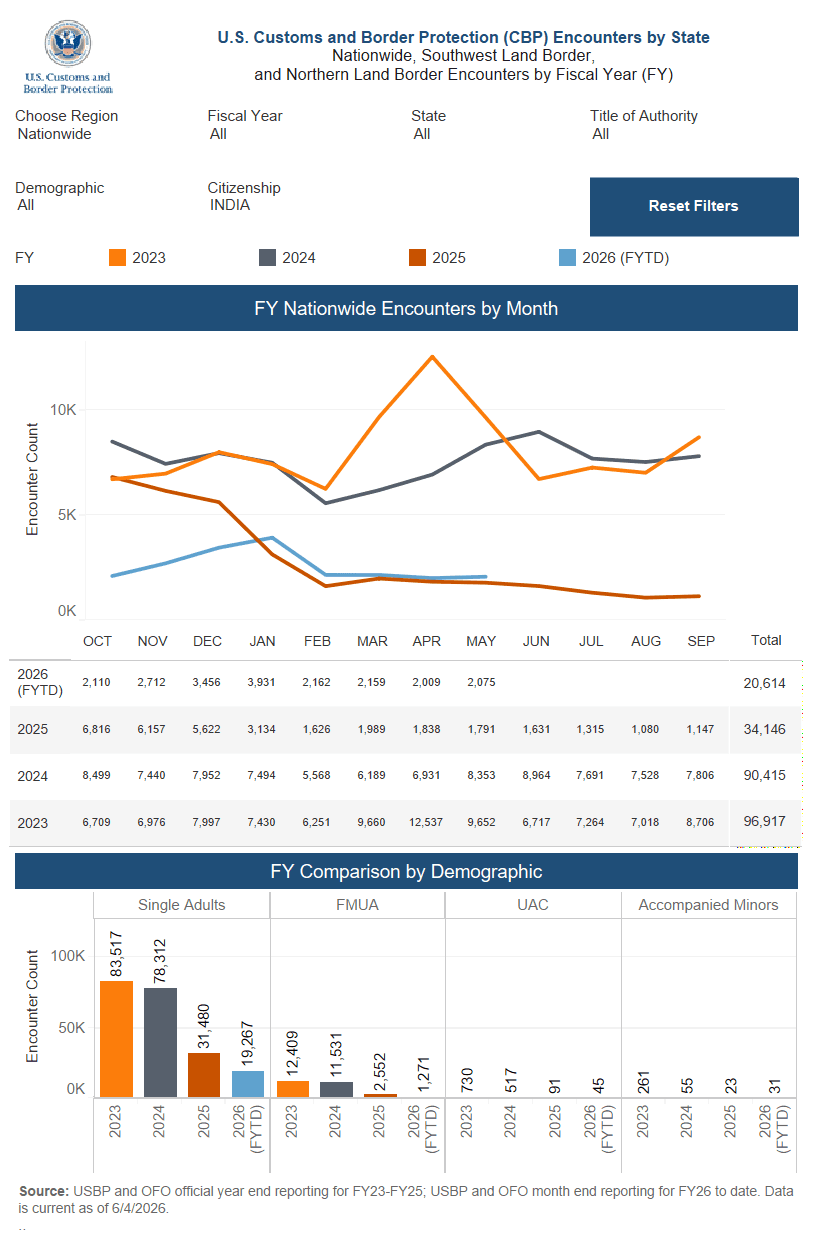
Today, India faces a major dilemma. While the government boasts of its global influence, youth migration from India, “India Youth Exodus”, is reaching record levels, as the country’s most talented young people are leaving in large numbers. I’m not making this up — I’m referring to data released by the government, which we’ll get into shortly. This isn’t just about migration to one destination country — it reflects a broader pattern across every country Indians have moved to. This trend isn’t simply about job search; it’s a clear indication of deep frustration with the current system. Let’s illustrate our point with a recent figure from U.S. Customs and Border Protection (CBP), which recorded thousands of “encounters” with Indian citizens between October 2025 and May 2026 alone.
Furthermore, the broader situation at the Southwest land border speaks for itself. While total encounters have declined sharply from the peak of 2023-24—20,614 have been reported so far in FY2026, compared to 90,415 in FY2024—the point is that this decline reflects tightening at the U.S. border, not a diminishing willingness to cross. If anything, it reveals something more disturbing: even as both legal and illegal routes are becoming increasingly difficult, Indians are still attempting this journey in large numbers. These figures are not just statistics; they reveal why, despite the U.S.’s stringent immigration restrictions, Indians are still willing to risk everything to reach American shores.
Renunciation of Indian Citizenship: An Escalating Trend
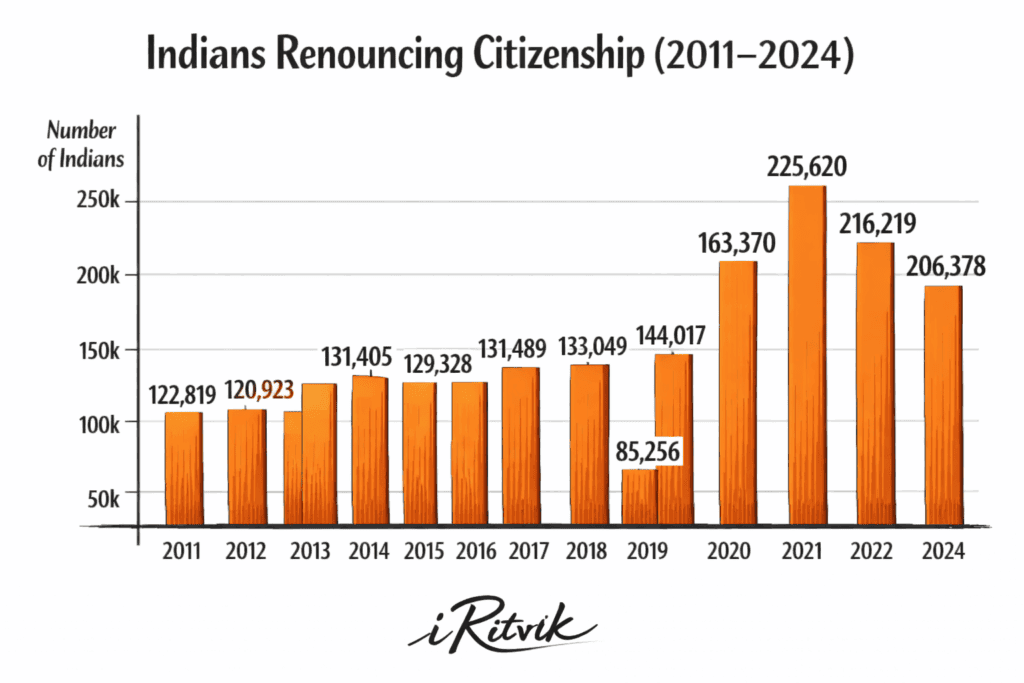
According to data provided by the Ministry, the number of Indians choosing to renounce their citizenship has seen a significant upward trajectory over the last decade. Specifically, 2,16,219 individuals gave up their Indian citizenship in 2023, following a record high of 2,25,620 in 2022. For further context, these figures have risen sharply from 1,22,819 in 2011 and 85,256 in 2020. While the government maintains that the reasons for renouncing citizenship are personal to each individual, the scale of this trend suggests a broader shift in how Indian citizens perceive their future opportunities.
To understand why so many are choosing to leave, one must look beyond the official narrative. While the government frames the departure of its citizens as a “personal choice” and describes the global diaspora as an “asset” for India, the scale of this exodus suggests a deeper systemic disconnect.
Here are the primary reasons driving this shift:
- Systemic Disillusionment and “Ease of Living”: Despite rapid economic growth, many professionals feel that the “Ease of Living” has not kept pace. High-earning citizens often struggle with infrastructure deficits—such as pollution, traffic, and unreliable public services—which are increasingly viewed as standard burdens rather than manageable hurdles.
- Failure of Employment Schemes and Innovation: While the government frequently highlights entrepreneurship schemes, these are often limited to “survival-mode” micro-enterprises rather than fostering sustainable, high-growth ecosystems. For the prosperous class—who are often serial investors, corporate leaders, or ambitious entrepreneurs—this signals a lack of a robust, innovation-driven environment. They perceive that the system is focused on mere subsistence rather than the large-scale wealth creation that drives national competitiveness. While government initiatives like the Mudra Yojana are designed to promote entrepreneurship, many perceive them as insufficient to support sustainable, high-growth ventures. There is a widening gap between the government’s definition of “employment” and the aspirations of a modern, skilled youth population.
- The Talent Drain Impact: The affluent class relies on a highly skilled workforce to scale their own businesses. When government initiatives inadvertently trap talent in low-impact, small-scale self-employment, it shrinks the pool of high-quality professionals available to the private sector. This structural mismatch hinders the business operations of the prosperous class and limits their growth potential within India.
- Misallocation of Taxpayer Wealth: Wealthy citizens, who contribute significantly to the tax base, often view these “survival-cycle” schemes as inefficient misallocations of public funds. They want their tax contributions used to build world-class infrastructure and competitive economic frameworks that attract global capital. Seeing their tax contributions directed toward short-term survival schemes rather than structural, long-term economic reforms deepens their disillusionment with the state’s economic vision.
- Lack of Dignity in the System: Many feel the bureaucratic system operates on a colonial mindset, prioritizing “control” over “service.” When successful individuals feel like “tax-collection machines” rather than respected participants in the nation’s growth, they begin seeking societies that offer greater personal agency and dignity.
- The “Safety Valve” of Migration: For many, migration is the final attempt to secure a predictable future. With 2,06,378 Indians renouncing their citizenship in 2024 alone, it is clear that the decision to leave remains a common response to the perceived instability or lack of opportunity within the domestic system.
Ultimately, the government cannot simply dismiss this trend as a private matter. When the trend involves hundreds of thousands of people annually—up from 1,22,819 in 2011, and still nearly double what it was just five years ago, even after easing slightly from its 2022 peak of 2,25,620 — it represents a failure of the system to retain its most valuable human capital. India must move beyond rhetoric and perform a deep, honest introspection into why its citizens are finding it increasingly difficult to see a dignified future within its borders.
The Failure of Healthcare Infrastructure
The Ayushman Bharat scheme is a well-intentioned move—and I have no doubts about it—but there is a huge difference between having the card and getting good care. Most private hospitals are reluctant to accept these cards due to low reimbursement rates, and public hospitals remain in a state where no middle-class citizen would voluntarily seek treatment. This scheme acts as a “band-aid” rather than a cure for structural failures.
‘WhatsApp University’ and Mental Distraction
Amidst these systemic failures, political propaganda and “WhatsApp University” are distracting the youth from their own growth. By filling minds with hatred and an illusion of superiority, the system steers them toward bitterness. Instead of questioning the system for their lack of opportunity, the youth are conditioned to find flaws in others, losing their prime years to a manufactured “superiority complex.”
Conclusion:
Amid these systemic failures, I’ve noticed how political propaganda and “WhatsApp University” seem to distract young people from questioning the system — though this is just my take, and others may see it differently. I think, fueled by manufactured hatred and a false sense of superiority, many end up projecting their frustrations outward — on other communities, other countries — instead of focusing on the lack of opportunities closer to home
Related Article: The Growing India-US Relationship Crisis in 2026-During the G-7 summit, the labels used by President Trump—referring to the relationship as ‘lovely’ and using terms like ‘angel’ and ‘killer’—might seem cordial on the surface, but they are merely political masks. Ground reality is completely the opposite. Read The Full Analysis here: https://iritvik.com/india-us-relationship-crisis/
Disclaimer: The content provided in this article is for informational and educational purposes only. The statistics regarding citizenship renunciation and border encounters are based on publicly available data from the Ministry of External Affairs and U.S. Customs and Border Protection (CBP) as of the date of publication. While every effort has been made to ensure the accuracy of the information provided, the author assumes no responsibility or liability for any errors or omissions in the content.
The views and opinions expressed in this article are solely those of the author and do not reflect the official policy or position of any government agency or organisation. The information regarding migration trends, economic policy, and infrastructure is intended for analytical discussion and should not be construed as professional, legal, or financial advice. Readers are encouraged to conduct their own independent research and consult with qualified professionals.