
If the previous article explored who controls artificial intelligence, this chapter asks an even bigger question: What happens when nations begin competing to control the AI Cold War and the future of intelligence itself?
For decades, we measured national power in simple, physical terms. We looked at the size of an army. We measured the strength of a GDP. We counted ships in a navy or nuclear warheads in a silo. These metrics still matter today. However, a new, quieter measure of influence has emerged. You cannot display it in a military parade. You cannot count it on a battlefield.
It is Artificial Intelligence.
Not long ago, people viewed AI as a commercial play. Tech giants raced to build better search engines. They created smarter digital assistants. Governments watched from the sidelines. They allowed the private sector to lead.
That changed almost overnight.
When generative AI hit the public consciousness in late 2022, the world realized that this was not just about chatbots. Governments saw a powerful tool. They recognized a technology that could accelerate scientific breakthroughs. It could revolutionize military strategy. It could rewrite the rules of economic dominance. Overnight, AI shifted from a consumer product to a strategic national asset.
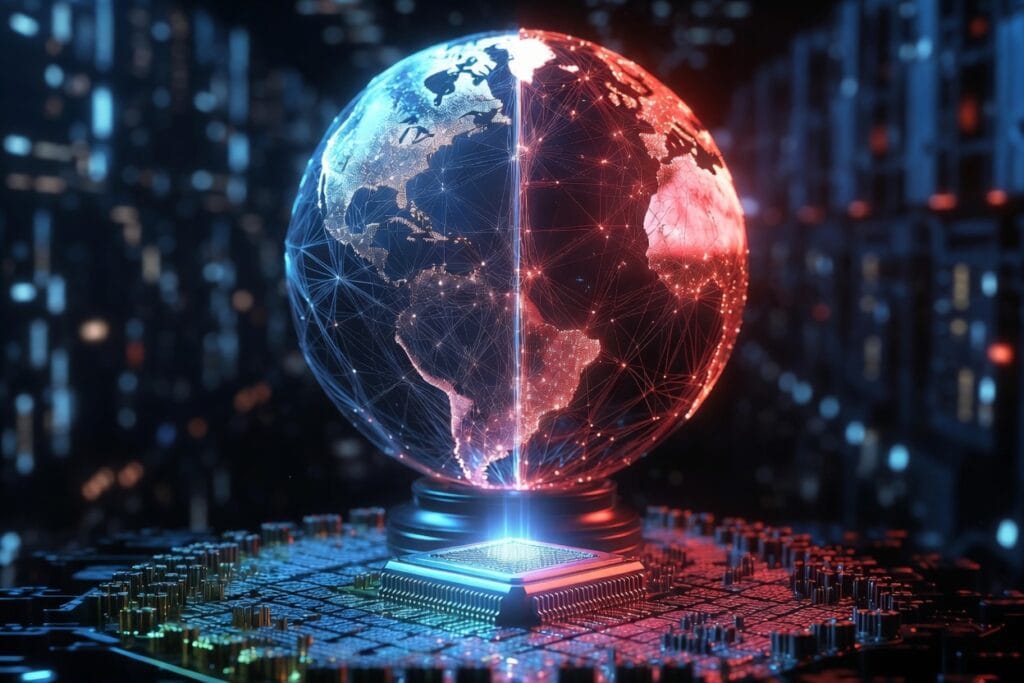
The AI Cold War
We aren’t entering a traditional Cold War. The global economy is far too tangled for the rigid blocs of the twentieth century. Yet, the patterns are unmistakable. We are witnessing the birth of an AI Cold War. Technological leadership is once again the ultimate currency of global power.
Unlike past rivalries, this competition unfolds in real-time. Nations now lock themselves in a frantic race. They must secure the massive data centers required to train the next generation of models. At the same time, they use export controls to restrict access to advanced semiconductors. These chips make intelligence possible. Meanwhile, a global war for talent is underway. Countries compete aggressively to attract the world’s top researchers and engineers.
The 2026 AI Index reports that global investment in AI continues to surge. Nations realize that AI serves as the foundation of national competitiveness. It is no longer just about innovation. It is about sovereignty.
The New Front Line
For most people, AI is simply a conversation on a screen. But behind that interface lies the most complex geopolitical game of the twenty-first century. Every new semiconductor launch acts as a strategic move. Every policy shift changes the board. Every massive data-center investment tightens the competition.
If we want to understand who will hold the reins of power, we must look past the chatbot. We must look at the hardware. We must study the physical chips that make the entire intelligence revolution possible.
The battlefield has shifted from the trenches to the silicon lab. The winner of this race will define the next century.
Next in this series:
The Island That Powers AI: Why Taiwan and TSMC Matter More Than Ever
AI may rely on software, but its future stays forged in silicon. In our next article, we travel to the epicentre of the global semiconductor industry. We will explore why one small island has become the most strategically important place on Earth.










[…] the previous article, The AI Cold War, we explored how artificial intelligence has evolved far beyond Silicon Valley. Governments are no […]