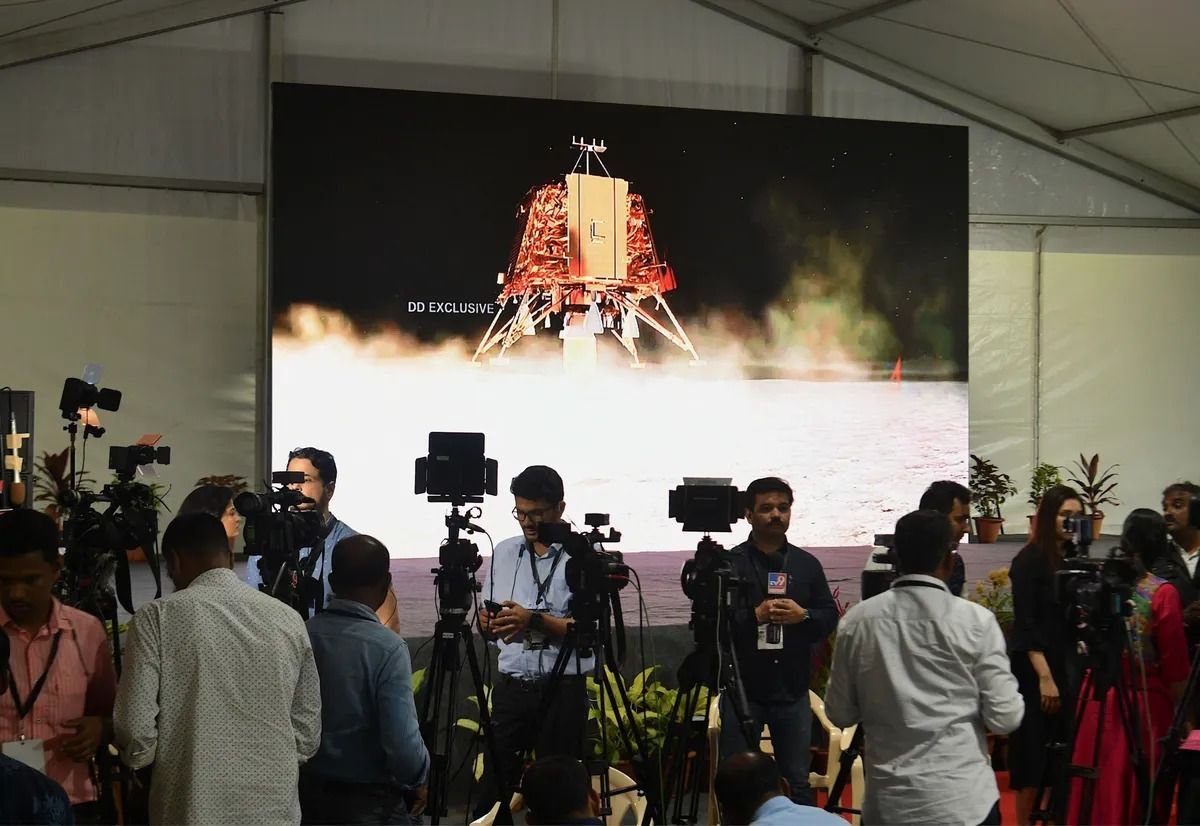
The global race for lunar dominance has officially shifted from a quest of mere exploration to a strategic battle for resource-rich territory. Recent spatial analyses and viral cosmic reports have turned the global scientific spotlight onto a specific, permanently dark patch near the lunar South Pole. Space experts and cosmic analysts are now aggressively labeling this freezing zone as “the Moon’s most valuable real estate.”
At the absolute center of this geopolitical and scientific buzz is the Faustini Crater. This highly coveted territory sits in a region where India’s historic Chandrayaan missions have already established a pioneering analytical footprint, providing the world with critical data about the lunar South Pole’s rugged geography.
The Deep-Freeze Goldmine
The primary reason behind the multi-billion-dollar valuation of the Faustini Crater is its status as a Permanently Shadowed Region (PSR). Due to the Moon’s unique axial tilt, the interior of this deep crater has remained completely untouched by sunlight for billions of years, causing temperatures to plummet to a bone-chilling $-240^\circ\text{C}$ ($30\text{ K}$).
This permanent cosmic deep-freeze has turned the crater into an elite cosmic trap for massive reserves of water ice. For humanity’s future in space, this ice is more valuable than gold. Beyond providing essential drinking water for astronauts, scientists plan to harvest this ice to split its molecules ($H_2O$) into liquid hydrogen and liquid oxygen.
Because these are the fundamental ingredients for high-grade rocket propellant, the Faustini Crater is poised to become humanity’s first official “fuel station” in deep space. Instead of hauling incredibly heavy and expensive fuel all the way from Earth’s deep gravity well, future spacecraft will be able to refuel directly on the lunar surface.
A Natural Fortress and Launchpad
Beyond its resource wealth, the Faustini Crater offers a structural sanctuary that is vital for human survival. The Moon completely lacks an atmosphere and a protective magnetic shield, leaving its open surface vulnerable to lethal solar flares, cosmic radiation, and a non-stop bombardment of hypersonic micro-meteorites.
The massive, towering walls of craters like Faustini, alongside connected underground lava tubes, provide an exceptional natural armor. Future lunar habitats built inside these deep depressions can utilize the thick lunar soil (regolith) as a natural shield, safely insulating human colonists from extreme outer-space hazards and violent temperature swings.
Furthermore, this location solves a massive financial hurdle for deep space travel. Escaping Earth’s brutal gravity requires rockets to burn over $90\%$ of their total weight just in fuel during liftoff. By contrast, the Moon features no atmospheric drag and only one-sixth ($1/6$) of Earth’s gravity. Establishing a permanent manufacturing and refueling hub within Faustini means humanity can launch heavy missions to Mars or the asteroid belt at a fraction of the current cost, making multi-planetary travel genuinely sustainable.


India’s Strategic Position
As global space agencies—including NASA through its ambitious Artemis program—scramble to secure footholds on the lunar South Pole, India holds a distinct analytical advantage. India’s Chandrayaan-3 mission made global history by executing the world’s first successful soft landing in this notoriously unforgiving southern terrain.
The precise data transmitted by India’s surface instruments regarding soil composition, thermal properties, and localized elements has given the global scientific community its most accurate maps of the region to date. As international space programs draw closer to the Faustini Crater, the foundational science established by India remains a vital cornerstone for future missions.
The unfolding transition from exploring space to actively utilizing its resources marks the beginning of a new lunar gold rush. The Faustini Crater stands at the absolute frontline of this historic shift, proving that the Moon is no longer just a barren rock in our night sky, but the definitive stepping stone for humanity’s future among the stars.
💡 Key Terms Explained
Before diving deeper into the strategic importance of this discovery, it is essential to understand the scientific terms shaping this lunar gold rush:
- PSR (Permanently Shadowed Region): These are deep craters near the Moon’s poles that never receive sunlight due to the Moon’s low axial tilt ($1.54^\circ$). They have remained in total darkness for billions of years.
- Regolith: The thick layer of loose, fragmented rock and fine dust that covers the entire surface of the Moon, acting as a potential building material for future structures.
- Lunar South Pole: The southern region of the Moon which has become the prime target for global space missions due to its unique topography and massive hidden resources.
The Deep-Freeze Goldmine
The primary reason behind the multi-billion-dollar valuation of the Faustini Crater is its status as a Permanently Shadowed Region (PSR). Due to the Moon’s unique orientation, the interior of this deep crater has remained completely untouched by sunlight for billions of years, causing temperatures to plummet to a bone-chilling $-240^\circ\text{C}$ ($30\text{ K}$).
This permanent cosmic deep-freeze has turned the crater into an elite cosmic trap for massive reserves of water ice. For humanity’s future in space, this ice is more valuable than gold. Beyond providing essential drinking water for astronauts, scientists plan to harvest this ice to split its molecules ($H_2O$) into liquid hydrogen and liquid oxygen.
Because these are the fundamental ingredients for high-grade rocket propellant, the Faustini Crater is poised to become humanity’s first official “fuel station” in deep space. Instead of hauling incredibly heavy and expensive fuel all the way from Earth’s deep gravity well, future spacecraft will be able to refuel directly on the lunar surface.
A Natural Fortress and Launchpad
Beyond its resource wealth, the Faustini Crater offers a structural sanctuary that is vital for human survival. The Moon completely lacks an atmosphere and a protective magnetic shield, leaving its open surface vulnerable to lethal solar flares, cosmic radiation, and a non-stop bombardment of hypersonic micro-meteorites.
The massive, towering walls of craters like Faustini, alongside connected underground lava tubes, provide an exceptional natural armor. Future lunar habitats built inside these deep depressions can utilize the thick lunar soil (regolith) as a natural shield, safely insulating human colonists from extreme outer-space hazards and violent temperature swings.
Furthermore, this location solves a massive financial hurdle for deep space travel. Escaping Earth’s brutal gravity requires rockets to burn over $90\%$ of their total weight just in fuel during liftoff. By contrast, the Moon features no atmospheric drag and only one-sixth ($1/6$) of Earth’s gravity. Establishing a permanent manufacturing and refueling hub within Faustini means humanity can launch heavy missions to Mars or the asteroid belt at a fraction of the current cost, making multi-planetary travel genuinely sustainable.
India’s Strategic Position & Official Data
As global space agencies—including NASA through its ambitious Artemis Program—scramble to secure footholds on the lunar South Pole, India holds a distinct analytical advantage. India’s Chandrayaan-3 mission made global history by executing the world’s first successful soft landing in this notoriously unforgiving southern terrain.
The precise data transmitted by the Indian Space Research Organisation (ISRO) regarding soil composition, thermal properties, and localized elements has given the global scientific community its most accurate maps of the region to date. As international space programs draw closer to the Faustini Crater, the foundational science established by India remains a vital cornerstone for future missions.
The unfolding transition from exploring space to actively utilizing its resources marks the beginning of a new lunar gold rush. The Faustini Crater stands at the absolute frontline of this historic shift, proving that the Moon is no longer just a barren rock in our night sky, but the definitive stepping stone for humanity’s future among the stars.
Leave a Reply