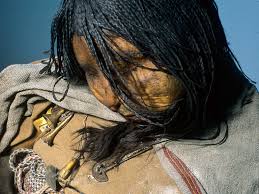
History usually decays. Bone crumbles, clothing rots, and the intimate details of a human life fade into dust. But at 22,000 feet, on the frozen, wind-blasted summit of Mount Llullaillaco, time simply stopped.
When archaeologists excavated a hidden stone chamber in 1999, they didn’t just find a mummy; they stumbled upon a flawless biological archive. A 14-year-old Inca girl, slumped forward as if taking a brief nap, stared back across five centuries. Her skin was soft, her braided hair perfectly retained its tension, and her hands looked entirely unchanged.
By treating this extraordinary discovery as an ancient forensic investigation, modern science has managed to reconstruct the final year of her life with terrifying, heartbreaking precision.
The Silent Witness Under the Scanner
Because the girl—codenamed “The Maiden”—is so incredibly fragile, scientists could never perform a traditional, invasive autopsy. To peek beneath her skin, curators had to orchestrate a high-stakes midnight operation, moving her from a specialized -4° F cryopreservation capsule to a local hospital scanner.
Through the lens of Computed Tomography (CT scans), forensic pathologist Dr. Richard Shepherd began mapping her internal anatomy:
- The Dental Timeline: The scans showed that her wisdom teeth were still deep inside her jaw, unexposed to the outside world. This, combined with the length of her bones, definitively locked her age at 14 years old.
- The Trauma Assessment: Her skeleton was completely intact. There were no broken bones, no skull fractures, and no internal bruising, instantly eliminating the theory that she fell or was physically attacked on the mountain.
Science Decoded: The Methodologies
To appreciate how this cold case was cracked, we must look at the highly specialized scientific terms and tools utilized by the research team:
| Science Term | The Real-World Function |
| Cryopreservation | A natural or artificial deep-freeze environment that suspends cellular decay, keeping organic material perfectly intact over centuries. |
| Bioarchaeology | The science of extracting chemical stories, diets, and environments from ancient human tissues like hair, nails, and bones. |
| Asphyxiation | The biological process of extreme oxygen starvation to the brain and lungs, resulting in a quiet cessation of life. |
Chemical Biography: What Her Hair Remembers
While the CT scans looked at her bones, bioarchaeologist Dr. Andrew Wilson looked at something even more revealing: her hair. Hair grows incrementally, trapping the chemicals circulating in our blood like a permanent, linear diary.
By slicing and analyzing tiny segments of The Maiden’s hair, scientists built a literal timeline of her final 12 months, revealing a massive geopolitical story:
- The Sudden Feast: Exactly three months before she died, her diet dramatically changed. She went from eating a basic peasant diet to consuming high-status food like maize (corn) and freeze-dried llama meat. This marks the exact moment she left her normal life behind.
- The Constant Narcotic: Her hair showed an exponential spike in the consumption of coca leaves over her final year. When she was found, she still had a massive wad of unchewed coca leaves tucked inside her cheek, creating a visible bulge.
This chemical data proves she underwent a massive 1,000-mile ritual pilgrimage from the imperial capital of Cusco, walking across the driest deserts on earth to reach the volcano base.
From Seclusion to Imperial Offering
The mystery of her journey is solved by her wardrobe. She was found wearing a magnificent feathered headdress worn only by the Aclla—the “Virgins of the Sun”. Chosen at a young age for their physical perfection, these girls were torn from their families and kept in absolute, windowless seclusion inside Cusco’s elite sanctuaries.
Ultimately, The Maiden was selected for the highest, most terrifying honor in the Inca world: a Capacocha offering.
A Matter of Perspective: In the indigenous Quechua language, there is no word for “sacrifice.” The correct term is “offering”. To the Inca, she wasn’t being murdered; she was being immortalized as a living bridge between humanity and the mountain gods who controlled the weather and crops.
The Terminal Event: A Quiet Suffocation
For years, it was assumed that she simply froze to death. However, the CT scans disproved this, showing a total absence of the stomach ulcers that typically form during hypothermia.
Instead, the forensic puzzle pieces come together to reveal a highly coordinated, peaceful termination:
- The Sedation: As she ascended past the 21,000-foot mark into the “Death Zone” (where oxygen is 50% lower than at sea level), the priests forced her to drink vast quantities of Chicha (a heavy corn beer) to dull her senses and eliminate altitude sickness.
- The Shroud: Once she lost consciousness from the alcohol, lack of oxygen, and high-altitude exhaustion, she was placed gently into her stone tomb. The priests then took a thick, heavy woolen cloth, wrapped it completely over her face, and tied it tight at the back of her head.
- The Final Breath: Incapable of struggling due to heavy sedation, and completely cut off from the thin mountain air by the woolen shroud, the 14-year-old girl quickly and painlessly succumbed to asphyxiation (suffocation).
Her hands, resting gently over one another, show absolutely no signs of a struggle or panic. She didn’t fight her fate; she simply drifted from an induced slumber into history. Today, she rests in the High Altitude Archaeology Museum in Salta, Argentina—not as a mere skeleton, but as a flawlessly preserved, hauntingly beautiful window into the ancient past.
To explore more independent research on high-altitude archaeology and pre-Columbian cultures, read the scientific field notes available through National Geographic and world preservation records via UNESCO.
Leave a Reply