When a brutal state crackdown silenced widespread economic protests in January 2026, international observers and the Trump administration anticipated an imminent domestic tipping point. With Washington ordering the largest U.S. military buildup in the Middle East since 2003 and initiating a stringent naval blockade, conventional wisdom suggested the clerical regime in Tehran was on the verge of collapse from within. Predictive models and media pundits pointed toward an inevitable civil war. Yet, months later, the streets of Tehran remain hauntingly quiet. There is no domestic insurgency, no fragmented military, and no visible civil strife. To the casual observer, this quietude might look like compliance or a total failure of the opposition. In reality, the domestic silence in Iran is a calculated, tragic survival strategy dictated by deep geopolitical and psychological realities.
The primary deterrent to a full-scale Iranian revolution is the horrific precedent set by its neighbors over the last two decades. The Iranian public is highly educated, politically conscious, and deeply aware of regional history. The aftermath of the 2011 Arab Spring—specifically the total disintegration of Syria and Libya, and the subsequent rise of ISIS—serves as a stark warning. When populations in those nations attempted to violently overthrow their dictators, the resulting vacuum was filled not by democracy, but by decades of sectarian bloodshed, foreign proxy warfare, and economic ruin. Human psychology dictates that under extreme duress, populations will choose a known oppressor over unknown chaos. For the average Iranian citizen, inciting a civil war does not guarantee freedom; it guarantees that their cities will share the fate of Aleppo or Tripoli.
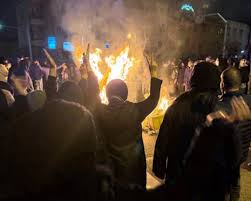
Furthermore, the Trump administration’s “Maximum Pressure” campaign, aimed at choking Iran’s economy to force a regime change, backfired domestically by triggering a well-documented political counter-reaction. Political science consistently proves the validity of the “rally ’round the flag” effect, where internal fractures temporarily mend when a nation perceives an existential threat from a foreign superpower. The physical presence of U.S. naval assets blocking the Strait of Hormuz and the constant threat of foreign airstrikes shifted the immediate narrative inside the country. Millions of Iranians who despise the clerical government despise foreign intervention even more. Recognizing that a domestic uprising during an active external conflict would inherently benefit foreign adversaries, ordinary citizens have chosen to suppress their grievances to prevent the external partitioning or colonization of their country.
This calculation is reinforced by Iran’s highly asymmetric security matrix, which has systematically prevented the structural cracks necessary for a successful regime change. Unlike traditional states, Iran relies on a dual-military structure. While the regular army is standard, the Islamic Revolutionary Guard Corps (IRGC) and its domestic volunteer paramilitary wing, the Basij, function purely as ideological guardians of the regime. Their surveillance network is deeply embedded in every local neighborhood, university, and internet service provider, while forty years of systemic purging has left Iran devoid of any viable opposition leadership inside the country. Without weapons, communication infrastructure, or central leaders to rally behind, mass mobilization against a heavily armed paramilitary force is viewed not as a revolution, but as collective suicide.
The prevailing stillness in Iran highlights a sophisticated miscalculation by both Western media and the White House. The absence of a civil war is not an endorsement of the regime, nor does it mean the civilian population has been pacified. Instead, the Iranian public finds itself trapped in a paralyzed status quo, caught between the economic devastation of a foreign blockade, a lethal internal security apparatus, and the terrifying specter of regional chaos. The silence on the streets of Tehran is not peace; it is a sullen, calculated truce born of sheer survival.
Authoritative Sources for Reference:
- Economic Unrest: Context on the currency collapse and the initial Tehran Bazaar unrest is analyzed in detail by the Stimson Center Report.
- State Suppression: Documented timelines of internet censorship and security crackdowns during the winter crisis can be verified through the GOV.UK Country Bulletin on Iran Protests.
- Military Conflict Scale: Details regarding the scope of the external threat and American deployment are cataloged under Wikipedia’s 2026 US Military Buildup in the Middle East.
Leave a Reply